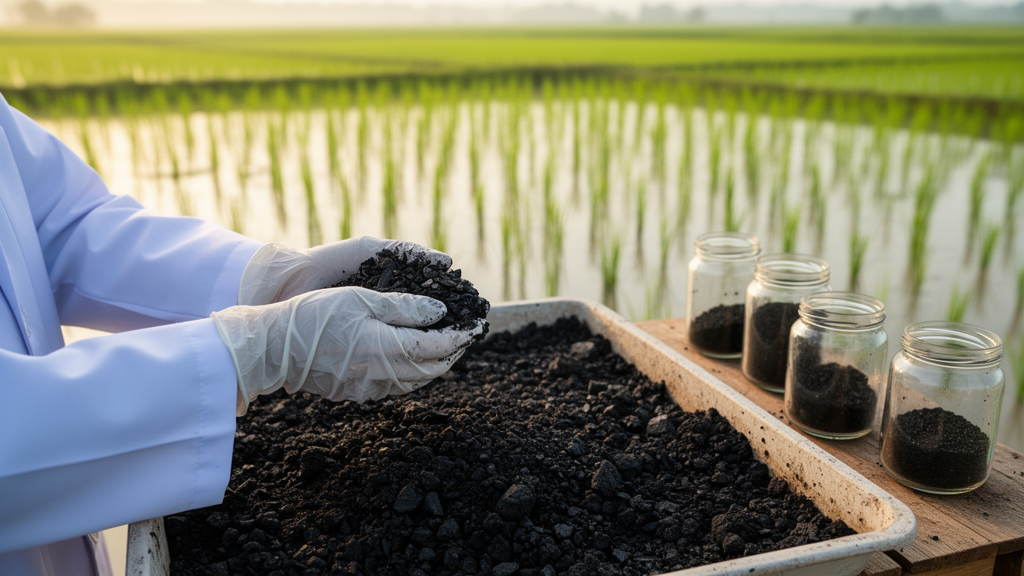
Scientists in China have engineered a biochar that dramatically shifts how paddy soil handles nitrate, steering it away from greenhouse-gas-producing denitrification and toward a nitrogen-conserving pathway that keeps fertilizer in the ground. By loading redox-active manganese onto the surface of ordinary wheat-straw biochar, a research team led by Jiao Yuan and Shuping Qin increased the rate of dissimilatory nitrate reduction to ammonium (DNRA) by 2.9-fold compared with an unamended control, while cutting nitrous oxide emissions to roughly a tenth of control levels over a 22-day anaerobic incubation.
DNRA is a microbial process that converts soil nitrate into ammonium, a form that is far less mobile and much more easily retained in soil than nitrate. That makes it attractive from both an agronomic and an environmental standpoint, because nitrate that escapes DNRA is typically lost through leaching or through denitrification, which releases nitrous oxide and dinitrogen gas into the atmosphere. The catch is that DNRA demands more electrons than denitrification: reducing one nitrate molecule all the way to ammonium requires eight electrons, whereas denitrification to nitrogen gas needs only five. In most soils, denitrification therefore wins the competition for nitrate, and valuable fertilizer nitrogen simply vanishes.
Biochar has long been known to act as an electron shuttle, storing and transferring electrons during microbially mediated redox reactions thanks to its aromatic carbon matrix, conjugated π-electron systems, and surface functional groups. Previous work showed that pristine biochar can promote ammonium accumulation in soil by facilitating DNRA. But the intrinsic electron-shuttling capacity of unmodified biochar is limited, and the team suspected that boosting that capacity could push DNRA further. Their solution was to load manganese onto biochar, exploiting the ability of manganese to cycle reversibly among the +II, +III, and +IV oxidation states, which creates localized electron-relay sites on the carbon surface.
The researchers produced their modified material by pyrolyzing wheat straw at 400 degrees Celsius, washing it, and then treating it with manganese sulfate followed by reduction with potassium borohydride. Characterization confirmed that manganese had been successfully incorporated, predominantly as crystalline Mn3O4 and Mn2O3 phases, with X-ray photoelectron spectroscopy revealing the coexistence of Mn(II), Mn(III), and Mn(IV) species on the surface, roughly 78 percent of surface manganese in reduced states. Manganese loading also transformed the physical structure of the biochar: the BET surface area jumped from 13.5 to 121.7 square meters per gram, and total pore volume increased about nineteen-fold, changes the authors attribute partly to the impregnation-reduction process itself rather than manganese alone.
Electrochemical measurements confirmed that the modification worked as intended. The electron exchange capacity of the manganese-loaded biochar, quantified through mediated electrochemical reduction and oxidation, reached 649.2 micromoles of electrons per gram, about 1.8 times that of pristine biochar, and specific capacitance rose roughly 2.4-fold. Across a gradient of manganese loadings prepared with 0.1 to 0.6 molar manganese sulfate solutions, both electron exchange capacity and specific capacitance increased steadily with manganese content and correlated most strongly with the abundance of reduced Mn(II) and Mn(III) species, supporting a central role for the lower-valence manganese phases in electron shuttling.
The soil experiments used sandy loam collected from a paddy field at Fujian Agriculture and Forestry University in China. In sealed flasks flushed with helium to create anaerobic conditions, the team added a nitrogen-15 potassium nitrate tracer so they could trace exactly where the reduced nitrate ended up. Over 22 days, the net ammonium production rate reached 0.63 milligrams of nitrogen per kilogram of dry soil per day under manganese-loaded biochar, compared with 0.28 under pristine biochar and 0.22 in the control. The nitrogen-15 tracing showed that DNRA accounted for 10.8 percent of total nitrate reduction under the modified biochar, against 6.7 percent for pristine biochar and just 2.0 percent for the control, meaning nitrogen gas still dominated overall, but the nitrogen-conserving pathway gained substantial ground.
The greenhouse-gas results were striking. Cumulative nitrous oxide emissions over the incubation were only 1.9 milligrams of nitrogen per kilogram of dry soil under the manganese-loaded biochar, compared with 7.4 under pristine biochar and 17.6 in the control. No significant differences in dinitrogen emissions appeared among treatments, and the authors caution that because nitrogen gas remained the dominant nitrate-reduction product, shifts in how denitrification partitioned its products may also have contributed to the lower nitrous oxide accumulation and cannot be excluded.
Microbial analyses revealed that the modified biochar reshaped the DNRA community. It increased the relative abundance of nrfA-harboring bacterial taxa, including Bacteroidota, Ignavibacteriota, and Bacillota, and significantly upregulated expression of the nrfA gene, which encodes the enzyme that performs the nitrite-to-ammonium step of DNRA. By the end of the incubation, Bacteroidota accounted for 18.6 percent of the community under the modified biochar, versus essentially zero under pristine biochar and control. Meanwhile the treatment reduced the abundance of Thermodesulfobacteriota, mainly sulfate-reducing bacteria that compete with DNRA for electron donors, and did not significantly increase transcription of denitrification-related genes.
A second line of evidence pointed to manganese-mediated mobilization of native soil organic carbon as an additional fuel for DNRA. The treated soil showed higher dissolved organic carbon concentrations but lower carbon dioxide emissions than the other treatments, with no detectable change in total soil carbon, suggesting that manganese oxides destabilized mineral-associated organic matter and released protected carbon into the dissolved phase without stimulating complete mineralization. The close agreement between the increase in total ammonium production and the increase in nitrogen-15-labeled ammonium derived from the nitrate tracer further indicated that soil organic carbon mineralization contributed only minor amounts to the observed ammonium accumulation.
The team also ran a test with sodium pyrophosphate, a complexing agent for dissolved manganese, to determine whether manganese leaching off the biochar, rather than manganese bound to its surface, drove the effect. The complexing agent did not significantly alter ammonium accumulation or DNRA rates, and only minimal manganese leaching was detected, suggesting surface-associated manganese phases were responsible. The authors note, however, that because pyrophosphate can alter the speciation and reactivity of dissolved manganese, particularly Mn(III), this test provides supporting rather than definitive evidence. They also emphasize that the findings come from short-term, controlled laboratory incubations of a single paddy soil, and that future work must evaluate the strategy across diverse soil types, moisture regimes, and field conditions, including the long-term fate of manganese under dynamic redox conditions, before manganese-loaded biochar can be recommended as a practical tool for sustainable nitrogen management.
Subject of Research: Manganese-loaded biochar enhancing electron shuttling to promote dissimilatory nitrate reduction to ammonium in paddy soil
Article Title: Redox-active Mn loading enhances the electron-shuttling capacity of biochar to promote DNRA in soil
Article References: Yuan, J., Yuan, D., Liu, X., Wu, P., Ma, L., Hu, C., & Qin, S. (2026). Redox-active Mn loading enhances the electron-shuttling capacity of biochar to promote DNRA in soil. Biochar, 8(1), Article 142. https://doi.org/10.1007/s42773-026-00653-5
Image Credits: AI Generated
DOI: 10.1007/s42773-026-00653-5
Keywords: biochar, manganese, DNRA, nitrogen cycle, paddy soil, electron shuttle, nitrous oxide, ammonium, soil microbiome, nrfA, nitrogen retention, dissolved organic carbon
Cite Scienmag News
Morgan Morrow. (October 28, 2026). Manganese-Loaded Biochar Supercharges Soil Nitrogen Retention in Paddy Soil Study. Scienmag. https://scienmag.com/manganese-loaded-biochar-supercharges-soil-nitrogen-retention-in-paddy-soil-study/
Morgan Morrow. "Manganese-Loaded Biochar Supercharges Soil Nitrogen Retention in Paddy Soil Study." Scienmag, 28 October 2026, https://scienmag.com/manganese-loaded-biochar-supercharges-soil-nitrogen-retention-in-paddy-soil-study/. Accessed 28 October 2026.
Morgan Morrow. "Manganese-Loaded Biochar Supercharges Soil Nitrogen Retention in Paddy Soil Study." Scienmag. October 28, 2026. https://scienmag.com/manganese-loaded-biochar-supercharges-soil-nitrogen-retention-in-paddy-soil-study/