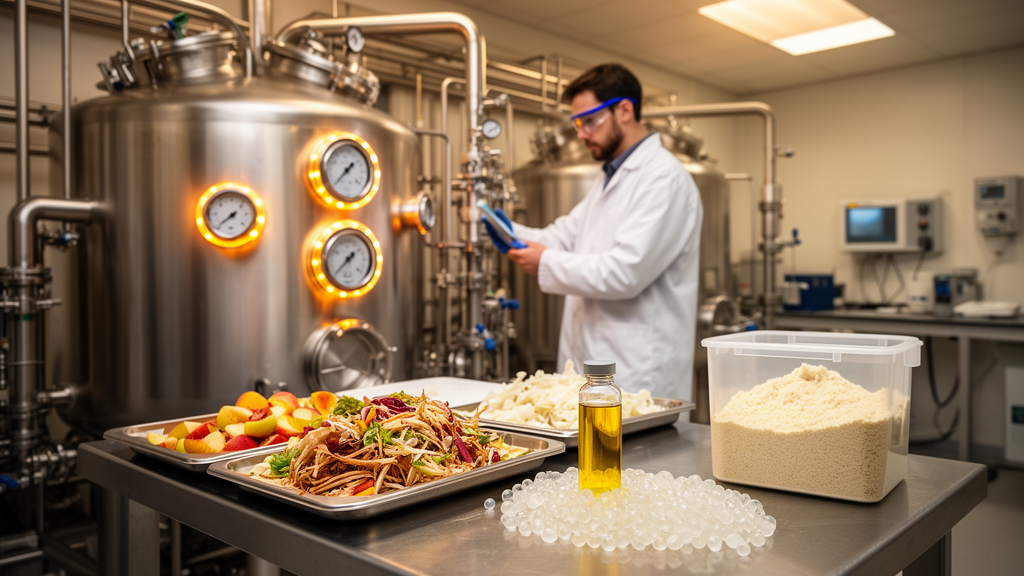
Roughly one third of all food produced for human consumption — about 1.3 billion metric tonnes every year, according to the Food and Agriculture Organization — never reaches a stomach. Instead, it rots in landfills, releasing methane, squandering the land, water, energy and labour embedded in it, and undermining food security. A new systematic review argues that this mountain of loss and waste should be treated not as a disposal problem but as a feedstock, and it maps in unprecedented detail the technologies that could turn food waste into biofuels, bioplastics, fertilizers, enzymes and even protein.
The review, published in the journal Green Technology, Resilience, and Sustainability, was conducted by Abhijeet Das, Satchidananda Mishra and Krishna Pada Bauri using the PRISMA framework for systematic reviews. The authors searched Scopus, Web of Science Core Collection and ScienceDirect for peer-reviewed studies published mainly between 2014 and 2025, screened the results against predefined eligibility criteria, and included 94 publications in their final qualitative synthesis. Their aim was unusually broad: rather than examining a single conversion technology or product stream, they set out to integrate biochemical and thermochemical valorisation pathways, life cycle assessment, digital innovations and implementation barriers within one unified circular bioeconomy framework.
The central conclusion is that no single technology wins everywhere. Integrated biorefinery systems — which combine biochemical, thermochemical, physicochemical and biological processes — offer superior resource recovery and product diversification compared with single-technology approaches, simultaneously yielding biofuels, biochemicals, biofertilizers, biopolymers and enzymes. But the choice of pathway depends on feedstock characteristics, process efficiency, infrastructure availability, economic feasibility and regional socio-economic conditions. High-moisture, readily biodegradable waste suits anaerobic digestion; carbohydrate-rich residues such as fruit peels and bakery waste are prime candidates for enzymatic hydrolysis and fermentation; dry, lignocellulosic fractions are better matched to pyrolysis, gasification or hydrothermal carbonization, though wet feedstocks may need energy-intensive drying first.
On the biochemical side, the review documents a striking range of demonstrations. Fermentation of citrus peels, banana pulp and spoiled fruits with the yeast Saccharomyces cerevisiae has produced good ethanol yields under controlled conditions, and newer processes are being tested for butyric acid, succinic acid and short-chain fatty acids from mixed food waste. In one small-scale example from West Africa, effluent from cassava starch processing into Garri yielded up to 50.1 percent ethanol by volume under ideal fermentation conditions — a result the authors highlight as a model for community-based biofuel production. Enzymatic hydrolysis, meanwhile, uses cellulases and other enzymes under mild conditions to break down rice husk, wheat straw, spent cereals, dairy waste and onion juice residue into sugars, amino acids and fatty acids that feed further fermentation, esterification or biopolymer production.
Some of the most commercially intriguing findings concern niche, high-value molecules. Spent coffee grounds have been converted into D-mannose, a functional sugar with prebiotic and pharmaceutical relevance, using enzymatic hydrolysis followed by fermentation and broth pervaporation; researchers recovered 15.7 grams of the sugar, a 46 percent yield from the initial waste biomass. The review also cites energy comparisons for bioplastics: fossil-based plastic production is estimated to consume roughly 77 megajoules per kilogram, while bioplastics made by fermenting and polymerising renewable biomass require about 57 megajoules per kilogram. Microbial fermentation of lactic acid from food waste hydrolysates offers a route to polylactic acid, a biodegradable alternative to petrochemical plastics.
Protein is another frontier. Single-cell protein — biomass cultivated from bacteria, yeasts, fungi and microalgae such as Candida utilis, Yarrowia lipolytica, Spirulina platensis and Chlorella vulgaris — can be grown on molasses, oilseed cakes, whey and brewer’s spent grains, turning low-value waste into protein-rich feed for aquaculture and livestock and easing pressure on soy and fishmeal. These microbial products also carry B-complex vitamins, omega-3 lipids and bioactive compounds, and advances in downstream processing point toward functional foods and pharmaceutical applications. The authors caution, however, that substrate pre-treatment, contamination control, energy-intensive harvesting and drying, and unresolved regulatory questions around microbial safety and allergenicity remain significant hurdles.
Thermochemical routes receive equally detailed treatment. Pyrolysis, typically run at 300 to 600 degrees Celsius under limited oxygen, yields biochar, syngas and bio-oil whose proportions depend on temperature, heating rate and residence time; slow pyrolysis of onion and garlic peels, for instance, produces high-surface-area biochar suitable for soil conditioning and water purification. Gasification, operating at temperatures up to 1400 degrees Celsius, converts waste into a combustible mix of carbon monoxide, hydrogen and methane for heat, power or chemical synthesis. Hydrothermal carbonization, increasingly recognised for wet biomass such as fruit pulp and vegetable trimmings, sidesteps the energy cost of drying and produces hydrochar, though high costs and technological immaturity still restrict its adoption. Beyond energy, these and related physico-chemical techniques enable extraction of polyphenols, flavonoids, essential oils and dietary fibres for use in nutraceuticals, cosmetics and food preservation.
The review also assesses the digital layer. Internet of Things sensors can monitor waste generation, collection, storage and processing in real time, while artificial intelligence and machine learning support predictive analytics, feedstock characterisation, contamination detection and process optimisation. Smart bins fitted with fill-level and contamination sensors have been demonstrated in cities across Europe and East Asia, improving collection efficiency and source segregation, and blockchain-based traceability systems piloted in Europe and Asia document the origin and quality of recovered compost, digestate and biochar, strengthening certification and market confidence. The authors stress that these tools work best when embedded in supportive governance and stakeholder engagement rather than deployed in isolation.
Scaling up remains the hard part. The review identifies inconsistent feedstock quality, limited infrastructure, fragmented regulatory frameworks, market constraints and inadequate sustainability assessment as the key barriers to large-scale implementation. Regional patterns differ sharply: high-income countries generate most waste at retail, food-service and household stages, driven by over-purchasing, strict aesthetic standards and confusion over date labels, whereas low- and middle-income countries lose more food during production, post-harvest handling and storage because of limited cold-chain capacity and inefficient logistics. Policy responses mirror this divide. The European Union’s Waste Framework Directive and Circular Economy Action Plan, Japan’s Food Recycling Law and South Korea’s mandatory source segregation with volume-based fees have produced some of the world’s highest food waste recycling rates, while India’s Solid Waste Management Rules of 2016 and its National Bioeconomy Roadmap illustrate emerging-economy reforms still constrained by weak enforcement and underdeveloped markets.
The authors are candid about their own limitations. Because the included literature is highly heterogeneous in feedstocks, process configurations and reported indicators, direct quantitative comparison among technologies was often impossible, and the review performs no meta-analysis, techno-economic modelling or life cycle modelling; quantitative values should be read in the context of the original studies. Grey literature and non-English publications were excluded. What the synthesis does offer is an integrated analytical framework: a map of which conversion pathways suit which waste streams, a warning that sustainability claims need life cycle assessment and techno-economic analysis to be credible, and a research agenda calling for mass-balance modelling, standardised sustainability metrics and context-specific biorefinery designs. As the authors put it, the transition from a linear produce-consume-dispose model to a circular one depends not only on technological advances but on supportive policies, infrastructure, market development, quality standards and stakeholder participation — a reminder that turning waste into value is as much a governance challenge as a chemical one.
Subject of Research: A PRISMA-guided systematic review of food waste valorisation technologies, sustainability assessment and digital innovations for the circular bioeconomy
Article Title: Food waste valorisation for a circular bioeconomy: integrating biochemical, thermochemical, and digital technologies with sustainability metrics
Article References: Das, A., Mishra, S., & Bauri, K. P. (2026). Food waste valorisation for a circular bioeconomy: integrating biochemical, thermochemical, and digital technologies with sustainability metrics. Green Technology, Resilience, and Sustainability, 6(1), Article 12. https://doi.org/10.1007/s44173-026-00037-9
Image Credits: AI Generated
DOI: 10.1007/s44173-026-00037-9
Keywords: food waste, circular bioeconomy, anaerobic digestion, fermentation, pyrolysis, hydrothermal carbonization, integrated biorefinery, life cycle assessment, artificial intelligence, Internet of Things, single-cell protein, bioplastics
Cite Scienmag News
Denise Maddox. (October 28, 2026). Turning Food Waste Into Fuels, Plastics and Protein: A New Roadmap. Scienmag. https://scienmag.com/turning-food-waste-into-fuels-plastics-and-protein-a-new-roadmap/
Denise Maddox. "Turning Food Waste Into Fuels, Plastics and Protein: A New Roadmap." Scienmag, 28 October 2026, https://scienmag.com/turning-food-waste-into-fuels-plastics-and-protein-a-new-roadmap/. Accessed 28 October 2026.
Denise Maddox. "Turning Food Waste Into Fuels, Plastics and Protein: A New Roadmap." Scienmag. October 28, 2026. https://scienmag.com/turning-food-waste-into-fuels-plastics-and-protein-a-new-roadmap/