


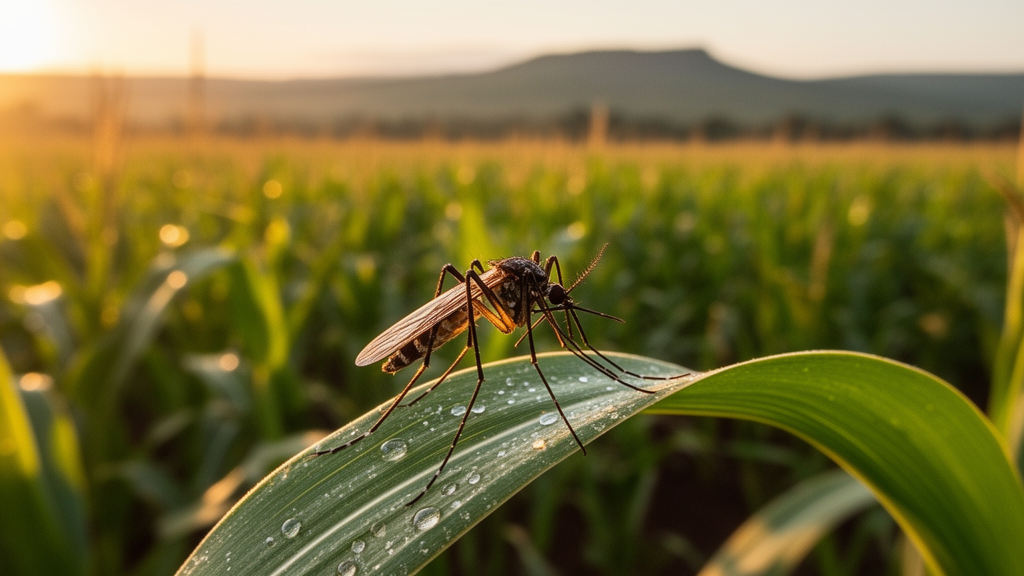
Malaria still kills hundreds of thousands of people every year, and the mosquito vectors that carry the Plasmodium parasite are becoming harder to fight. Insecticide-treated bed nets and indoor residual spraying, the backbone of malaria control in sub-Saharan Africa, are losing ground as mosquitoes shift toward outdoor and daytime biting and as resistance to all major insecticide classes spreads. That is why a strange, naturally occurring microbe called Microsporidia MB has generated such excitement. This maternally inherited fungal symbiont infects several Anopheles mosquito species and, in Anopheles arabiensis, strongly blocks transmission of Plasmodium falciparum while causing no detectable harm to its host. A new study from western Kenya, published in Frontiers in Malaria, now provides a crucial field test of whether this symbiont could actually be deployed as a control tool across real, messy agricultural landscapes.
The research team, led by Joseph Gichuhi and Jeremy Keith Herren at the International Centre of Insect Physiology and Ecology in Nairobi, set out to answer a deceptively simple question: at what spatial scale does Microsporidia MB prevalence vary? Previous work had shown that prevalence differs across regions of Kenya more than 100 kilometers apart, ranging from 1 to 9 percent in An. arabiensis. But if the microbe’s prevalence swung wildly from village to village, or even from house to house, a symbiont-based control strategy could falter before it ever reached scale. The team needed to know whether local ecological differences could undermine the microbe’s stability.
To find out, the researchers conducted simultaneous longitudinal sampling in two contrasting agroecosystems just 8 kilometers apart: Ahero, an irrigated rice scheme, and Miwani, a non-irrigated sugarcane-growing zone. Both areas are known malaria hotspots, but they differ dramatically in hydrology, vegetation, and microclimate. The team selected 10 sentinel houses per area and collected indoor-resting mosquitoes early in the morning using CDC backpack aspirators over 15 sampling rounds between May 2023 and February 2024, capturing the Long Rains, Short Rains, and Dry Season. Larval surveys from temporary rain-fed pools ran in parallel. Every mosquito was screened by PCR for both Microsporidia MB and Plasmodium, and the team correlated abundance and infection rates with remotely sensed environmental variables including vegetation greenness, rainfall, humidity, temperature, and wind speed.
The first striking finding was ecological. Both areas harbored similar Anopheles species pools dominated by An. arabiensis, An. gambiae sensu stricto, and An. funestus, the three principal malaria vectors of East Africa. Larval surveys mirrored this composition, though An. funestus was absent from the sampled pools. But abundance told a very different story. The irrigated rice scheme supported a seven-fold greater Anopheles population than the sugarcane zone, with 2,525 mosquitoes collected in Ahero compared to just 349 in Miwani. This strong spatial heterogeneity in vector density, driven purely by location and irrigation, is exactly the kind of landscape variation that could theoretically disrupt a symbiont’s transmission dynamics.
Yet Microsporidia MB refused to follow that pattern. The symbiont was detected across both areas in all three major vector species and in other uncharacterized Anopheles species, with prevalence ranging from 2 to 15.6 percent. Statistical analysis confirmed there was no significant difference in prevalence between the two sites, with a chi-square test yielding p = 0.1902. Nor was there significant variation across sentinel houses within either area, with Kruskal-Wallis tests returning p = 0.35 in Ahero and p = 0.45 in Miwani. Even between larvae collected in the two zones, prevalence was statistically indistinguishable, with p = 0.8990. In other words, despite a seven-fold difference in host population density, the microbe maintained remarkably consistent prevalence across both landscapes.
The team did observe significant temporal variation in prevalence across collection rounds within each site. In Ahero, prevalence peaked at 38.8 percent in one round and dropped to 0.6 percent in another, with these fluctuations positively associated with mosquito host abundance and seasonal changes in relative humidity. In Miwani, peaks reached 47.6 percent, linked to host abundance and the Normalized Difference Vegetation Index, a satellite-derived measure of vegetation greenness. But these were seasonal surges rather than systematic spatial differences. Both landscapes maintained sufficient host populations to support stable endosymbiont persistence, suggesting that while abundance drives transmission peaks, baseline prevalence is resilient to local ecological shifts.
Beyond prevalence, the researchers also measured infection intensity, essentially the density of Microsporidia MB within infected mosquitoes. Here again, the results were consistent. Infection densities did not vary significantly between the two locations or between sentinel houses within each location, indicating that once established, the symbiont maintains relatively stable within-host densities across geographic space. Densities did vary between mosquito species, with An. arabiensis carrying the highest loads and An. funestus the lowest, hinting at species-specific physiological compatibility. But the overall picture was one of a symbiont whose dynamics are largely decoupled from the agroecological context of its host.
The environmental drivers that did emerge were intriguing. Using Bayesian hierarchical models, the team found that a one standard deviation increase in NDVI around a sentinel house was linked to a 30 percent increase in infection odds, while a comparable increase in wind speed reduced infection odds by 24 percent. The researchers suggest that vegetation promotes conditions suitable for resting, foraging, swarming, and mating, thereby enhancing symbiont transmission, while stronger winds could interfere with these behaviors or disperse infected mosquitoes from nearby aquatic habitats. These findings add to a growing understanding of factors shaping Microsporidia MB dynamics, including diet, mating characteristics, breeding site chemistry, and climatic factors.
Plasmodium detection, by contrast, followed the ecological gradient precisely. The rice scheme, with its higher vector-producing capacity, also showed greater spatio-temporal detection of the malaria parasite, with 15 of 17 total infections recorded in Ahero. Several sentinel houses in Ahero showed recurrent Plasmodium detections across multiple rounds, suggesting persistent transmission foci likely tied to irrigation. Notably, only a single co-infection of Microsporidia MB and Plasmodium was observed across both areas. In An. arabiensis, the Plasmodium infection rate was lower in symbiont-infected females, at 0.49 percent, than in uninfected individuals, at 0.84 percent. While the low frequency of natural infections precludes definitive statistical correlation, this pattern is consistent with the antagonistic interference phenotypes reported in laboratory settings and suggests the symbiont’s blocking potential is maintained across varying field conditions.
The implications for malaria control are significant. The consistency of Microsporidia MB prevalence across contrasting agroecosystems, despite dramatic differences in host density, provides the first field evidence that symbiont dynamics can be decoupled from agricultural land use. This addresses a key concern for symbiont-based control strategies, namely whether deployment efficacy could be hindered by fine-scale ecological variation. The researchers caution that their findings are specific to this study’s spatial scale of roughly 8 kilometers, and that prevalence estimates for the less abundant species may be limited by small sample sizes. But as a proof of concept, the message is clear: a microbe that can stop malaria transmission inside its mosquito host appears robust enough to persist across the very landscapes where it would need to work. Future large-scale longitudinal studies with increased sampling intensity will be essential to formally quantify the strength of the symbiont’s antagonism against Plasmodium under field conditions, but this study offers a promising baseline for wider-scale assessments of one of the most biologically elegant malaria control ideas yet proposed.
Subject of Research: Different agroecosystems have similar Anopheles–Microsporidia MB infection dynamics in the Ahero region of Western Kenya: implications for symbiont control strategies
Article Title: Different agroecosystems have similar Anopheles–Microsporidia MB infection dynamics in the Ahero region of Western Kenya: implications for symbiont control strategies
Article References: Gichuhi, J., Bukhari, T., Onchuru, T. O., Mbare, O., Odoyo, E., & Herren, J. K. (2026). Different agroecosystems have similar Anopheles–Microsporidia MB infection dynamics in the Ahero region of Western Kenya: implications for symbiont control strategies. Frontiers in Malaria, 4, Article 1794884. https://doi.org/10.3389/fmala.2026.1794884
Image Credits: AI Generated
DOI: 10.3389/fmala.2026.1794884
Keywords: Microsporidia MB, malaria, Anopheles, symbiont control, Kenya, Plasmodium falciparum, vector ecology, agroecosystems, Different, similar, Microsporidia, infection
Cite Scienmag News
Morgan Morrow. (October 16, 2026). Malaria-blocking mosquito symbiont proves surprisingly stable across very different Kenyan farmlands. Scienmag. https://scienmag.com/malaria-blocking-mosquito-symbiont-proves-surprisingly-stable-across-very-different-kenyan-farmlands/
Morgan Morrow. "Malaria-blocking mosquito symbiont proves surprisingly stable across very different Kenyan farmlands." Scienmag, 16 October 2026, https://scienmag.com/malaria-blocking-mosquito-symbiont-proves-surprisingly-stable-across-very-different-kenyan-farmlands/. Accessed 16 October 2026.
Morgan Morrow. "Malaria-blocking mosquito symbiont proves surprisingly stable across very different Kenyan farmlands." Scienmag. October 16, 2026. https://scienmag.com/malaria-blocking-mosquito-symbiont-proves-surprisingly-stable-across-very-different-kenyan-farmlands/


