


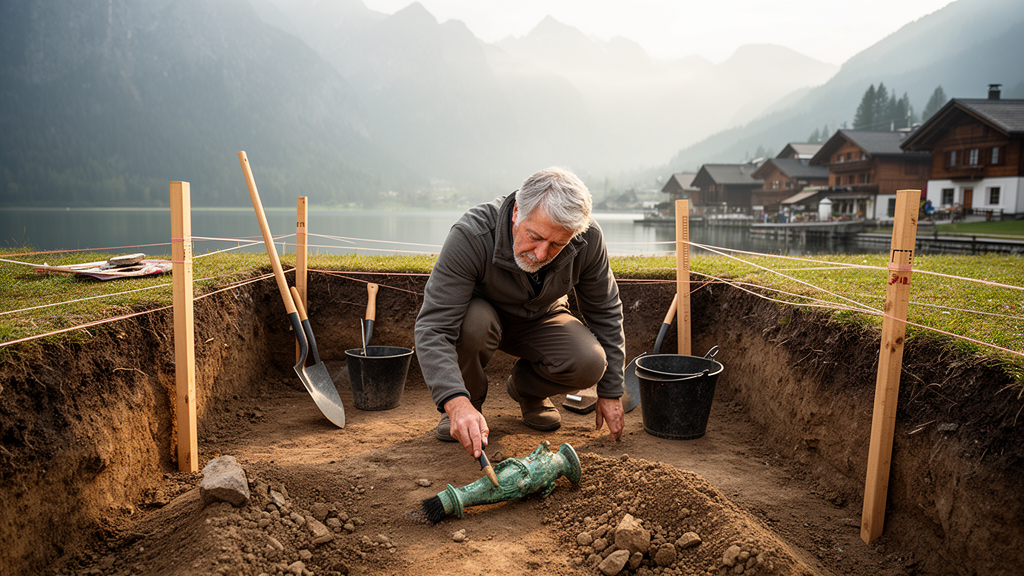
Hofrat Dr. Anton Kern, who led the Prehistoric Department of the Natural History Museum Vienna from 2001 until his retirement in 2022, died on 28 October 2023 after a severe battle with cancer. Born on 7 February 1957 in Laa an der Thaya, Kern rose from a provincial Austrian childhood to become one of the most influential figures in European prehistoric archaeology, best known for his decades of work at the iconic salt-mining site of Hallstatt and for transforming how the museum communicated archaeology to the public.
Kern’s academic path began unconventionally. He first studied history and English to become a teacher before turning to prehistoric and early history at the University of Vienna. His 1987 doctoral dissertation examined the prehistoric finds from the Oberleiserberg in the Ernstbrunn district, cataloguing unstratified material held in private, federal, state and local museum collections. That early engagement with prehistoric artefacts foreshadowed a career devoted to the material culture of ancient Austria, including his 1990–1991 contribution to the Kulturpark Kamptal, a cultural tourism project run with the regional development agency Ecoplus in Lower Austria.
He joined the Prehistoric Department of the Natural History Museum in 1991, first serving as curator for the Bronze and Iron Age before becoming Director in 2001. His research portfolio was broad: excavations at the multiperiod site of Mannersdorf an der March uncovered settlement features from the Middle Neolithic through the Early Middle Ages, along with graves from the Late Neolithic and Early Bronze Age. He also pursued the reanalysis of Late Celtic finds from the Oberleiserberg, a project rooted in his dissertation research.
But Hallstatt was his great passion. From 1992 until his retirement in 2022, Kern devoted himself to the exploration of the Hallstatt cemetery, working in fruitful cooperation with the Salinen and Salzwelten salt operations. The cemetery, which once held probably more than 5,000 cremation and inhumation burials, ranks among the most important archaeological legacies in Europe because of its rich grave goods drawn from across the continent. The burials, dating between 800 and 400 BC, offer crucial evidence for the beliefs, daily life and working world of the people interred there. Major discoveries such as the grave containing the second cow-calf vessel and the grave of the shaman owe their recovery to his efforts.
Kern and his team also solved a persistent technical problem: the recovery of ceramics from the Hallstatt cemetery. Their solution made it possible for this crucial class of archaeological material to finally enter Hallstatt research in a systematic way. A rich grave with numerous ceramics, now displayed in the permanent exhibition of the Natural History Museum, stands as a direct testament to that work. Away from the cemetery, his surface research in Hallstatt led to the discovery of a Late Bronze Age block building, a fascinating structure that was also featured in a Terra Mater documentary production.
He championed popular science publishing as well. Kern co-edited Salz-Reich. 7000 Jahre Hallstatt, published in 2008 by the Natural History Museum Vienna, and its English version Kingdom of Salt: 7000 Years of Hallstatt, released in 2009. Both appeared in two editions, reaching audiences far beyond the specialist community. His expertise also shaped the management plan for the UNESCO World Heritage Site Hallstatt/Dachstein-Salzkammergut, commissioned by the Upper Austrian state government. After the 2013 flood in Hallstatt, he became a key advocate for heritage protection during torrential water and avalanche control measures, pressing for sound building-archaeological practices in the high valley.
Public outreach was where Kern truly broke new ground. When Hallstatt/Dachstein-Salzkammergust received UNESCO World Heritage status in 1997, the Prehistoric Department staged a science event that later became the annual Archäologie am Berg. Kern inspired many University of Vienna students to serve as science communicators at the event, which alternated with the mining team to present the latest research results. Even in September 2023, already severely weakened by his illness, he attended the event, chatting with colleagues and sharing cheerful anecdotes about the newest discoveries.
Under his directorship, the first decades of the twenty-first century saw a massive increase in international and interdisciplinary research cooperation and in the acquisition of national and EU-level projects, including Dress ID – Clothing and Identity in the Roman Empire (2007–2012) and CINBA – Creativity in the Bronze Age (2010–2013). He also guided major long-term excavations at the Celtic sanctuary of Roseldorf, the early farming settlement of Brunn am Gebirge, and the hunter-gatherer site of Grub Kranawetberg. In recent years, his focus shifted toward digitisation, making archaeological research and its underlying processes more accessible to the public. The 2015 redesign of the permanent prehistoric exhibition in halls 11–13, including the Gold and Venus cabinets, was another landmark of his tenure, accompanied by the bilingual exhibition guide Fundstücke/Artifacts. Treasures of the Millennia, co-edited with Karina Grömer and published in 2017 and 2018 respectively.
Kern initiated numerous travelling exhibitions, including shows on Situla art and on Hallstatt research, which travelled to Bibracte in France, Switzerland, Germany and even Alicante in Spain. He held leading positions across Austrian archaeology: a member of the Archaeological Council of the Federal Ministry for Science and Research since 2005, a board member of the Kuratorium Pfahlbauten from 2012, which manages the UNESCO World Heritage Prehistoric Pile Dwellings around the Alps, and a scientific advisory board member of the Germanisches Nationalmuseum in Nürnberg from 2017. He served on the boards of the Anthropological Society in Vienna and the Austrian Society for Prehistoric and Early History, where he ultimately held the presidency. He also promoted Hallstatt locally as a leading member of the Musealverein Hallstatt and sat on the board of the Musealverein Stillfried an der March.
Colleagues remember Kern as a unifying figure who acted across disciplinary boundaries, remaining composed even when wronged and never losing his humour despite tragic losses and personal turbulence. The many anecdotes and appreciative words shared on his Facebook page after news of his death speak clearly to that character. Even a month before his death, when a friend at the Archäologie am Berg event in mid-September 2023 remarked that she still had so many questions, Kern replied with characteristic warmth: I have them too. His scientific curiosity and positive spirit remained intact to the very end, a fitting close to a life devoted to connecting people with the deep past.
Subject of Research: Obituary and scientific legacy of prehistoric archaeologist Anton Kern, former director of the Prehistoric Department at the Natural History Museum Vienna and leading Hallstatt researcher
Article Title: Nachruf HR Dr. Anton Kern, Direktor der Prähistorischen Abteilung i.R. (1957–2023)
Article References: Nachruf HR Dr. Anton Kern, Direktor der Prähistorischen Abteilung i.R. (1957–2023). (n.d.). https://doi.org/10.3897/anhmw.169455
Image Credits: AI Generated
DOI: 10.3897/anhmw.169455
Keywords: Anton Kern, Hallstatt, Natural History Museum Vienna, prehistoric archaeology, UNESCO World Heritage, Iron Age cemetery, salt mining, Bronze Age, Austrian archaeology, archaeological exhibitions, science communication, obituary
Cite Scienmag News
Courtney Benton. (October 16, 2026). Anton Kern, Archaeologist Who Shaped Hallstatt Research, Dies at 66. Scienmag. https://scienmag.com/anton-kern-archaeologist-who-shaped-hallstatt-research-dies-at-66/
Courtney Benton. "Anton Kern, Archaeologist Who Shaped Hallstatt Research, Dies at 66." Scienmag, 16 October 2026, https://scienmag.com/anton-kern-archaeologist-who-shaped-hallstatt-research-dies-at-66/. Accessed 16 October 2026.
Courtney Benton. "Anton Kern, Archaeologist Who Shaped Hallstatt Research, Dies at 66." Scienmag. October 16, 2026. https://scienmag.com/anton-kern-archaeologist-who-shaped-hallstatt-research-dies-at-66/


