


Deep in the forests of the western United States, a silent war is being waged between scientists and some of nature’s most destructive insects. Bark beetles, tiny beetles no larger than a grain of rice, have killed millions of hectares of conifer trees across the American West, transforming lush green landscapes into seas of rust-colored dead timber. Now, a comprehensive review published in Frontiers in Insect Science reveals the remarkable science behind a chemical counterattack that uses the beetles’ own communication system against them.
The scale of the devastation is staggering. Since 2000, mountain pine beetle alone has impacted more than 10 million hectares of western forests, with populations peaking in 2007 when approximately 3.7 million hectares were affected across several states. In California, record tree mortality in the Sierra Nevada during 2012 through 2015 prompted the governor to declare a state of emergency, with most of the losses attributed to western pine beetle colonizing ponderosa pine. In Alaska, an ongoing spruce beetle outbreak has impacted over 650,000 hectares since 2016, the largest in that state since the 1990s. These are not merely ecological tragedies; they represent fundamental alterations to forest structure, composition, and function that ripple through entire ecosystems.
The science behind the counterattack centers on semiochemical inhibitors, chemicals that reduce bark beetle responses to attractants. The most important of these are antiaggregation pheromones, which beetles themselves produce during the later stages of host colonization to signal to their kin that a tree is already occupied. Verbenone, the primary antiaggregation pheromone for pine bark beetles, and 3-methylcyclohex-2-en-1-one, known as MCH, for Douglas-fir beetle and spruce beetle, are the workhorses of this approach. When deployed strategically, these compounds essentially tell approaching beetles that a potential host tree is already fully colonized, causing them to fly elsewhere in search of unoccupied hosts.
The developmental sequence for these inhibitors follows a rigorous pathway. Researchers begin by identifying potential inhibitors through literature searches, sampling volatile profiles from bark beetle extracts, frass, infested host materials, and the forest environment, and conducting gas chromatographic-electroantennographic detection analyses to determine whether target beetle species can actually detect the compounds. Promising candidates are then evaluated in baited trapping assays under field conditions, with inhibitors that cause greater than 90 percent reductions in trap catches considered promising for tree protection studies. The process continues through individual tree protection assays, zone of inhibition studies, and ultimately stand-level evaluations, a sequence that can take years to complete.
Among the most notable recent advances is the development of Verbenone Plus, a blend combining verbenone with acetophenone and two green leaf alcohols. This formulation has demonstrated remarkable efficacy for protecting ponderosa pine from western pine beetle, a system where verbenone alone had repeatedly failed. In trapping assays, Verbenone Plus inhibited western pine beetle attraction by levels far exceeding verbenone alone. The blend was recently extended to southwestern pine beetle in West Texas, where it inhibited attraction by as much as 99.5 percent and effectively protected experimental plots of ponderosa pine during a large outbreak in the Davis Mountains Preserve. This is particularly significant because southwestern pine beetle was only recognized as a full species separate from western pine beetle in 2019.
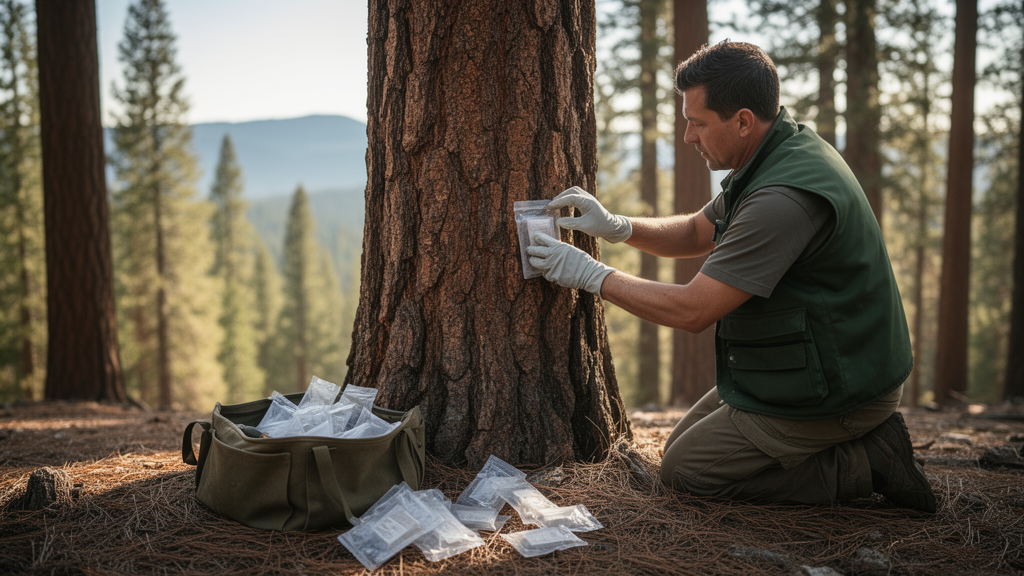
For mountain pine beetle, the most extensively studied bark beetle for inhibitor development, verbenone has proven effective for protecting lodgepole pine, whitebark pine, limber pine, and sugar pine. The introduction of SPLAT Verb, a wax emulsion matrix containing 10 percent verbenone applied with caulking guns, has revolutionized deployment. This formulation allows for applying release points at high densities and provides a larger zone of inhibition than other verbenone formulations. In some studies, 100 percent tree protection was reported. The product was first registered by the EPA in 2013 and is now widely used throughout the western United States, with the Colorado State Forest Service estimating that approximately 70,000 verbenone release devices will be distributed during 2022 through 2027.
The success story of MCH for Douglas-fir beetle stands as an unparalleled achievement among bark beetle inhibitors. MCH bubblecaps, first registered by the EPA in 1999, have demonstrated the ability to reduce mass attacks on Douglas-fir from 8.5 percent in control plots to just 0.2 percent in treated plots. The number of MCH bubblecaps sold annually treats approximately 8,000 hectares. More recently, biodegradable formulations including SPLAT MCH and Hercon Bio-Beads have been developed to address the environmental persistence of plastic bubblecaps, which require removal from the field after use. For spruce beetle, recent research has demonstrated that MCH alone is more effective than previously suggested, with maximum inhibition extending to 12 meters in Colorado forests.
However, the efficacy of these inhibitors is far from universal and depends on a complex interplay of factors. Population density of the target beetle species is perhaps the most critical variable, with evidence strongly suggesting that efficacy declines as beetle populations increase. Tree density also plays a paradoxical role: lower densities reduce forest susceptibility to some bark beetles, but higher densities increase the concentration and directionality of inhibitor plumes due to microclimate effects. The stereochemistry of inhibitors matters as well, though the enantiomeric composition of verbenone has less effect on inhibition than might be expected. Release rates, strength of inhibition, and the zone of inhibition all influence outcomes, as do the presence of other stressors such as fire injury, which can compromise tree defenses and reduce inhibitor effectiveness.
Despite decades of research, commercial availability of bark beetle inhibitors remains limited. Registration as biochemical pesticides through the EPA requires substantial data including efficacy trials, toxicology assessments, and environmental impact evaluations. The average registration time is approximately 18 months, with costs ranging from $2,000 to $5,000, though substantial delays can occur. No products containing nonhost volatiles are registered for bark beetles in any state, and Verbenone Plus has not yet been registered in the United States. These regulatory barriers, combined with the modest annual research investments of less than $0.5 million, represent significant hurdles for a technology that could yield enormous returns given that bark beetles in some years cause more tree mortality than wildfires.
The opportunities ahead are compelling. Researchers are exploring unmanned aerial vehicles for automating inhibitor applications in remote terrain, developing more efficient synthesis methods including olefin metathesis reactions, and investigating integration with other management tactics such as push-pull strategies and insecticide bole injections. The technology has already been extended beyond its original targets: SPLAT Verb was registered in Hawaii in 2025 for protecting ohia from ambrosia beetles that vector rapid ohia death, and formulations have been used in agricultural systems including coffee for coffee berry borer management. Meta-analyses demonstrate substantial reductions in bark beetle attacks and tree mortality across hundreds of assays, suggesting that with continued investment in research, development, and streamlined regulatory processes, semiochemical inhibitors could become a cornerstone of integrated forest pest management in an era of accelerating environmental change.
Subject of Research: Semiochemical inhibitors for protecting conifers from bark beetles in the western United States
Article Title: Semiochemical inhibitors for protecting conifers from bark beetles (Coleoptera: Curculionidae) in the Western United States: research, development, and application
Article References: Fettig, C. J., & Audley, J. P. (2026). Semiochemical inhibitors for protecting conifers from bark beetles (Coleoptera: Curculionidae) in the Western United States: research, development, and application. Frontiers in Insect Science, 6, Article 1939049. https://doi.org/10.3389/finsc.2026.1939049
Image Credits: AI Generated
DOI: 10.3389/finsc.2026.1939049
Keywords: bark beetles, semiochemicals, verbenone, MCH, conifer forests, pest management, chemical ecology, Semiochemical, inhibitors, protecting, conifers, bark
Cite Scienmag News
Gavin Prescott. (October 16, 2026). Chemical Whispers: How Scientists Jam Bark Beetle Communication to Save Western Forests. Scienmag. https://scienmag.com/chemical-whispers-how-scientists-jam-bark-beetle-communication-to-save-western-forests/
Gavin Prescott. "Chemical Whispers: How Scientists Jam Bark Beetle Communication to Save Western Forests." Scienmag, 16 October 2026, https://scienmag.com/chemical-whispers-how-scientists-jam-bark-beetle-communication-to-save-western-forests/. Accessed 16 October 2026.
Gavin Prescott. "Chemical Whispers: How Scientists Jam Bark Beetle Communication to Save Western Forests." Scienmag. October 16, 2026. https://scienmag.com/chemical-whispers-how-scientists-jam-bark-beetle-communication-to-save-western-forests/


