


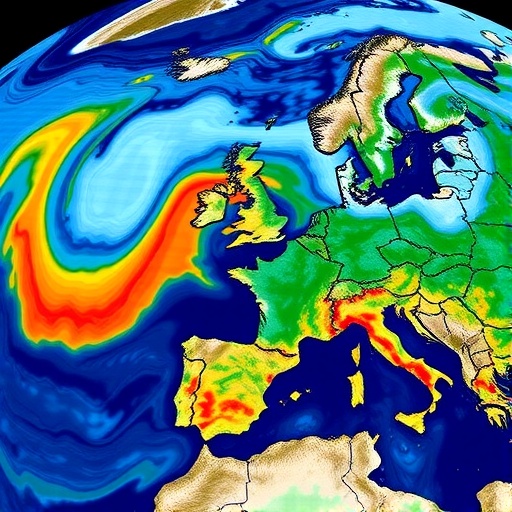
The European Centre for Medium-range Weather Forecasts (ECMWF) is on the verge of deploying a major upgrade to its global weather prediction system, scheduled to go live on May 12, 2026. This upgrade is poised to significantly enhance the accuracy and consistency of medium-range and sub-seasonal weather forecasts through the latest iteration of the Integrated Forecast System (IFS Cycle 50r1), complemented by advancements in its Artificial Intelligence counterpart, the AI/Integrated Forecast System (AIFS) version 2. Together, these enhancements promise a deeper integration of atmospheric and oceanic processes, improved representation of marine parameters, and breakthroughs in AI-driven forecasting products.
At the heart of the new IFS Cycle 50r1 lies a transformative approach to modeling the dynamical interactions between the atmosphere, ocean, and sea ice through a fully coupled data assimilation framework. This harmonized approach allows the system to simultaneously process observational data from multiple Earth system components, reducing inconsistencies and enabling more realistic forecast trajectories. By tightly coupling the atmosphere with ocean currents and sea ice dynamics, the updated system addresses longstanding challenges in predicting complex interfacial feedbacks that significantly influence weather systems, especially in coastal and polar regions.
One of the most notable scientific advancements in this cycle concerns the representation of convective precipitation. Convective storms, characterized by localized heavy rainfall and severe thunderstorms, have historically been difficult to simulate due to their mesoscale nature and rapid temporal evolution. The refined convection and cloud microphysics scheme in IFS Cycle 50r1 effectively resolves these processes at higher fidelity, reducing the unrealistic spatial persistence of intense rainfall often seen in previous forecasts. This development ensures a more accurate depiction of how convective activity forms, dissipates, and propagates from oceanic sources onto landmasses, critically improving risk assessments for flood-prone regions.
The oceanic and sea ice components of IFS have also been revolutionized through the introduction of the NEMO4-SI³ coupled ocean–sea ice model. This state-of-the-art model incorporates advanced physics to simulate ocean currents, temperature, salinity, and sea ice concentration with unprecedented accuracy. The NEMO4-SI³ model enhances the representation of wave-ice interactions, acknowledging sea ice’s role in modulating wave energy and dynamics, particularly under rough sea conditions. By integrating over 40 novel ocean- and sea ice-related variables, the upgraded system achieves superior skill in marine forecasts, benefitting sectors such as shipping, fisheries, and offshore energy production.
Further refinements are apparent in the upper atmosphere, with improvements to tropical upper-air temperature and wind forecasts. Enhanced data assimilation methods now better capture the conditions around the tropopause—the atmospheric boundary layer that separates the troposphere and stratosphere—leading to more reliable predictions of jet stream dynamics and the onset of extreme weather patterns. These developments contribute to extending the lead time and precision of weather services, effectively supporting disaster preparedness and mitigation efforts globally.
The Copernicus Atmosphere Monitoring Service (CAMS), operating under ECMWF auspices, will see significant gains in its atmospheric composition analyses thanks to this upgrade. Enhanced assimilation of observational data for aerosols, reactive gases, and greenhouse gases now permits more nuanced tracking of air quality and climate-relevant emissions. Improved input datasets on anthropogenic emissions facilitate better scenario modeling to inform policy and regulate environmental impacts from human activities. CAMS’s improved forecasts will be instrumental for urban planners, health authorities, and climate scientists.
Complementing the physical model advancements, AIFS v2 marks a milestone in ECMWF’s AI-driven forecasting capabilities. The upgraded AI forecasting platform integrates machine learning techniques trained on vast historical datasets to deliver faster and often more accurate predictions for specific variables. A key innovation within AIFS v2 is the introduction of eleven wave-related variables, empowering users with enhanced tools to predict sea state conditions, including rough seas and wave heights—critical information for maritime navigation and coastal management.
Additionally, AIFS v2 pioneers ECMWF’s first-ever data-driven snow cover forecasts. By harnessing AI algorithms that learn complex patterns from multimodal observational and model input data, the system produces snow cover fraction estimates that closely align with real-world observations. This improvement is a breakthrough for hydrological forecasts, winter sports planning, and disaster response to snowstorms, providing stakeholders with actionable information that reduces uncertainties inherent in conventional modeling.
ECMWF’s commitment to user engagement is evident in the careful consideration of feedback throughout the development period. This commitment culminated in removing legacy complexities within the IFS forecasting hierarchy, such as the redundancy between the high-resolution single forecast (“HRES”) and the ensemble control forecast. Streamlining these components simplifies user experience while maintaining or improving forecast quality. Stakeholder collaboration underpins ECMWF’s mission to continually adapt its products to evolving scientific knowledge and practical needs.
The combined effect of the IFS Cycle 50r1 and AIFS v2 upgrades is transformative, delivering a holistic suite of enhanced forecasting tools that span physical and AI methodologies. Together, they offer better insight into atmospheric phenomena, oceanic processes, wave dynamics, and surface cryosphere characteristics. This integration potentiates improved weather prediction accuracy, particularly during sudden and intense precipitation events and in complex marine environments, underscoring ECMWF’s leadership in global numerical weather prediction.
As these systems become operational starting May 12, 2026, ECMWF anticipates a new era of forecasting precision and utility. Users from governmental agencies to private businesses stand to gain from improved hazard warnings, improved marine forecasts, and more reliable climate trend assessments. The synergistic incorporation of AI with traditional physics-based modeling heralds a new paradigm in meteorology where data-driven insights complement mechanistic understanding, ultimately benefiting society by informing decision-making under uncertainty.
In an era marked by increasing climate variability and extreme weather events, ECMWF’s dual advancements exemplify the forefront of forecasting innovation. By pushing the boundaries of atmospheric, oceanic, and cryospheric science integrated with cutting-edge AI technology, ECMWF not only enhances scientific understanding but also provides critical tools to mitigate the impacts of weather-related hazards worldwide. This upgrade exemplifies the critical intersection of computational modeling, data assimilation, and artificial intelligence in building resilient societies.
The future of weather and environmental forecasting is multidisciplinary and data-rich, and ECMWF’s latest system upgrade testifies to that vision. With this release, the broader meteorological community gains access to refined datasets, new predictive products, and AI-driven analysis capabilities that will undoubtedly inspire further research and operational improvements. As users begin to deploy these tools in real-world scenarios, the feedback loop between scientific innovation and practical application will continue to drive progress in Earth system prediction.
News Publication Date:
May 12, 2026
Web References:
https://mediasvc.eurekalert.org/Api/v1/Multimedia/edfe8c57-4ba7-407c-badf-9e1fc83ac7e3/Rendition/low-res/Content/Public
Cite Scienmag News
Russell Cooper. (May 11, 2026). Major Upgrade to ECMWF’s IFS and AIFS Forecasting Systems Launches. Scienmag. https://scienmag.com/major-upgrade-to-ecmwfs-ifs-and-aifs-forecasting-systems-launches/
Russell Cooper. "Major Upgrade to ECMWF’s IFS and AIFS Forecasting Systems Launches." Scienmag, 11 May 2026, https://scienmag.com/major-upgrade-to-ecmwfs-ifs-and-aifs-forecasting-systems-launches/. Accessed 3 September 2026.
Russell Cooper. "Major Upgrade to ECMWF’s IFS and AIFS Forecasting Systems Launches." Scienmag. May 11, 2026. https://scienmag.com/major-upgrade-to-ecmwfs-ifs-and-aifs-forecasting-systems-launches/


