


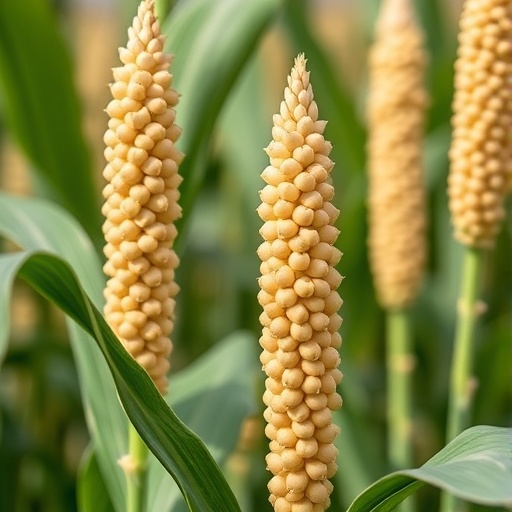
In the relentless battle between crops and pathogens, understanding the genetic basis of disease resistance remains one of the most formidable challenges in plant biology. Sorghum, a staple cereal crop integral to global food security, is no exception. Among the myriad diseases threatening its yield, grain mold—a complex fungal affliction—stands out for its detrimental impact on grain quality and productivity. Recent advances spearheaded by a team led by Ahn, Prom, and Park provide a groundbreaking glimpse into the genetic interplay underpinning this resistance, leveraging cutting-edge machine learning techniques to unravel the intricate polygenic architecture concealed within the sorghum genome.
Traditional genome-wide association studies (GWAS) have long served as the gold standard for associating genetic variants with phenotypic traits. However, grain mold resistance in sorghum exemplifies a classic polygenic trait, where multiple genes with small effects collectively modulate disease response. This diffuse genetic control often obscures association signals, rendering classical GWAS approaches blunt tools for comprehensive dissection. Recognizing this, the researchers pursued a revolutionary path—melding the predictive prowess of modern machine learning (ML) algorithms with the rich phenotypic diversity offered by an extensive sorghum panel.
The study utilized a carefully curated collection of 306 genetically diverse sorghum accessions, each phenotyped under controlled inoculation and mock-treatment conditions. Unlike conventional approaches solely reliant on raw disease severity scores, the team innovatively incorporated a ‘difference phenotype’—capturing the quantitative contrast between inoculated and control states—and undertook principal component analyses to distill complex symptom patterns. These multi-faceted phenotypic representations provided a nuanced data landscape perfectly suited for the analytical flexibility of machine learning.
Central to their methodology were two ensemble learning models grounded in decision tree architectures: the Boosted Tree and Bootstrap Forest frameworks. Both algorithms iteratively refine their predictions by combining the strengths of numerous weak learners to form a robust consensus model, adept at handling high-dimensional genomic data riddled with noise and nonlinear interactions. When trained on the full dataset encompassing diverse phenotypic inputs, these ML models exhibited striking explanatory capacities, capturing substantial phenotypic variance with precision surpassing that of traditional GWAS.
This sophisticated ML-GWAS synergy illuminated the highly polygenic nature of grain mold resistance. Rather than isolating a handful of major-effect loci, the approach detected a constellation of single nucleotide polymorphisms (SNPs) dispersed across multiple chromosomes. Intriguingly, a subset of these SNPs consistently emerged as significant across both algorithms and all phenotypic modalities, underscoring their potential as pivotal genetic determinants of resistance.
Delving deeper, the spatial proximity of these key SNPs to annotated genic regions revealed compelling functional insights. Often neighboring genes implicated in classical plant defense pathways—including pathogen recognition receptors, and stress-response regulators—these loci suggested a highly orchestrated defense network. Moreover, gene ontology enrichment analyses corroborated this, highlighting categories related to immune signaling, DNA repair mechanisms, and reactive oxygen species modulation. The convergence of these biological themes paints a portrait of grain mold resistance as a dynamic, multi-layered system integrating pathogen detection with cellular maintenance and stress amelioration.
One particularly captivating facet of the work lies in the dual utilization of diverse phenotypic datasets. By contrasting raw disease scores, differential responses, and principal components within an ML-GWAS framework, the researchers demonstrated how multidimensional trait representations can unveil hidden genetic signals. This multidimensionality empowers models to capture subtle aspects of disease progression and host response heterogeneity that simplistic scoring may obscure.
The successful application of Boosted Tree and Bootstrap Forest models further highlights the transformative potential of ensemble machine learning in plant genomics. These methods accommodate complex interactions and non-additive genetic architectures, traits endemic to quantitative disease resistance yet notoriously elusive to classical association tests depending on linear assumptions. This paradigm shift not only enhances marker discovery but also bolsters predictive breeding by identifying robust SNP candidates predictive of resistance phenotypes.
From an applied perspective, this research provides breeders with a valuable genetic toolkit. The suite of identified candidate genes and associated SNP markers lays a foundation for marker-assisted selection programs aiming to develop sorghum varieties resilient to grain mold. Given the disease’s adverse effects—a reduction in grain quality, mycotoxin contamination risks, and yield loss—integrating these insights into breeding pipelines could translate into tangible agronomic benefits and food safety improvements.
Beyond sorghum, the broader implications of this study resonate across plant science disciplines. As polygenic traits abound—whether in disease resistance, drought tolerance, or nutritional enhancement—traditional single-locus approaches often fall short in dissecting their genetic labyrinth. This work exemplifies how harnessing artificial intelligence and machine learning algorithms paired with high-resolution phenotyping can revolutionize genetic analysis frameworks, offering scalable, interpretable solutions adaptable across crops.
Importantly, the methodology embraces the complexity rather than simplifying it, reflecting a realistic view of plant defense as an emergent property of interconnected pathways. The integration of genome-wide markers with flexible machine learning architectures facilitates the capture of epistatic interactions and background genetic effects frequently overlooked yet biologically fundamental.
In a world grappling with climate change, emerging pathogens, and mounting food demands, accelerating the genetic improvement of staple crops is imperative. Studies such as this do not merely push the frontiers of basic science; they offer pragmatic avenues to accelerate breeding cycles through precise marker deployment, ultimately enhancing global food security.
As machine learning continues to evolve, future research might build upon these findings by incorporating additional ‘omics layers such as transcriptomics, metabolomics, or epigenetics, further deepening our mechanistic understanding. Integrative ML frameworks combining multi-omic datasets hold promise to decode even more complex trait architectures, enabling fully predictive breeding frameworks aimed at harnessing the latent genetic potential encoded within crop genomes.
This pioneering work thus represents a landmark achievement, demonstrating how synergistic blending of phenotypic innovation and computational power can unlock the genetic intricacies underlying complex traits. The genetic architecture of sorghum grain mold resistance, once veiled in complexity, now stands illuminated—offering new hope for resilient crop development.
Moving forward, the authors anticipate that similar ML-aided GWAS pipelines could become standard practice in dissecting traits characterized by polygenic influences and environmental interactions. This transformation within plant genetics and breeding heralds a future where data-driven, AI-informed strategies become indispensable tools for sustainable agriculture.
In summary, the convergence of machine learning and traditional genetic association studies showcased in this work elucidates the multifaceted genetic blueprint governing fungal resistance in sorghum grain mold. By unmasking a network of defense-related loci distributed throughout the genome, this research paves the way for accelerated breeding and improved crop resilience, holding promise not only for sorghum but for myriad other crops confronting complex biotic stresses.
Cite Scienmag News
Teresa Odom. (July 19, 2025). Machine Learning Uncovers Sorghum’s Complex Mold Resistance. Scienmag. https://scienmag.com/machine-learning-uncovers-sorghums-complex-mold-resistance/
Teresa Odom. "Machine Learning Uncovers Sorghum’s Complex Mold Resistance." Scienmag, 19 July 2025, https://scienmag.com/machine-learning-uncovers-sorghums-complex-mold-resistance/. Accessed 7 September 2026.
Teresa Odom. "Machine Learning Uncovers Sorghum’s Complex Mold Resistance." Scienmag. July 19, 2025. https://scienmag.com/machine-learning-uncovers-sorghums-complex-mold-resistance/


