


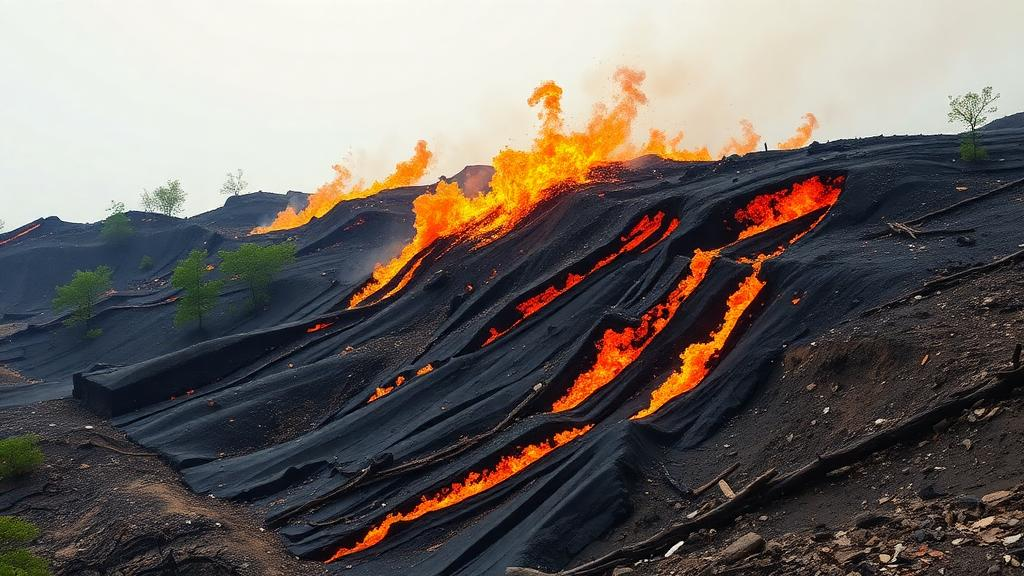
After a wildfire, the danger does not end when the flames go out. Burned soil often becomes water-repellent, and the first heavy rain can trigger fast-moving debris flows within minutes. A new study published in AI in Civil Engineering shows that machine learning models trained on controlled laboratory experiments can predict which soil, slope, and rainfall combinations are most likely to set off such failures, and it identifies the first ten minutes of high-intensity rainfall as the most dangerous window.
The research, led by Mahta Movasat and Ingrid Tomac, drew on 36 flume experiments in which artificially prepared hydrophobic sand layers on sloped channels were subjected to simulated rainfall from a nozzle-based rain device. Unlike earlier machine learning studies of post-wildfire debris flows, which rely on field data where soil properties, burn severity, and rainfall intensity are difficult to control, this work systematically varied the key parameters in the laboratory: median grain size (D50), water entry value, slope gradient, and rainfall intensity.
The experiments modeled two soil configurations relevant to burned hillslopes. In the H-Top layout, a 2-centimeter hydrophobic layer sat directly on the soil surface, while in the H-Sub layout, a 1-centimeter hydrophobic layer was buried beneath a 1-centimeter hydrophilic layer, both atop a 13-centimeter hydrophilic base. Although the laboratory setup is far smaller than a full-scale hillslope, the researchers argue that the tests capture the origins of erosion at full-scale slope angles, sand particle sizes, and raindrop sizes, offering mechanistic insight that field data alone cannot provide.
For the H-Top configuration, the team applied multiple linear regression to predict two outputs: total cumulative water discharge and total cumulative erosion. The model was trained on 65 percent of the 18 experimental results, with the remaining 35 percent reserved for testing. Because discharge and erosion should theoretically approach zero when rainfall stops, the soil features were multiplied by rainfall intensity in the regression equation, an approach consistent with recent post-fire debris-flow likelihood studies.
The regression performed well for water but struggled with sediment. For total discharge, the model achieved an R-squared of 0.96 on training data and 0.72 on testing data, meaning the input variables explained a substantial share of the variance. For total erosion, however, the R-squared dropped from 0.87 on training data to just 0.45 on testing data, a pattern the authors attribute to probable overfitting and to the very low erosion measured in coarse sand, where near-zero values distort the regression fit and can even produce negative predictions. The correlation matrix underlying the models showed rainfall intensity had the strongest absolute correlation with discharge at 0.77, followed by slope gradient at 0.44, while grain size and water entry value correlated more strongly with erosion than with discharge.
The H-Sub experiments posed a different question: whether a given combination of conditions would trigger infinite slope failure. To answer it, the researchers first reduced the dataset to two principal components, which together explained 75 percent of the variance, then applied K-means clustering to partition the 18 experiments into failed and non-failed classes. The clustering separated the classes almost perfectly, misclassifying only two data points that had in fact experienced failure. A support vector classifier with a linear kernel was then trained to draw the maximal-margin boundary between the classes, with a regularization parameter of C = 1 selected to balance underfitting and overfitting.
The classifier’s performance was evaluated with precision, accuracy, and threat score across training and testing splits. On training data, precision and accuracy were both approximately 0.8, while on the small testing set precision reached 1.0 and accuracy 0.85, a difference the authors attribute to the limited sample size. Sevenfold cross-validation, run five times with reshuffled data, yielded accuracies ranging from roughly 0.75 to 0.80, supporting the model’s reliability. A logistic regression model, trained with batch gradient descent and a probability threshold of 0.5, achieved training precision and accuracy of about 0.8 and 0.9 with a threat score of 0.66, and testing precision of 1.0 with accuracy of 0.9, confirming that the four input parameters carry enough information to classify failure outcomes satisfactorily.
The most striking results came from a sensitivity analysis based on the standard deviation method, which varied one parameter at a time while holding the others at their mean values. Fine sand proved highly susceptible to erosion across the full range of rainfall intensities, remaining sensitive to rainfall variation at both 20-degree and 30-degree slopes. In contrast, the model’s sensitivity to rainfall intensity diminished sharply for coarser grains: at a rainfall intensity of 120 millimeters per hour, the predicted probability of failure dropped by roughly 50 percent for medium sand and 65 percent for coarse sand. Under high rainfall intensity, grain size and slope gradient became the dominant controls on failure probability, while the water entry value, restricted to positive values in hydrophobic samples, had a comparatively smaller influence.
The temporal dynamics add another layer of urgency. The experiments ran for 60 minutes, divided into six 10-minute intervals, a duration chosen empirically because no measurable changes in erosion or discharge occurred beyond that point. Under high-intensity rainfall, the first ten minutes emerged as the critical period for discharge generation and slope failure, with most damage occurring during that initial window. During low-intensity rainfall, discharged water maintained a relatively consistent percentage of total rainfall, meaning that for fine sand slopes, prolonged moderate rain can be more consequential than a brief intense burst.
The authors are careful to note the limitations: the dataset is small, carries some risk of overfitting, and the principal component loadings depend on the specific variables and ranges of this laboratory study rather than being universally reproducible constants. Even so, the study identifies fine sand as the most problematic soil type for post-wildfire debris flow initiation, supporting the underlying experimental findings, and suggests that areas dominated by fine sand may undergo drastic behavioral changes after a fire. The researchers conclude that such locations warrant greater precaution in emergency response and evacuation planning, and that machine learning tools of this kind could sharpen post-wildfire hazard assessment by highlighting the critical variables and conditions that drive debris flow initiation.
Subject of Research: Machine learning prediction of post-wildfire debris flow onset from controlled laboratory rainfall experiments on hydrophobic sands
Article Title: Predicting post-wildfire debris flow onset using machine learning models on multi-parameter experimental data
Article References: Movasat, M., & Tomac, I. (2026). Predicting post-wildfire debris flow onset using machine learning models on multi-parameter experimental data. AI in Civil Engineering, 5(1), Article 12. https://doi.org/10.1007/s43503-026-00094-w
Image Credits: AI Generated
DOI: 10.1007/s43503-026-00094-w
Keywords: post-wildfire debris flows, machine learning, soil hydrophobicity, logistic regression, support vector classifier, principal component analysis, slope failure, rainfall intensity, erosion, flume experiments, fine sand, hazard assessment
Cite Scienmag News
Teresa Odom. (October 29, 2026). Machine Learning Pinpoints When Burned Hillslopes Turn Into Deadly Debris Flows. Scienmag. https://scienmag.com/machine-learning-pinpoints-when-burned-hillslopes-turn-into-deadly-debris-flows/
Teresa Odom. "Machine Learning Pinpoints When Burned Hillslopes Turn Into Deadly Debris Flows." Scienmag, 29 October 2026, https://scienmag.com/machine-learning-pinpoints-when-burned-hillslopes-turn-into-deadly-debris-flows/. Accessed 2 November 2026.
Teresa Odom. "Machine Learning Pinpoints When Burned Hillslopes Turn Into Deadly Debris Flows." Scienmag. October 29, 2026. https://scienmag.com/machine-learning-pinpoints-when-burned-hillslopes-turn-into-deadly-debris-flows/









