


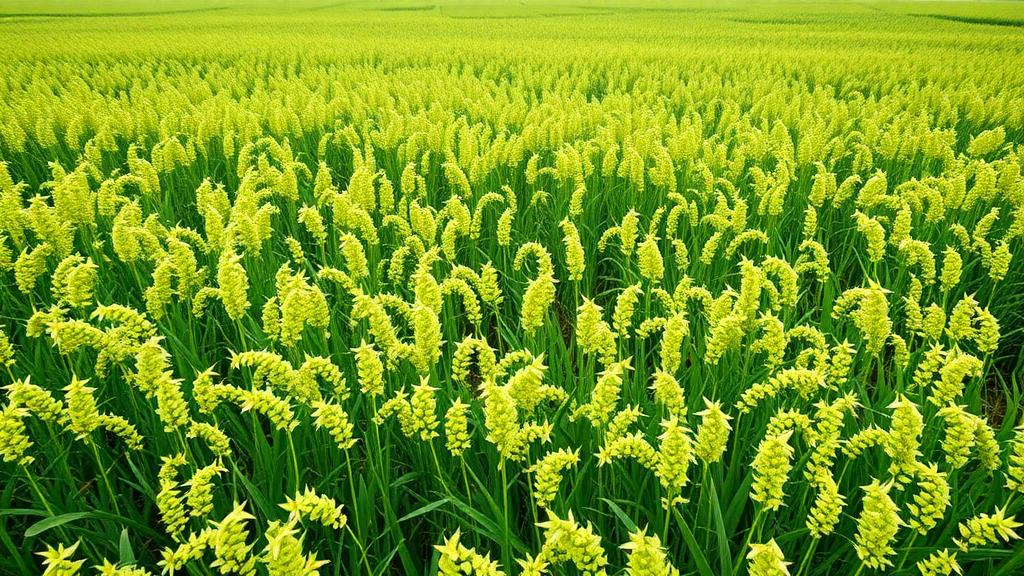
Across the rice paddies of southern China, a modest legume known as Chinese milk vetch quietly performs some of the most valuable work in the agricultural landscape. Planted in the winter months when rice fields would otherwise lie bare, it draws nitrogen from the atmosphere through its symbiotic bacteria, adds organic carbon to the soil when it is turned under in spring, and helps farmers reduce their dependence on synthetic fertilizers. A new peer-reviewed study published in Agricultural Ecology and Environment has now mapped, with unusual precision, how the biomass of this green manure crop varies across southern China and where a warming, shifting climate may push it beyond its comfort zone.
The research team, led by corresponding author Hao Liang of Hohai University together with Xiaoyue Wu, Ruidong Chen and Songjuan Gao, assembled one of the most comprehensive field datasets ever compiled for this crop. The analysis drew on 572 individual biomass measurements collected at 111 monitoring sites spread across 13 provinces of southern China. Rather than relying on simple correlations, the researchers combined a Random Forest machine learning model with SHAP, an interpretable artificial intelligence technique that reveals how much each input variable contributes to a prediction and in which direction. This pairing allowed the team to move beyond black-box predictions and identify the specific climatic, geographic and soil conditions under which the crop thrives or falters.
The baseline picture is striking. The average dry biomass of Chinese milk vetch across the surveyed sites was 3.23 metric tons per hectare, a figure with direct agronomic consequences because biomass determines how much biologically fixed nitrogen and organic carbon is returned to the paddy soil before the next rice crop. The highest biomass was concentrated in the middle and lower reaches of the Yangtze River, particularly in Hunan, Hubei and Jiangxi, where mild, moist winters create near-ideal growing conditions. Lower biomass values appeared in parts of southern and southwestern China, hinting that the crop’s productivity is far from uniform across its cultivated range.
The machine learning model explained 68 percent of the observed spatial variation in biomass, a substantial share for a field-scale ecological dataset. When the contributions of different variable groups were separated, climatic factors emerged as the dominant force, accounting for 40.5 percent of the explained variation. Geographic factors contributed 31.7 percent and soil properties 27.8 percent. In other words, while local conditions and soil management matter, the weather that a milk vetch crop experiences during its winter growing season is the single most important determinant of how much nitrogen and carbon it will ultimately deliver to the rice system.
Perhaps the most consequential finding of the study is that these climatic effects are strongly nonlinear. Biomass did not simply rise or fall with temperature and rainfall; instead, the analysis uncovered clear thresholds. Growing-season precipitation between approximately 533 and 877 millimeters was associated with favorable biomass accumulation, while rainfall below or above that window was linked to reduced growth, reflecting the twin hazards of winter drought and waterlogging in paddy fields. Mean growing-season temperatures of roughly 10.7 to 13.7 degrees Celsius formed a broad thermal buffer within which the crop performed well. Above 13.7 degrees Celsius, however, the relationship shifted, with warmer conditions increasingly associated with heat stress and declining biomass.
These thresholds matter because they can be tested against the future. The team coupled its biomass model with projections from three CMIP6 climate models run under four Shared Socioeconomic Pathway scenarios, the standard framework used in international climate assessments to explore futures ranging from low to high greenhouse gas emissions. The result was a spatially explicit forecast of how Chinese milk vetch productivity might evolve through the end of the century, with projections extending to 2098.
Across southern China as a whole, the projected decline in milk vetch biomass was moderate, on the order of roughly 2 to 4 percent by 2098. But the aggregate number conceals a deeply uneven regional picture. The Huang Huai Hai single-cropping rice region was projected to suffer some of the largest losses, with biomass reductions reaching about 13 to 14 percent under higher-emission scenarios. In sharp contrast, the middle and lower Yangtze River double-cropping region, already the crop’s productivity heartland, remained comparatively stable and could even see biomass increases of approximately 1.9 to 5.9 percent under some scenarios. The same climate change that stresses the crop at the northern edge of its range may, within limits, extend favorable conditions in its core zone.
The practical implication, the authors argue, is that a single management strategy will not work everywhere. In regions facing the steepest projected losses, adaptation measures become urgent. The study proposes region-specific approaches, including adjusting sowing dates so that the growing season avoids the most stressful temperature and moisture conditions, developing stress-tolerant milk vetch varieties for vulnerable areas, conserving soil moisture through mulching and water management, and optimizing the integration of the green manure with rice straw return and nitrogen fertilization. Each of these levers interacts with the thresholds identified by the model, giving agronomists a quantitative basis for deciding where and how to intervene.
As corresponding author Hao Liang emphasized, Chinese milk vetch is more than a winter cover crop, because its biomass directly determines how much biologically fixed nitrogen and organic carbon can be returned to rice fields. The study’s results show that climate does not affect this crop in a simple linear way, and that the clear temperature and precipitation ranges within which milk vetch performs best can guide more precise regional management under a changing climate. That framing turns what might have been a purely descriptive mapping exercise into a decision-support tool for one of China’s most important low-input rice systems.
Beyond its immediate agronomic value, the work delivers a set of field-based benchmark data that could support crop modeling and remote sensing studies aimed at improving green manure management across southern China. The 572 measurements and the quantified climate thresholds provide calibration points for simulation models, and the spatial patterns documented by the team offer ground truth for satellite-based estimates of winter cover crop biomass. As climate pressures intensify through the coming decades, the study suggests that the future of Chinese milk vetch will be decided region by region, at the precise intersection of temperature, rainfall and management that the new analysis has now made visible.
Subject of Research: Climate-driven spatial variation and future projections of Chinese milk vetch biomass in southern China's rice paddies
Article Title: Climate change could reshape the future of Chinese milk vetch in southern rice paddies
Article References: Climate change could reshape the future of Chinese milk vetch in southern rice paddies. (n.d.). Original publication
Image Credits: AI Generated
DOI: Not provided
Keywords: Chinese milk vetch, green manure, rice paddies, climate change, machine learning, Random Forest, SHAP, CMIP6, Shared Socioeconomic Pathways, biomass thresholds, nitrogen fixation, southern China
Cite Scienmag News
Alan Morgan. (October 2, 2026). Machine learning maps the climate limits of Chinese milk vetch in southern rice paddies. Scienmag. https://scienmag.com/machine-learning-maps-the-climate-limits-of-chinese-milk-vetch-in-southern-rice-paddies/
Alan Morgan. "Machine learning maps the climate limits of Chinese milk vetch in southern rice paddies." Scienmag, 2 October 2026, https://scienmag.com/machine-learning-maps-the-climate-limits-of-chinese-milk-vetch-in-southern-rice-paddies/. Accessed 4 October 2026.
Alan Morgan. "Machine learning maps the climate limits of Chinese milk vetch in southern rice paddies." Scienmag. October 2, 2026. https://scienmag.com/machine-learning-maps-the-climate-limits-of-chinese-milk-vetch-in-southern-rice-paddies/


