

Saturday, May 16, 2026
Science
No Result
View All Result
  • Login
  • HOME
  • SCIENCE NEWS
  • CONTACT US
  • HOME
  • SCIENCE NEWS
  • CONTACT US
No Result
View All Result
Scienmag
No Result
View All Result
Home Science News Marine

Listen up: New insights into little penguins’ sensitivity to noise

August 28, 2024
in Marine
Reading Time: 2 mins read
0
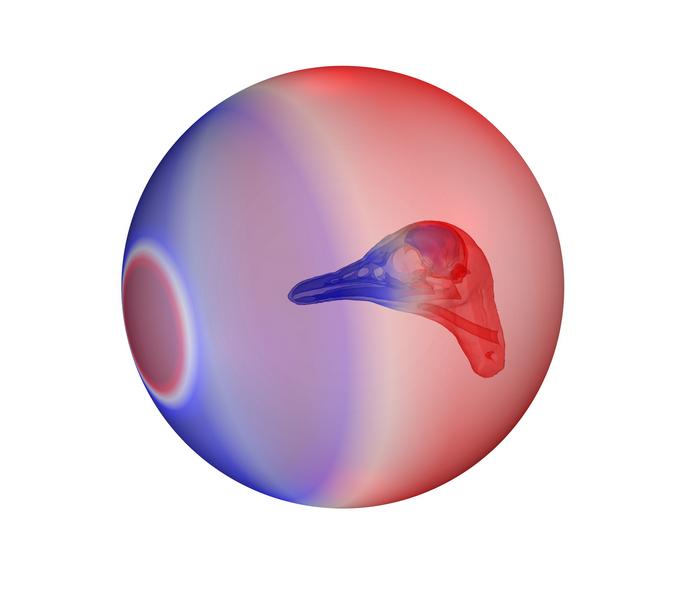
The sound pressure field in sound reception
67
SHARES
606
VIEWS
Share on FacebookShare on Twitter
ADVERTISEMENT

Curtin University researchers have used state-of-the-art imaging technology to shed light on the hearing sensitivity of Australian Little Penguins and the danger of marine noise pollution.

The sound pressure field in sound reception

Credit: Dr Chong Wei

Curtin University researchers have used state-of-the-art imaging technology to shed light on the hearing sensitivity of Australian Little Penguins and the danger of marine noise pollution.

Supported by the Western Australian Marine Science Institution’s Westport program, the study is the first to detail how Little Penguins, also known as fairy penguins, perceive sound both in air and under water.

Study lead Dr Chong Wei, from Curtin’s Centre for Marine Science and Technology, said Little Penguins are particularly vulnerable to human-made noise as their habitats often overlap with shipping lanes, recreational activities and coastal developments.

“Ocean noise pollution is steadily increasing and this is particularly concerning for Little Penguins whose populations are significantly declining,” Dr Wei said.

“We know very little about the impact of this noise on penguin hearing. To address this, we created 3D digital models using microCT scans of the heads of three Little Penguins that had died naturally at Garden Island to simulate what they can hear at different frequencies.

“Units of frequency are called hertz (Hz) and these 3D models revealed that Little Penguins can hear sounds across a broad range between 200 and 6,000 Hz under water, similar to other diving birds like the Great Cormorant.

“Vessel noise typically ranges from 20 to 10,000 Hz, as does pile driving.”

Co-author John Curtin Distinguished Professor Christine Erbe, from Curtin’s Centre for Marine Science and Technology, said the research findings are valuable for marine conservation efforts.

“Continuous exposure to high noise levels from passing vessels and near-shore construction might increase stress and interfere with Little Penguin behaviours such as feeding,” Professor Erbe said.

“Understanding their hearing range helps us identify potentially harmful noise frequencies and the results can inform management plans aimed at reducing the impact of noise pollution.”

The research titled “Sound reception and hearing capabilities in the Little Penguin (Eudyptula minor): first predicted in-air and underwater audiograms” has been published in the journal Royal Society Open Science and can be found here.


Journal

Royal Society Open Science

DOI

10.1098/rsos.240593

Method of Research

Imaging analysis

Subject of Research

Animals

Article Title

Sound reception and hearing capabilities in the Little Penguin (Eudyptula minor): first predicted in-air and underwater audiograms

Article Publication Date

28-Aug-2024

Share27Tweet17
Previous Post

Marine engineering group to award ORNL researchers for innovative welding software

Next Post

The Public Health Career Explorer launches, matching health department job openings with career interests and preparation

Related Posts

Microscopic Marine Life Aids Scientists in Estimating Whale Populations off California Coast — Marine
Marine

Microscopic Marine Life Aids Scientists in Estimating Whale Populations off California Coast

May 14, 2026
Exploring the Physics of Marine Snow: Unveiling Mysteries in Uncharted Ocean Depths — Marine
Marine

Exploring the Physics of Marine Snow: Unveiling Mysteries in Uncharted Ocean Depths

May 14, 2026
Innovative Technique Offers Washington Shellfish Farmers a New Way to Manage Troublesome Shrimp — Marine
Marine

Innovative Technique Offers Washington Shellfish Farmers a New Way to Manage Troublesome Shrimp

May 14, 2026
Ultrafast Water Harvesting via Flexible Zeolite Membranes — Marine
Marine

Ultrafast Water Harvesting via Flexible Zeolite Membranes

May 14, 2026
Ancient Reefs Reveal Secrets Behind Modern Marine Life Evolution — Marine
Marine

Ancient Reefs Reveal Secrets Behind Modern Marine Life Evolution

May 14, 2026
New Hormone Analysis of Baleen Reveals Life Story of Critically Endangered Rice’s Whale with Only 50 Adults Left — Marine
Marine

New Hormone Analysis of Baleen Reveals Life Story of Critically Endangered Rice’s Whale with Only 50 Adults Left

May 13, 2026
Next Post

The Public Health Career Explorer launches, matching health department job openings with career interests and preparation

  • Mothers who receive childcare support from maternal grandparents show more parental warmth, finds NTU Singapore study

    Mothers who receive childcare support from maternal grandparents show more parental warmth, finds NTU Singapore study

    27645 shares
    Share 11054 Tweet 6909
  • University of Seville Breaks 120-Year-Old Mystery, Revises a Key Einstein Concept

    1049 shares
    Share 420 Tweet 262
  • Bee body mass, pathogens and local climate influence heat tolerance

    678 shares
    Share 271 Tweet 170
  • Researchers record first-ever images and data of a shark experiencing a boat strike

    542 shares
    Share 217 Tweet 136
  • Groundbreaking Clinical Trial Reveals Lubiprostone Enhances Kidney Function

    528 shares
    Share 211 Tweet 132
Science

Embark on a thrilling journey of discovery with Scienmag.com—your ultimate source for cutting-edge breakthroughs. Immerse yourself in a world where curiosity knows no limits and tomorrow’s possibilities become today’s reality!

RECENT NEWS

  • Flexible Framework Optimizes Data Center Site Planning
  • Short-Term Home Cognitive & Physical Training Tested in Seniors
  • New Kineococcus Species Discovered on Anabasis Seeds
  • Stress Evolution and Time Control in Retreat Roadways

Categories

  • Agriculture
  • Anthropology
  • Archaeology
  • Athmospheric
  • Biology
  • Biotechnology
  • Blog
  • Bussines
  • Cancer
  • Chemistry
  • Climate
  • Earth Science
  • Editorial Policy
  • Marine
  • Mathematics
  • Medicine
  • Pediatry
  • Policy
  • Psychology & Psychiatry
  • Science Education
  • Social Science
  • Space
  • Technology and Engineering

Subscribe to Blog via Email

Success! An email was just sent to confirm your subscription. Please find the email now and click 'Confirm Follow' to start subscribing.

Join 5,146 other subscribers

© 2025 Scienmag - Science Magazine

Welcome Back!

Login to your account below

Forgotten Password?

Retrieve your password

Please enter your username or email address to reset your password.

Log In
No Result
View All Result
  • HOME
  • SCIENCE NEWS
  • CONTACT US

© 2025 Scienmag - Science Magazine
