


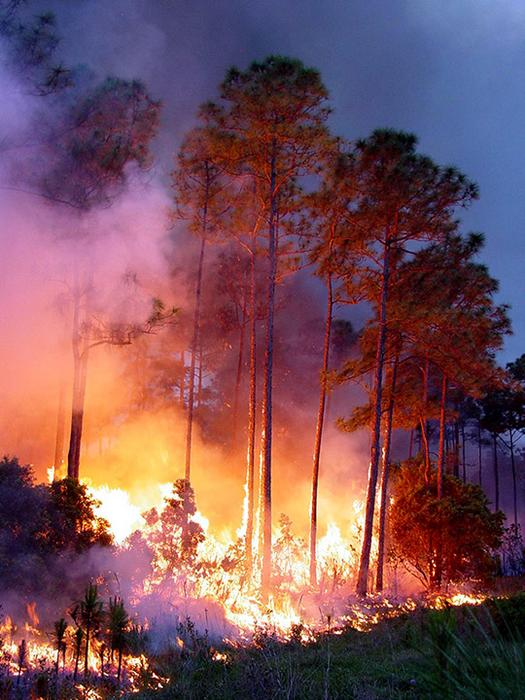
A new UC Riverside study shows soot from large wildfires in California traps sunlight, making days warmer and drier than they ought to be.

Credit: National Park Service
A new UC Riverside study shows soot from large wildfires in California traps sunlight, making days warmer and drier than they ought to be.
Many studies look at the effect of climate change on wildfires. However, this study sought to understand the reverse — whether large fires are also changing the climate.
“I wanted to learn how the weather is affected by aerosols emitted by wildfires as they’re burning,” said lead study author and UCR doctoral candidate James Gomez.
To find his answers, Gomez analyzed peak fire days and emissions from every fire season over the past 20 years. Of these fire days, he examined a subset that occurred when temperatures were lower, and humidity was higher. “I looked at abnormally cool or wet days during fire season, both with and without fires. This mostly takes out the fire weather effects,” Gomez said.
Published in the journal Atmospheric Chemistry and Physics, the study found that large fires did have an effect. They made it hotter and drier than usual on the days the fires burned. The extra heat and aridity may then make conditions favorable for more fire.
“It appears these fires are creating their own fire weather,” Gomez said.
The most intense fires occurred in Northern California, where fire-fueling vegetation is denser than elsewhere in the state. On average, temperatures were about 1 degree Celsius warmer per day during the fires.
There are likely two reasons for this. One — soot traps heat, and two —the extra heat reduces humidity in the atmosphere, making it more difficult for clouds to form.
“Fires emit smoke with black carbon, or soot. Since it is very dark, the soot absorbs sunlight more readily than bright or reflective things,” Gomez said.
There are two types of aerosols: reflective and absorptive. Sulfate aerosols, which are byproducts of fossil fuel burning, are reflective and can cool the environment. These particles reflect the sun’s energy back into space, keeping it out of the atmosphere.
Recent UCR research points to an unfortunate byproduct of improving air quality by reducing sulfate aerosols. Since these particles have a cooling effect, removing them makes climate change more severe and leads to an increase in wildfires, especially in northern hemisphere forests.
Sulfate aerosols can also help make clouds brighter, more reflective, and more effective at cooling the planet.
The researchers note that the only way to prevent additional wildfires when cleaning up reflective sulfate air pollution is to simultaneously reduce emissions of greenhouse gases like carbon dioxide and methane.
Absorptive aerosols have the opposite effect. They trap light and heat in the atmosphere, which can raise temperatures. Black carbon, the most common aerosol emission from wildfires, is an absorbing aerosol. They not only directly make temperatures hotter, but indirectly as well by discouraging cloud formation and precipitation.
“What I found is that the black carbon emitted from these California wildfires is not increasing the number of clouds,” Gomez said. “It’s hydrophobic.” Fewer clouds mean less precipitation, which is problematic for drought-prone states.
While some studies have shown an association between fires and brighter, more numerous clouds, this one did not.
Notably, the study found that days with fewer fire emissions had a more muted effect on the weather. “If the aerosols are coming out in smaller amounts and more slowly, the heating effect is not as pronounced,” Gomez said.
Gomez is hopeful that mitigating CO2 emissions, alongside better land management practices, can help reduce the number of large wildfires.
“There is a buildup of vegetation here in California. We need to allow more frequent small fires to reduce the amount of fuel available to burn,” Gomez said. “With more forest management and more prescribed burns, we could have fewer giant fires. That is in our control.”
Journal
Atmospheric Chemistry and Physics
Article Publication Date
14-Jun-2024
Cite Scienmag News
Bethany Barker. (June 18, 2024). Large wildfires create weather that favors more fire. Scienmag. https://scienmag.com/large-wildfires-create-weather-that-favors-more-fire/
Bethany Barker. "Large wildfires create weather that favors more fire." Scienmag, 18 June 2024, https://scienmag.com/large-wildfires-create-weather-that-favors-more-fire/. Accessed 3 September 2026.
Bethany Barker. "Large wildfires create weather that favors more fire." Scienmag. June 18, 2024. https://scienmag.com/large-wildfires-create-weather-that-favors-more-fire/

