


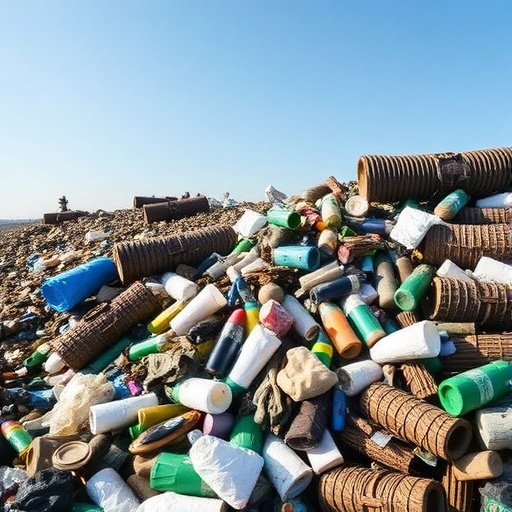
Plastic waste is often imagined as something that disappears from everyday life once it is buried beneath layers of soil, compacted refuse and engineered cover. A new study in Nature Communications challenges that convenient illusion, presenting landfills as both “time capsules” that preserve plastic for decades and active sources capable of generating microplastics. The research by Huang, Wang, Yang and colleagues focuses attention on a largely hidden stage of the plastic life cycle: what happens after bottles, packaging, films and synthetic materials are removed from public view and entombed underground. Rather than marking the end of plastic pollution, disposal in a landfill may begin a slow transformation in which larger objects remain recognizable while simultaneously breaking down into particles small enough to migrate through water, soil and waste-management systems.
The distinction between plastic persistence and plastic degradation is central to the study’s significance. Most conventional plastics do not readily biodegrade because their long polymer chains are resistant to attack by microorganisms. Instead, they undergo physical and chemical weathering. Sunlight can initiate photochemical reactions in exposed material, while oxygen, heat, moisture, pressure and repeated mechanical stress can weaken polymer structures. In a landfill, direct sunlight may be limited, but compaction, shifting waste, acidic or alkaline conditions and the movement of leachate can still alter plastic over time. A discarded food wrapper may remain visibly intact while its surface becomes brittle, cracked and fragmented. Those fragments can then continue breaking apart, producing microplastics generally defined as plastic particles smaller than five millimeters.
Landfills are particularly complex environments because they are not uniform underground containers. They are layered ecosystems containing organic waste, construction debris, textiles, metals, chemicals, water and gases, all interacting under changing physical conditions. Rainfall entering the landfill can generate leachate, a contaminated liquid that moves through waste and may carry dissolved substances and suspended particles. As water encounters aging plastic, particles released from packaging, synthetic fibers and degraded consumer products may be transported downward or laterally. Modern landfill liners and collection systems are designed to reduce leakage, but their effectiveness does not eliminate the possibility of particle formation within the waste mass. The study’s central message is therefore not simply that plastic survives burial, but that survival and fragmentation can occur at the same time.
This creates a paradox with major consequences for environmental monitoring. A landfill can preserve relatively large pieces of plastic for long periods, allowing future researchers to identify the materials and products used by past societies. Yet the same site may also function as a continuous microplastic-generation source. The process resembles the slow disassembly of a vast archive: recognizable objects remain stored in the waste, while abrasion and weathering release increasingly smaller fragments. Microplastics may be produced from rigid containers, flexible films, foam materials, synthetic fabrics and composite products. Their composition determines how they respond to heat, oxidation and chemical exposure, while additives such as plasticizers, pigments, flame retardants and stabilizers can influence both degradation and environmental toxicity.
The scientific concern extends beyond the particles themselves. Microplastics can act as mobile carriers for chemicals associated with plastic manufacturing or pollutants already present in the landfill. Their surfaces may also collect microorganisms and other contaminants as they move through leachate or surrounding soil. Once released, particles can be difficult to recover because they vary enormously in size, shape, density and chemical composition. Some may float, others sink, and many can remain suspended in water. Fibers can behave differently from fragments, while thin films may break into irregular flakes that are challenging to distinguish from natural particles. These differences complicate efforts to measure the quantity of microplastics leaving a landfill and make standardized sampling essential.
The work arrives as scientists increasingly recognize that waste-management facilities must be studied as part of the broader plastic-pollution system. Research has already documented microplastics in oceans, rivers, agricultural soils, atmospheric dust and wastewater. Landfills, however, have often been treated primarily as final disposal locations rather than as active sources that may redistribute pollution. The study reframes that assumption. It suggests that understanding plastic pollution requires tracking material flows after collection, not merely calculating how much plastic enters recycling, incineration or burial. A product’s environmental history does not end when it reaches a waste facility; its physical form, chemical composition and surrounding conditions continue to determine where its components may eventually go.
The findings also raise questions about how landfill age and operating conditions influence particle production. Newly deposited waste may experience intense compaction and mechanical stress, while older sections undergo long-term chemical transformation and water movement. Differences in temperature, moisture, oxygen availability and waste composition could create distinct degradation patterns within the same landfill. Closed sites may continue to produce leachate and gas for many years, meaning that environmental risks can persist after active disposal ends. Climate change may add further complexity. More intense rainfall can increase leachate generation, flooding can damage containment infrastructure, and higher temperatures may accelerate some forms of polymer aging. These factors make long-term surveillance important even when a landfill appears stable at the surface.
For waste managers, the implications point toward prevention as well as containment. Improved sorting can remove plastic items from mixed waste before burial, while stronger recycling systems may reduce the volume entering landfills, although recycling itself must also be evaluated for particle release. Landfill design can help control contaminated water through liners, drainage layers, leachate collection and treatment. Monitoring programs may need to include microplastics in addition to conventional measurements such as dissolved chemicals, metals and organic pollutants. Detecting particles requires careful procedures because sampling equipment, clothing and airborne dust can introduce contamination. Researchers must often combine microscopy with spectroscopic techniques, including Fourier-transform infrared or Raman analysis, to confirm that suspected particles are plastic rather than mineral or biological material.
The broader public-health and ecological implications remain an active area of investigation, and the study does not turn every landfill into an immediate catastrophe. Risk depends on how many particles are generated, their size and chemistry, the effectiveness of containment, and whether they reach ecosystems or human exposure pathways. What the research makes difficult to ignore is the idea that burial equals disappearance. Landfills may preserve a record of modern consumption while quietly transforming that record into a new source of persistent pollution. The plastic bottle, wrapper or synthetic garment placed in a bin today could remain identifiable for generations, yet also contribute to a dispersed cloud of microscopic debris. By revealing this hidden afterlife of waste, the study adds urgency to efforts aimed at reducing unnecessary plastic production, improving product design and treating disposal sites as dynamic environmental systems rather than permanent endpoints.
Cite Scienmag News
Violet Maxwell. (August 24, 2026). Landfills Preserve Plastic Waste Yet Generate Microplastics. Scienmag. https://scienmag.com/landfills-preserve-plastic-waste-yet-generate-microplastics/
Violet Maxwell. "Landfills Preserve Plastic Waste Yet Generate Microplastics." Scienmag, 24 August 2026, https://scienmag.com/landfills-preserve-plastic-waste-yet-generate-microplastics/. Accessed 3 September 2026.
Violet Maxwell. "Landfills Preserve Plastic Waste Yet Generate Microplastics." Scienmag. August 24, 2026. https://scienmag.com/landfills-preserve-plastic-waste-yet-generate-microplastics/


