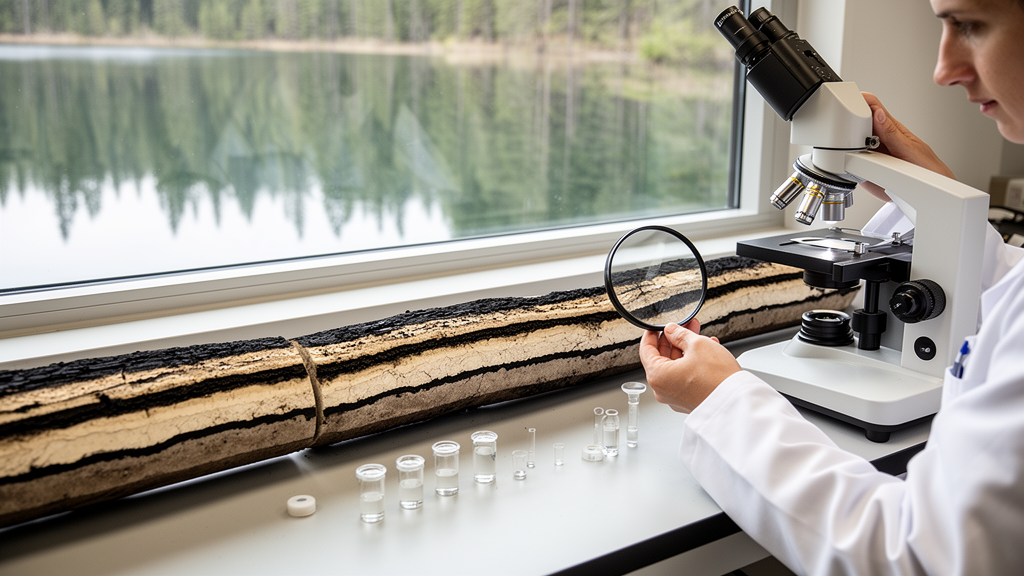
Wildfire activity around an alpine lake in northwestern Yunnan was most intense between about 2,900 and 2,000 years before present, when several independent indicators point to reduced regional moisture, according to an analysis of molecular markers preserved in lake sediment. The study reconstructs approximately 4,500 years of biomass burning from Wodi Co, a high-elevation freshwater lake on the southeastern margin of the Tibetan Plateau. Its strongest sustained fire interval coincided with evidence of concentrated lake water, more oxygenated sediment and low simulated wet-season precipitation, supporting an association between long-term fire variability and regional moisture availability.
The reconstruction is based on fluxes of three combustion-derived anhydrosugars. Levoglucosan, produced mainly during the pyrolysis of plant cellulose, served as the principal tracer of biomass burning, while its isomers mannosan and galactosan, formed principally during hemicellulose pyrolysis, helped characterize the relative composition of combusted material. The researchers standardized the three flux records and averaged them to construct a composite fire activity index, or FAI. They compared this index with elemental ratios, total organic carbon, grain-size measurements and climate-model output to examine whether wildfire changes coincided with local hydrological conditions or broader circulation variability.
The chronology came from a Bayesian age-depth model previously established for the Wodi Co core using accelerator mass spectrometry radiocarbon dating, the IntCal20 calibration curve and the rbacon modelling package. The full 880-centimeter core extends from approximately 5,120 years before present to 69 years after present, while the analyzed upper 810 centimeters cover roughly the past 4,550 years and end at about 62 years after present. The model showed no age reversals, although sediment accumulation rates changed substantially, including relatively rapid deposition around 2,300 to 1,600 years before present. Calculating fluxes rather than relying on concentrations alone was therefore important for separating changes in the amount of burned material from changes in the rate at which sediment accumulated.
Stratigraphically constrained clustering divided the molecular fire record into three principal phases. From about 4,550 to 2,885 years before present, the proxies showed generally low to moderate biomass burning. Mean levoglucosan flux was 1.55 ± 1.06 micrograms per square centimeter per year, mean mannosan flux was 0.92 ± 0.33 micrograms per square centimeter per year and mean galactosan flux was 1.90 ± 1.58 micrograms per square centimeter per year. The FAI averaged −0.63 ± 0.64 during this first phase, indicating activity below the full-record average. The most active and variable period followed, extending from roughly 2,885 to 1,946 years before present. Mean levoglucosan flux rose to 3.66 ± 3.27 micrograms per square centimeter per year, while mannosan and galactosan fluxes and the FAI also reached their highest phase averages.
Large standard deviations in the high-fire phase show that the increase was episodic rather than uniform. Several short fire episodes, including a multi-decadal peak near 2,000 years before present, were embedded within the broader interval. The authors note that the peaks may reflect short-lived enhancements in fire intensity or biomass combustion, although variations in fuel availability, atmospheric transport and sedimentary preservation may also have contributed. Since about 1,946 years before present, mean levoglucosan, mannosan and galactosan fluxes declined to 1.25 ± 1.21, 0.98 ± 0.62 and 1.74 ± 1.35 micrograms per square centimeter per year, respectively. The FAI averaged −0.76 ± 0.82 in this final phase, returning activity to levels broadly comparable with those of the earliest phase.
Several lines of evidence pointed toward drier conditions during the high-fire interval. In the Wodi Co catchment, calcium-to-silicon ratios rose as a whole, a pattern interpreted as greater concentration of lake water and reduced effective moisture, although detrital inputs and carbonate sources may also affect the ratio. Conversely, iron-to-manganese ratios declined, consistent with lower lake levels and more oxic sedimentary conditions. Simulated precipitation for the wettest quarter also remained comparatively low, averaging 321.44 ± 4.95 millimeters during the main fire phase. The FAI was significantly correlated with calcium-to-silicon at Spearman’s rho of 0.24 and inversely correlated with iron-to-manganese at rho of −0.34, with both relationships significant at p less than 0.05. By contrast, total organic carbon, the greater-than-64-micrometer fraction and zircon-to-rubidium ratio were not significantly correlated with the principal fire proxies.
Independent statistical tests identified changes at roughly the same broad times. A multiple structural-break analysis selected two FAI transitions, at approximately 2,910 and 1,950 years before present, closely matching the clustering boundaries. The result remained similar when first-order autoregressive errors were included, indicating that moderate temporal autocorrelation did not erase the principal transitions. The iron-to-manganese record also retained two breakpoints, at approximately 1,740 and 2,910 years before present, whereas the calcium-to-silicon breakpoint at about 2,250 years before present was sensitive to the statistical treatment of temporal dependence. The timing of the main fire-state transitions was therefore more robust than the exact timing of every hydrological change.
The broad climate context points to a weakened Indian summer monsoon and enhanced El Niño-like conditions during the principal fire interval. An Oman Cave speleothem oxygen-isotope record indicated relatively weak monsoonal moisture transport, while a sediment record from El Junco Lake in the tropical Pacific indicated pronounced El Niño-like conditions, including the strongest anomaly in the approximately 4,500-year comparison period. These large-scale indicators broadly coincided with the Wodi Co fire episode, although their principal extremes lagged local changes by about 500 years. The ENSO index was significantly associated with lower simulated dry-season relative humidity at the lake, with rho of −0.47 and p less than 0.05, whereas the Indian summer monsoon showed only a weak relationship with that measure, with rho of −0.26 and p below 0.10. The winter westerly jet was positioned slightly farther north during the high-fire phase, at a mean December-to-February latitude of 30.02 ± 1.05 degrees north, but its position was not significantly related to either the moisture indicators or the fire proxies.
After about 2,000 years before present, the transition was marked by reduced and less variable burning, lower calcium-to-silicon, higher iron-to-manganese and a general increase in simulated wet-season precipitation. Mean precipitation for the wettest quarter was 325.15 ± 5.50 millimeters during the final phase, with an overall increase after about 2,100 years before present. The change was also visible in the mean calcium-to-silicon ratio of 0.76 ± 0.21 and iron-to-manganese ratio of 131.92 ± 53.95. This local shift broadly agrees with hydroclimatic reorganizations described across parts of the Asian monsoon domain, although the response was spatially uneven and the exact breakpoints did not match perfectly among records. The authors interpret the Wodi Co change as a local reorganization of the relationship between moisture and wildfire within the broader “2-kyr shift,” rather than as proof that a single event occurred simultaneously everywhere. After the transition, wildfire activity remained generally low and stable.
The reconstruction offers a long-term example of drought-related drying coinciding with greater biomass burning in a high-elevation environment, but it does not establish that moisture alone caused every fire peak. The levoglucosan-to-mannosan ratio ranged from 0.15 to 6.96 and may indicate changes in the relative contribution of woody or herbaceous fuels, yet overlapping fuel signatures, combustion conditions, atmospheric transport and differential preservation prevent it from identifying fuel types conclusively. Organic-carbon accumulation likewise cannot serve as a direct measure of vegetation productivity because it is affected by aquatic production, catchment delivery, degradation and preservation. The Wodi Co catchment also lacks independent archaeological, pollen-based disturbance or anthropogenic-biomarker records, so the magnitude of past human influence cannot be separated confidently from climatic effects, especially during the late Holocene. The study instead supports a moisture-linked regional explanation for the long-term pattern, while treating the Indian summer monsoon, ENSO and westerly circulation as the larger climatic backdrop rather than independent, immediate causes of individual fire episodes.
Subject of Research: Holocene wildfire variability and regional moisture conditions in alpine northwestern Yunnan
Article Title: Regional moisture conditions and mid- to late-Holocene wildfire variability along the southeastern margin of the Tibetan Plateau
Article References: Yang, P., Gao, Y., Hu, C., Kong, L., Chen, G., Chen, J., Li, R., Ma, J., Fu, Z., & Xie, Z. (2026). Regional moisture conditions and mid- to late-Holocene wildfire variability along the southeastern margin of the Tibetan Plateau. Frontiers in Earth Science, 14, Article 1963785. https://doi.org/10.3389/feart.2026.1963785
Image Credits: AI Generated
DOI: 10.3389/feart.2026.1963785
Keywords: paleofire, lake sediments, Wodi Co, Tibetan Plateau, Holocene, wildfire, moisture variability, Indian summer monsoon, ENSO, levoglucosan, Yunnan, Regional
Cite Scienmag News
Violet Maxwell. (October 21, 2026). Lake Sediments Link 4,500-Year Fire History to Moisture Variability. Scienmag. https://scienmag.com/lake-sediments-link-4500-year-fire-history-to-moisture-variability/
Violet Maxwell. "Lake Sediments Link 4,500-Year Fire History to Moisture Variability." Scienmag, 21 October 2026, https://scienmag.com/lake-sediments-link-4500-year-fire-history-to-moisture-variability/. Accessed 21 October 2026.
Violet Maxwell. "Lake Sediments Link 4,500-Year Fire History to Moisture Variability." Scienmag. October 21, 2026. https://scienmag.com/lake-sediments-link-4500-year-fire-history-to-moisture-variability/