


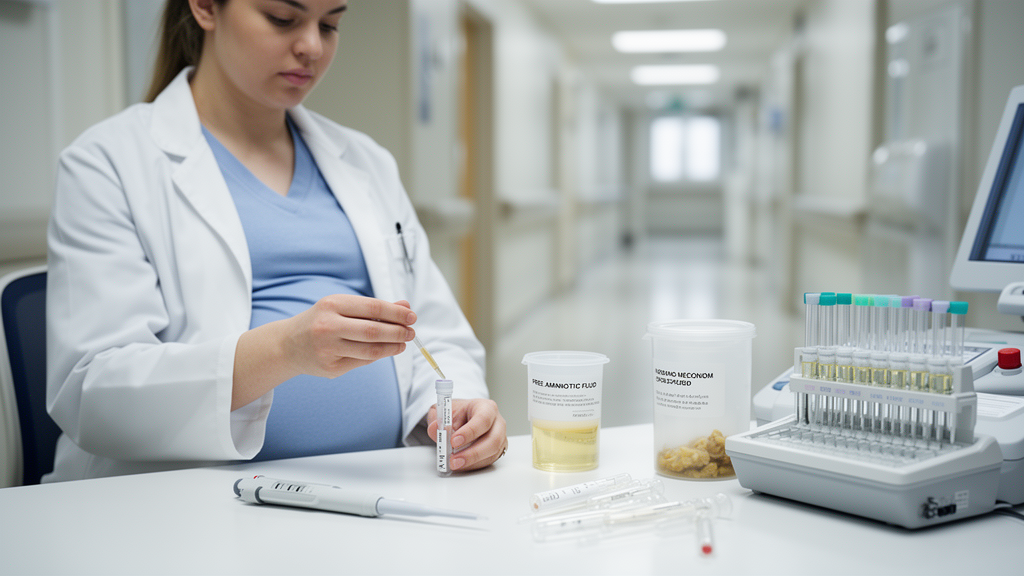
A paired observational analysis of maternal saliva, amniotic fluid and neonatal meconium found distinct microbial patterns associated with gestational diabetes mellitus, hypertensive disorders of pregnancy and fetal macrosomia. Researchers at the Affiliated Hospital of Qingdao University in China analyzed 162 samples from 54 mother–neonate pairs using 16S rRNA gene sequencing. The findings identify candidate microbial signatures for further study, rather than demonstrating that microbes cause the complications or can be used clinically.
The participants were divided into four mutually exclusive groups: 20 normal controls, 18 with gestational diabetes mellitus, six with fetal macrosomia and 10 with hypertensive disorders of pregnancy. The study primarily enrolled women with singleton pregnancies between 20 and 40 years of age. All newborns were delivered by cesarean section, and all mothers received cefazolin for infection prophylaxis.
Maternal saliva was collected within 24 hours before delivery, amniotic fluid was aspirated before membrane rupture during elective cesarean delivery, and the first neonatal meconium was collected after birth. The samples were stored at minus 80 degrees Celsius before investigators extracted DNA, amplified the variable V3–V4 region of the bacterial 16S rRNA gene and performed paired-end sequencing. The comparison group established a markedly site-specific baseline.
Meconium communities were clearly distinct from saliva and amniotic fluid communities in principal-coordinate analysis, while saliva and amniotic fluid partially overlapped. Meconium had greater microbial richness and contained the largest number of unique taxa. Its composition was dominated by Firmicutes and Proteobacteria, whereas saliva and amniotic fluid contained relatively similar proportions of Actinobacteria, Bacteroidota and Firmicutes.
At the genus level, Fusobacterium, Haemophilus, Prevotella_7 and Solobacterium were more abundant in saliva than in amniotic fluid or meconium. These observations indicate that the three sites contain partly distinct ecological communities, but the taxonomic analysis cannot determine the direction or timing of microbial movement between them. Neonatal meconium showed several complication-associated differences.
Microbial richness was significantly lower in the hypertensive-disorder and fetal-macrosomia groups than in controls, while gestational diabetes was associated with a downward trend that did not reach statistical significance. Meconium from hypertensive-disorder pregnancies contained significantly higher relative abundances of Klebsiella, Enterobacter and Sphingomonas than control meconium, with reported p-values below 0.001. In the fetal-macrosomia group, Staphylococcus and Methyloversatilis had higher relative abundances, and Prevotellaceae was significantly elevated.
Gestational diabetes was associated with increased relative abundances of Bergeyella, Helicobacter, Mycobacterium and Streptomyces, along with higher Bifidobacterium and Staphylococcus and lower Pseudomonas than in controls. These were group comparisons, not measurements of diagnostic accuracy. Amniotic fluid also carried signatures that differed by complication.
Emticicia was significantly more abundant in the hypertensive-disorder group than in controls. Fetal macrosomia was associated with increased Erysipelatoclostridiaceae, and LEfSe analysis identified Comamonadaceae as a differential taxon for that group. In gestational diabetes, Acinetobacter and Lactobacillus iners were enriched according to LEfSe analysis.
The investigators regarded these findings as evidence that the intrauterine microbial environment may differ among the complication groups. However, the study did not determine whether the organisms preceded the condition, arose in response to maternal or fetal changes, or reflected other clinical factors. Maternal saliva contained a broadly similar core community in all four groups, dominated by Veillonella, Neisseria, Prevotella_7, Haemophilus, Alloprevotella and Streptococcus.
Despite that similarity, individual taxa differed. Hypertensive disorders were associated with increased Desulfomicrobium, Novosphingobium and Lachnospiraceae, while LEfSe analysis identified enrichment of Neisseria and Neisseria sicca. Fetal macrosomia was associated with higher Streptococcus, Rothia and Parvimonas and enrichment of Alloprevotella_ravazai.
Gestational diabetes was associated with increased Lactococcus and Arthrobacter. A separate multi-site comparison identified Rothia mucilaginosa as enriched in hypertensive-disorder saliva and Neisseria sicca in gestational-diabetes saliva, illustrating that results varied with the statistical method and taxonomic level used. Shared organisms followed different abundance patterns across the three sampling sites.
In the hypertensive-disorder group, Prevotella, Neisseria, Haemophilus and Streptococcus were most abundant in saliva, less abundant in amniotic fluid and remained relatively high in meconium, creating a continuous cross-site gradient. Fetal macrosomia showed a similar pattern for Prevotella_7, Haemophilus and Streptococcus. Fusobacterium was moderately abundant in amniotic fluid and more abundant in meconium, while Paucibacter was scarce in amniotic fluid but enriched in meconium; the authors described the latter pattern as potentially consistent with maternal contact during delivery.
In gestational diabetes, Streptococcus, Prevotella and Fusobacterium followed similar saliva-to-meconium gradients, whereas Veillonella was low in amniotic fluid and rebounded in meconium. These patterns are compatible with cross-site concordance, but do not by themselves prove microbial transfer. The number of genera shared across saliva, amniotic fluid and meconium differed among the complication groups: 142 in hypertensive disorders, 62 in fetal macrosomia and 217 in gestational diabetes.
The investigators interpreted the larger overlap in gestational diabetes as compatible with more extensive cross-site concordance. In principal-coordinate analysis for the complication groups, saliva separated from both amniotic fluid and meconium, while amniotic fluid and meconium partially overlapped, suggesting a closer compositional association between the intrauterine environment and neonatal gut than between saliva and those sites. Because the analysis measured taxonomic sharing and relative abundance rather than strain identity, it could not distinguish prenatal exposure, delivery-associated transfer, subsequent colonization or contamination.
Several taxa were also associated with clinical measurements. In saliva, Rothia was positively correlated with triglycerides, Neisseria with glycated hemoglobin and Actinomyces negatively with triglycerides. In amniotic fluid, Pseudomonas was positively correlated with lactate dehydrogenase, Marinobacter with diastolic blood pressure and Bacillus with urinary protein levels.
In meconium, Methyloversatilis was positively correlated with pre-pregnancy body mass index, Klebsiella with diabetic status and Staphylococcus with neonatal birth weight, while Sedimenticola was negatively correlated with gestational age at delivery. All reported correlations met a p-value threshold below 0.05. They are associations within a small dataset and do not show that microbial abundance can predict birth weight, diabetes, hypertension or other clinical outcomes.
Important limitations constrain the findings. The fetal-macrosomia group included only six mother–neonate pairs, reducing statistical power and making subgroup estimates unstable. Dietary intake and other clinical characteristics were not systematically collected or incorporated as covariates, so their influence could not be excluded.
The researchers also note the limited taxonomic resolution of 16S rRNA sequencing, which generally cannot distinguish strains or demonstrate strain-level transfer and colonization. Amniotic fluid is a low-biomass sample, and extraction blanks were not systematically included; total bacterial load was also not quantified independently of amplicon sequencing, complicating interpretation. The uniform use of cesarean delivery and cefazolin further limits generalizability to different delivery methods and antibiotic exposures.
Larger longitudinal studies using multivariable models, absolute microbial quantification, additional contamination controls and strain-resolved metagenomics are needed to validate the reported associations before they can support early-warning or risk-assessment applications.
Subject of Research: Microbial patterns across maternal saliva, amniotic fluid and neonatal meconium in three pregnancy complications
Article Title: Complication-specific microbial signatures in gestational diabetes mellitus, hypertensive disorders of pregnancy, and fetal macrosomia: a multi-site analysis of the maternal saliva–amniotic fluid–neonatal meconium continuum
Article References: Li, Y., Qiao, B., Ma, C., Li, C., Meng, Q., Cheng, M., & Li, C. (2026). Complication-specific microbial signatures in gestational diabetes mellitus, hypertensive disorders of pregnancy, and fetal macrosomia: a multi-site analysis of the maternal saliva–amniotic fluid–neonatal meconium continuum. Frontiers in Nutrition, 13, Article 1961007. https://doi.org/10.3389/fnut.2026.1961007
Image Credits: AI Generated
DOI: 10.3389/fnut.2026.1961007
Keywords: gestational diabetes, hypertensive disorders of pregnancy, fetal macrosomia, maternal saliva, amniotic fluid, neonatal meconium, maternal–infant microbiome, 16S rRNA sequencing, cross-site concordance, microbial signatures, Complication-specific, microbial
Cite Scienmag News
Harold Sullivan. (October 21, 2026). Research report: Complication-specific microbial signatures in gestational diabetes mellitus, hypertensive disorders of pregnancy, and fetal macrosomia: a multi-site analysis of the maternal saliva–amniotic fluid–neonatal meconium continuum. Scienmag. https://scienmag.com/research-report-complication-specific-microbial-signatures-in-gestational-diabetes-mellitus-hypertensive-disorders-of-pregnancy-and-fetal-macrosomia-a-multi-site-analysis-of-the-maternal-saliva/
Harold Sullivan. "Research report: Complication-specific microbial signatures in gestational diabetes mellitus, hypertensive disorders of pregnancy, and fetal macrosomia: a multi-site analysis of the maternal saliva–amniotic fluid–neonatal meconium continuum." Scienmag, 21 October 2026, https://scienmag.com/research-report-complication-specific-microbial-signatures-in-gestational-diabetes-mellitus-hypertensive-disorders-of-pregnancy-and-fetal-macrosomia-a-multi-site-analysis-of-the-maternal-saliva/. Accessed 21 October 2026.
Harold Sullivan. "Research report: Complication-specific microbial signatures in gestational diabetes mellitus, hypertensive disorders of pregnancy, and fetal macrosomia: a multi-site analysis of the maternal saliva–amniotic fluid–neonatal meconium continuum." Scienmag. October 21, 2026. https://scienmag.com/research-report-complication-specific-microbial-signatures-in-gestational-diabetes-mellitus-hypertensive-disorders-of-pregnancy-and-fetal-macrosomia-a-multi-site-analysis-of-the-maternal-saliva/


