

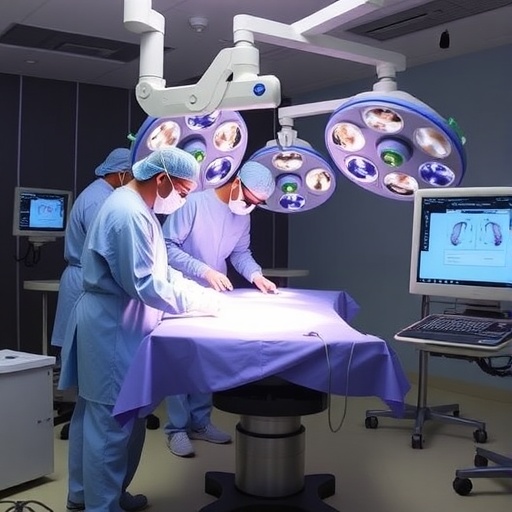
In a landmark recognition that signals a new chapter for robotic surgery, Korea University Anam Hospital’s Department of Urology has been named an official “Epicenter” by Intuitive Surgical, the American corporation behind the da Vinci surgical systems. Far from a mere honorary title, the Epicenter designation is reserved for a handful of global institutions that demonstrate not only exceptional surgical volumes and outcomes but also a commitment to reshaping how surgeons are trained in the age of intelligent machines. The hospital earned the status after a rigorous evaluation by Intuitive’s global headquarters, becoming a hub from which robotic surgical expertise will radiate across Asia and beyond.
Central to this achievement is the hospital’s early adoption of the da Vinci 5, the latest generation of the robotic platform. Korea University Anam Hospital was the first in Asia to install the system, which introduces several technological leaps over its predecessors. Most notably, da Vinci 5 integrates Force Feedback technology, a long-awaited feature that transmits subtle tactile sensations back to the surgeon’s hands. In earlier systems, surgeons operated entirely by visual cues, unable to feel the tension of sutures or the resistance of tissue. The new system uses sensor arrays and advanced algorithms to recreate haptic feedback with enough fidelity that a surgeon can sense the difference between a delicate vessel and a fibrotic margin, reducing the risk of inadvertent injury and improving the precision of tasks like nerve-sparing dissection.
The Epicenter model hinges on a digital ecosystem called the Intuitive Hub, a secure, cloud-connected platform that transforms an operating room into a globally accessible classroom. Through this portal, surgeons at Korea University Anam Hospital can livestream procedures in ultra-high definition to observers anywhere in the world, annotate video feeds in real time, and archive every movement of the robotic instruments for later analysis. In early 2025, the team pushed these capabilities to a milestone: the world’s first international live broadcast of a robotic prostatectomy performed with the da Vinci 5. During the event, surgeons in multiple countries watched as the Korean team executed a retrograde nerve-sparing radical prostatectomy, narrating decision points and demonstrating how the new force-sensing instruments allowed them to preserve the neurovascular bundles critical for postoperative urinary and sexual function.
Beyond broadcasting, the hospital has pioneered a practice called teleproctoring, widely considered a precursor to true remote surgery. Teleproctoring allows an expert surgeon to observe a procedure from a distant location and provide guidance by drawing on the video feed or controlling a pointer within the robotic console’s viewfinder. Unlike telesurgery, where a remote surgeon physically manipulates instruments—a feat still constrained by latency and regulatory barriers—teleproctoring works within current network capabilities and offers immediate educational value. Korea University Anam Hospital has used the method to mentor physicians in Asia and Europe through complex operations such as totally intracorporeal urinary diversion for bladder cancer, a demanding reconstruction that requires fashioning a new bladder entirely inside the body without large incisions.
The hospital’s clinical portfolio underpins its educational authority. Surgeons have performed more than 3,000 robotic-assisted procedures, spanning not just prostate and bladder cancers but also partial nephrectomies for kidney malignancies, where the goal is to excise a tumor while preserving as much of the healthy kidney as possible. In such cases, the integration of Case Insights, a da Vinci 5 analytics tool, helps teams review objective performance metrics—instrument speeds, force application, and economy of motion—and correlate them with patient recovery data. This feedback loop allows the institution to gradually standardize techniques that were once considered an art form, building a training curriculum that can be shared with novice robotic surgeons worldwide through the Epicenter network.
The designation also validates a year-long period in which Anam Hospital operated as an Observation Center, methodically collecting insights from visiting surgeons and funneling them back to Intuitive Surgical. That feedback has already influenced the company’s educational modules, particularly around the standardization of steps in robotic prostate and bladder surgery. By codifying what leading surgeons do intuitively, and then testing these steps across diverse healthcare settings, the Epicenter program is effectively industrializing surgical education in a way that could narrow the gap between elite academic centers and community hospitals.
A crucial frontier is simulation-based training using the SimNow platform integrated into the da Vinci 5 console. Before ever touching a patient, a trainee can practice skills such as needle driving, energy instrument handling, and vascular dissection in a physics-based virtual environment that monitors performance across dozens of parameters. The software adapts the difficulty based on the user’s progress and can even recreate rare intraoperative emergencies, such as sudden bleeding from a renal artery branch, so that surgeons develop reflexive composure. Korea University Anam Hospital plans to combine SimNow training with live case observation, creating a blended curriculum that accelerates the learning curve for international fellows.
Seung-beom Han, President of Korea University Anam Hospital, described the Epicenter designation as a recognition of the institution’s dual identity: a provider of safe, precise patient care and a global classroom. Sung Gu Kang, Chair of the Department of Urology and Director of the Robotic Surgery Center, emphasized that the honor was “particularly significant because it was awarded by Intuitive’s global headquarters through a rigorous evaluation process.” He noted that the department’s case range—from pyeloplasty for congenital ureteric obstructions to benign prostatic hyperplasia surgery—demonstrates the versatility required to serve as a benchmark for robotic programs worldwide. As the Epicenter network expands, the operating theaters in Seoul may soon become a familiar backdrop for a new generation of surgeons learning to meld human judgment with machine precision.
Subject of Research: Robotic-assisted surgery training and technology transfer using the da Vinci 5 surgical system
Article Title: Seoul Hospital Becomes Global Epicenter for Robotic Surgery Education
News Publication Date: Not specified in source
Web References: https://mediasvc.eurekalert.org/Api/v1/Multimedia/7b7b9a78-b990-4260-995c-a19542297a4e/Rendition/low-res/Content/Public
References: None provided
Image Credits: KU Medicine
Keywords: robotic surgery, da Vinci 5, Force Feedback, teleproctoring, surgical education, prostatectomy, urology, Intuitive Surgical, Epicenter, nerve-sparing, Case Insights, SimNow


