


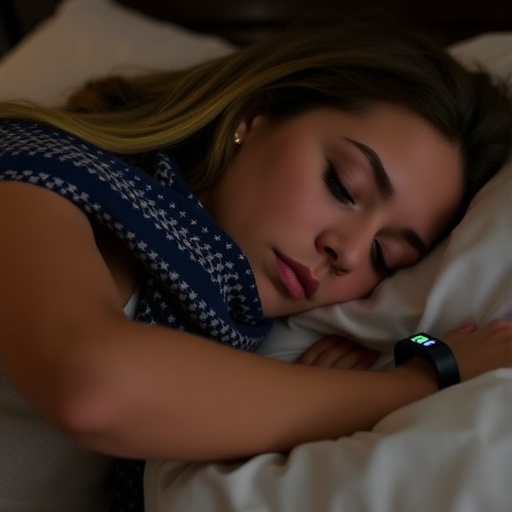
A groundbreaking new study published in PLOS One offers a comprehensive, data-driven look at how sleep patterns evolve over an entire college career and how these patterns interrelate with academic performance and social dynamics. By harnessing wearable technology and advanced functional data analysis (FDA) methods, researchers have illuminated the intricate, dynamic nature of sleep behaviors among undergraduate students, providing novel insights with profound implications for health and education.
Sleep is universally recognized as a cornerstone of human health, critical not only for physical restoration but also for cognitive processes such as learning, memory consolidation, and decision-making. Yet despite its importance, sleep patterns among college students—a demographic facing unique stresses and schedules—remain understudied, particularly over longer timescales. Prior investigations often relied heavily on retrospective self-reporting, susceptible to recall biases and insufficient detail. This new study breaks fresh ground by leveraging objective, longitudinal data from wearable devices.
The research team, led by Yao Zhao at Temple University, analyzed more than 61,000 nights of sleep data collected between 2015 and 2019 from Fitbit devices worn continuously by 76 undergraduates at the University of Notre Dame. This extensive dataset allowed for unprecedented granularity in observing sleep duration, timing, and variability across the entirety of the students’ collegiate journey—from freshman to senior year. Such continuous passively collected data represents a crucial advance over traditional survey-based approaches.
A key methodological innovation of the study was the use of functional data analysis (FDA), an approach particularly well-suited to modeling complex, time-varying phenomena like sleep. Unlike conventional statistical methods that segment data into discrete intervals, FDA treats sleep metrics as continuous functions over time. This enables preservation of the rich temporal structure intrinsic to sleep behaviors, accounts for the irregular timing of measurements typical of wearable data, and facilitates nuanced modeling of dynamic relationships, such as how academic pressures induce fluctuations in sleep.
The results reveal subtle but meaningful shifts in sleep patterns throughout college. On average, students’ nightly sleep duration increased by approximately 8 minutes when comparing freshman and senior years, a trend that runs counter to common assumptions that sleep worsens as academic demands escalate. Furthermore, a remarkably stable positive association emerged between sleep quantity and academic achievement: students maintaining higher GPAs consistently obtained longer sleep durations across all four years.
This robust link suggests that adequate sleep is not merely a correlate but potentially a contributing factor to sustained academic success. It calls attention to the importance of promoting healthy sleep habits as part of educational support systems, challenging the prevailing culture that implicitly condones sleep deprivation as part of college life. The findings underscore that prioritizing sleep could be a strategic leverage point to enhance cognitive functioning and academic outcomes.
Yet, the study also documented marked seasonal fluctuations tied closely to the academic calendar, with sleep duration typically dipping during periods of heightened academic stress such as midterms and finals. These cyclical changes highlight the ongoing tension students face as they negotiate competing demands on their time and energy, and the physiological costs incurred during peak pressure periods. Such temporal patterns underscore the value of continuously monitoring sleep to identify windows of vulnerability.
Despite its pioneering scope, the research faced limitations. The sample size was relatively small and drawn from a single, selective university context, potentially restricting generalizability. The investigation did not incorporate confounding variables like mental health status, alcohol consumption, or course difficulty—factors known to influence sleep and academic performance. Participant attrition also reduced longitudinal coverage. The authors emphasize the need for replication across diverse populations and integration of multifactorial models to deepen understanding.
In advancing the use of FDA for sleep research, this study charts a promising path forward for chronobiology and behavioral health sciences. By capturing the continuous ebb and flow of sleep behaviors at scale and resolution previously unattainable, FDA empowers researchers to map individual and collective sleep trajectories, interrogate causal pathways, and design interventions with precise temporal targeting. This methodological framework can be extended to other populations and health outcomes reliant on longitudinal patterns.
The implications for public health and higher education policy are compelling. These findings advocate for institutional efforts to foster environments conducive to adequate sleep, such as reconsidering scheduling practices, enhancing time management resources, and integrating sleep education into orientation and wellness programs. Recognizing sleep as integral to cognitive performance reframes it from a personal lifestyle choice to a communal priority.
As wearable technologies and real-time monitoring become increasingly ubiquitous, large-scale, longitudinal datasets coupled with advanced analytical tools like FDA will revolutionize our understanding of human behavior and its context-dependent variability. This study exemplifies how technology-driven insights can inform evidence-based strategies to optimize sleep, academic success, and well-being, particularly during pivotal developmental phases such as college.
In sum, Zhao and colleagues’ investigation offers a rare, nuanced portrait of how collegiate sleep evolves dynamically over time and interlocks with academic trajectories. It delivers a compelling argument for reexamining attitudes toward sleep within academic ecosystems and harnesses cutting-edge statistical techniques to unlock the hidden rhythms of student life. The integration of wearable data and FDA constitutes an invaluable advance, poised to reshape future research and intervention design in sleep science and education.
News Publication Date: 1-Jul-2026
Web References: http://dx.doi.org/10.1371/journal.pone.0351120
References: Zhao Y, Zhou H (2026) Functional data analysis of college students’ sleep patterns and their relationships with academic performance and social networks: A four-year longitudinal study. PLoS One 21(7): e0351120.
Cite Scienmag News
Courtney Benton. (July 1, 2026). Wearable Devices Reveal New Insights into College Students’ Sleep Patterns. Scienmag. https://scienmag.com/wearable-devices-reveal-new-insights-into-college-students-sleep-patterns/
Courtney Benton. "Wearable Devices Reveal New Insights into College Students’ Sleep Patterns." Scienmag, 1 July 2026, https://scienmag.com/wearable-devices-reveal-new-insights-into-college-students-sleep-patterns/. Accessed 3 September 2026.
Courtney Benton. "Wearable Devices Reveal New Insights into College Students’ Sleep Patterns." Scienmag. July 1, 2026. https://scienmag.com/wearable-devices-reveal-new-insights-into-college-students-sleep-patterns/


