


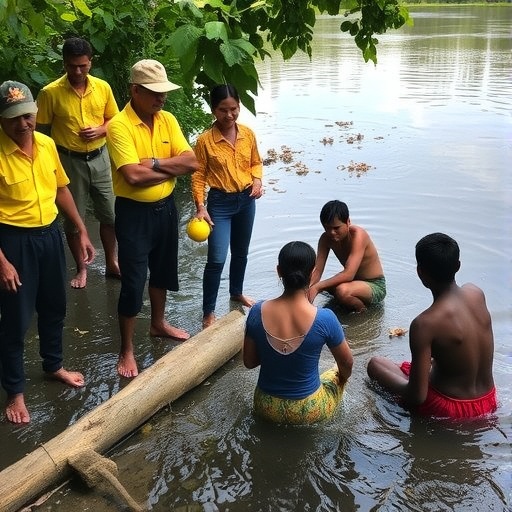
For decades, the default prescription for environmental problems has been the same: inform the public, and behavior will follow. A new study from Thailand’s most important river system suggests that prescription may be exactly backwards. Surveying 420 households along the Chao Phraya River, researchers found that the single strongest predictor of water conservation behavior is not how much environmental information people absorb, but how deeply they believe in indigenous water wisdom. More striking still, greater exposure to information through television and social media platforms such as Facebook and Line was associated with lower endorsement of conservation strategies—a counterintuitive result that strikes at the heart of the modern assumption that awareness campaigns change minds. The study, published in the open-access journal Environmental Challenges by Wanjai Lamprom, Surasak Jotaworn, and Areewan Hussadin, offers one of the first integrated quantitative portraits of what actually moves riverine communities to protect the water they live beside. The answer, emphatically, is local—and it is old.
The stakes could hardly be higher. The Chao Phraya River Basin is Thailand’s largest and most socio-economically significant watershed, underpinning agricultural production, urban development, and the livelihoods of millions, yet it faces mounting pressure from water pollution, ecosystem degradation, and rapid social and economic change. Like freshwater systems worldwide, it is squeezed by climate change, industrialization, and intensifying agriculture—pressures that persist despite decades of investment in water infrastructure and top-down regulation. International frameworks such as Sustainable Development Goal 6 now explicitly call for integrated, inclusive, and participatory governance that brings local stakeholders into conservation and decision-making, on the recognition that riverine communities are not passive beneficiaries but primary users and frontline stewards of water resources. Thailand has internalized this shift, elevating sustainable water management to a national priority in its 20-Year National Strategy (2018–2037) and its National Water Resources Management Master Plan. What has been missing is quantitative evidence about which factors turn that policy vision into behavior on the ground.
To find that evidence, the research team turned to Ang Thong Province, an agricultural landscape of historical importance where settlements, rice fields, and livelihoods cluster tightly along the river and its tributaries. The study employed a quantitative cross-sectional explanatory design, drawing from a sampling frame of 21,009 households across three municipalities: Pa Mok Subdistrict Municipality, Chaiyo Subdistrict Municipality, and Ang Thong Town Municipality. The required sample size was calculated with Yamane’s formula, n = N/(1 + Ne²), where N is the population size and e the acceptable sampling error, set at 0.05, yielding a minimum of 396 respondents. The team surveyed 420 households, allocated proportionally to population size—61.4 percent from Ang Thong Town, 20.7 percent from Chaiyo, and 17.9 percent from Pa Mok—through face-to-face structured questionnaires administered to one representative per household. Participants had to be at least 18 years old and live along the Chao Phraya, ensuring direct experience with the river’s use and conservation.
The questionnaire was engineered to exacting psychometric standards. It contained six sections covering socio-demographic characteristics, knowledge and understanding of water conservation, information exposure, attitudes toward indigenous knowledge and water conservation, the presence of local indigenous knowledge practices, and water resource conservation behavior. Three experts in environmental management, water resource conservation, and social science methodology rated every item with the Index of Item-Objective Congruence, keeping only items scoring 0.50 or higher, and the instrument was pilot-tested with 30 respondents outside the main sample. Internal consistency, assessed with Cronbach’s alpha, reached 0.940 for the questionnaire overall, with construct values ranging from 0.659 for the knowledge scale—judged acceptable for exploratory research—to 0.984 for the behavior scale. Conservation behavior was operationalized as respondents’ orientation toward and endorsement of 20 community-based strategies, each rated on a five-point appropriateness scale from 0 (“not appropriate”) to 4 (“most appropriate”), while attitudes were captured on a five-point agreement scale, with negatively worded items reverse-coded before analysis.
Before any coefficients were computed, the team verified the assumptions of multiple linear regression, confirming with tolerance values above 0.20 and variance inflation factors below 5.0 that multicollinearity posed no threat to the model. Then came the results—and one variable towered over the rest. Attitudes toward indigenous knowledge and water conservation produced a standardized regression coefficient—beta—of 0.724 (t = 22.486, p < 0.001), meaning that a one-standard-deviation increase in positive attitudes was associated with a 0.724-standard-deviation rise in conservation endorsement when every other factor was held constant. For context, standardized betas above 0.3 are routinely considered strong in social science. Knowledge of water conservation contributed positively but modestly (B = 0.470, beta = 0.084, p = 0.011). Information exposure, by contrast, carried a significant negative coefficient (B = −0.078, beta = −0.121, p = 0.001), and length of residence also predicted slightly lower endorsement (p = 0.045). Gender, age, education, household size, and household income showed no statistically significant associations at the 0.05 level.
The negative signal for information exposure is the study’s most provocative finding. Respondents encountered water-related content primarily through interpersonal channels—community leaders, relatives, and neighbors—alongside Facebook, Line, and TikTok, with television remaining the most heavily used mass medium. Yet greater exposure tracked with weaker endorsement of conservation strategies. Cross-sectional data establish association, not causation, but prior literature offers a plausible mechanism. The effectiveness of environmental communication, the authors note, depends less on the quantity of information than on message quality, source credibility, local relevance, and the capacity to trigger practical action. Generic messaging, however abundant, may be passively consumed and instantly forgotten—or may substitute for action, allowing people to feel informed without ever acting, a phenomenon sometimes labeled slacktivism. It is also possible that the most committed stewards simply spend less time in digital feeds and more time on the riverbanks, in water user groups and village committees. Whatever the precise mechanism, the message for campaign designers is uncomfortable: reach is not engagement, and volume is not persuasion.
The survey also mapped, in unusual detail, what riverine residents actually know. Presented with twenty statements blending established science and local wisdom, respondents performed strongly on traditional practice: 94.5 percent correctly identified that vetiver grass, bamboo, and riparian vegetation reduce riverbank erosion; 91.9 percent knew that the celebrated “Kaem Ling”—the “monkey cheeks” water retention approach used in the Chao Phraya Basin—helps store water during the dry season; and around 90 percent recognized community water banking systems and the role of native riparian plants in filtering sediments and nutrients. Understanding of the Chaipattana Aerator’s role in raising dissolved oxygen reached 83.6 percent. But technical and adaptive gaps emerged. Only 47.1 percent knew that groundwater and surface water are interconnected in the basin; just 43.6 percent recognized that effective indigenous knowledge must adapt to climate change rather than remain frozen; and only 42.6 percent understood that flash floods are shaped by land-use patterns rather than rainfall alone. Even cultural knowledge had holes: while 62.4 percent correctly affirmed that river rituals and boat races do play a role in conservation, more than a third missed it.
Practice on the ground tracked knowledge closely. Household wastewater recycling for gardening and cleaning was the most prevalent indigenous practice, reported by 81.0 percent of households, followed by seasonal fishing restrictions timed to spawning cycles (71.9 percent) and annual maintenance plans for small dams and sluice gates (66.7 percent). The use of biological microorganisms for localized water treatment under technical guidance (64.3 percent), management of water hyacinths for compost and community products (57.1 percent), and fish conservation zones established with temples (55.0 percent) rounded out the middle tier. More institutionalized and ecosystem-based measures were conspicuously rarer: forest ordination ceremonies (19.0 percent), biological water-quality monitoring (27.4 percent), community fish banks (30.7 percent), and constructed wetlands at wastewater collection points (32.1 percent). When respondents rated the twenty proposed conservation strategies, the overall mean was 3.19 out of 4.00, with more than 78 percent rating every strategy as appropriate or most appropriate. A participatory flood and drought preparedness plan topped the rankings at 3.31, followed by community water quality surveillance (3.28) and the development of emerging local leaders (3.27); an open water-data platform ranked lowest at 3.03.
The demographic texture of the sample helps explain the pattern. Nearly 44 percent of respondents were aged 61 or older, 59.5 percent were women, and 74.4 percent had been born in the area, with an average length of residence of roughly 37 years—an established population with deep personal histories along the river. Most participants were household heads or their spouses, directly involved in family and community decision-making, and 81 percent reported sufficient household income. Yet in the regression, neither income nor education predicted conservation endorsement, suggesting the behavior is not a luxury of wealth or schooling but something transmitted through culture and community. Social participation told its own story: involvement in water user groups, village health volunteering, and elderly clubs provided exactly the dense local networks that Social Network Theory identifies as conduits for norms, trust, and collective action. By folding the Theory of Planned Behavior, Social Network Theory, and indigenous knowledge scholarship into one regression, the study mends a literature that has long examined these forces in isolation.
For policymakers, the implications are concrete. The authors argue that water governance strategies should embed indigenous knowledge within formal management systems, cultivate emerging community leaders, and design communication that pairs the credibility of local messengers—monks, teachers, village broadcasters—with digital tools rather than relying on either alone. The documented knowledge gaps point to clear targets for community education: groundwater-surface water connectivity, climate adaptation of traditional practice, and the links between land use and flooding. The study, ethically approved by Rajamangala University of Technology Thanyaburi and conducted under the Declaration of Helsinki with written informed consent from every participant, carries the standard caveats of the genre. It measures orientation and endorsement rather than directly observed behavior, and its cross-sectional design captures association, not cause—only longitudinal follow-up can test whether strengthening attitudes toward indigenous knowledge actually raises conservation action over time. But the headline finding is hard to dismiss. Along the Chao Phraya, the will to protect the river appears to flow less from what scrolls across a screen than from what has been remembered, practiced, and passed down along the riverbanks for generations.
Cite Scienmag News
Margaret Porter. (August 30, 2026). Knowledge and indigenous wisdom drive water conservation in Thai river communities. Scienmag. https://scienmag.com/knowledge-and-indigenous-wisdom-drive-water-conservation-in-thai-river-communities/
Margaret Porter. "Knowledge and indigenous wisdom drive water conservation in Thai river communities." Scienmag, 30 August 2026, https://scienmag.com/knowledge-and-indigenous-wisdom-drive-water-conservation-in-thai-river-communities/. Accessed 3 September 2026.
Margaret Porter. "Knowledge and indigenous wisdom drive water conservation in Thai river communities." Scienmag. August 30, 2026. https://scienmag.com/knowledge-and-indigenous-wisdom-drive-water-conservation-in-thai-river-communities/


