


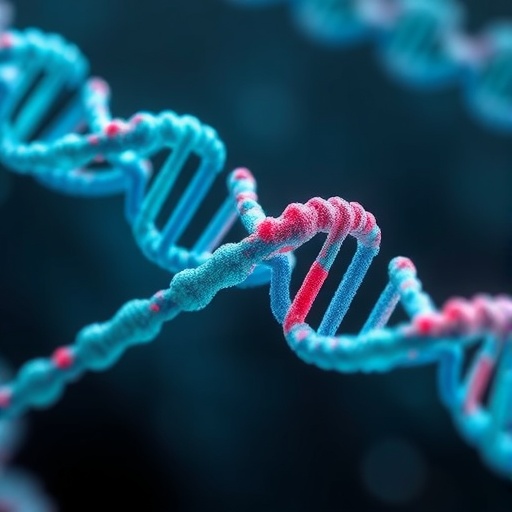
DNA, the fundamental blueprint of all living organisms, is under constant attack, sustaining tens of thousands of lesions each day. Among these various damages, apurinic/apyrimidinic (AP) sites, where the genetic information representing a single DNA base is erased, pose a significant threat to cellular health. If left unrepaired, AP sites can precipitate catastrophic outcomes such as cancer and premature aging. Yet, locating these minuscule imperfections within the expansive, intricately packed human genome resembles the near-impossible task of “finding a single needle in Seoul.”
A groundbreaking study spearheaded by a Korean research consortium, comprising scientists from KAIST, UNIST, and Sungkyunkwan University, has unveiled the sophisticated mechanism employed by a vital DNA repair enzyme known as APE1 (apurinic/apyrimidinic endonuclease 1). This enzyme is tasked with detecting and initiating repair at such lesions, thus safeguarding genomic integrity. Their remarkable discovery delineates how APE1 utilizes a refined search strategy to swiftly navigate the labyrinthine DNA environment.
Traditionally, the conceptualization of protein-DNA interactions involved random collisions and diffusive binding events. However, the K-Research team, led by Professor Gwangrog Lee, leveraged cutting-edge methodologies—single-molecule Förster resonance energy transfer (smFRET), DNA curtain technology, and molecular dynamics simulations—to observe APE1’s real-time behavior with unprecedented precision. These innovative approaches revealed that APE1 does not resort to stochastically sampling DNA sites but rather exploits a “one-dimensional diffusion” mechanism, systematically sliding along DNA strands to efficiently track down damaged loci.
This mode of operation can be analogized to an intelligent robotic inspector methodically progressing through a complex maze of subterranean pipelines to detect an elusive leak. Unlike aimless wandering, APE1’s sliding strategy optimizes its DNA surveillance, markedly accelerating lesion detection in the dense genomic landscape. This discovery redefines our understanding of DNA repair dynamics, emphasizing spatial and temporal efficiency that is critical for cellular survival.
Intriguingly, the investigative team also highlighted the pivotal contribution of APE1’s intrinsically disordered region (IDR), a protein segment characterized by structural flexibility and absence of a fixed conformation. This flexible domain acts as a molecular anchor, enabling APE1 to maintain sustained contact with the DNA strand while sliding, thus preventing premature dissociation. Experimental ablation of this domain led to a dramatic fivefold diminution in the enzyme’s lesion-finding efficacy, underscoring the IDR’s indispensable role.
Magnesium ions (Mg²⁺), commonly regarded as passive cofactors in enzymatic processes, were revealed to have a more dynamic function in facilitating DNA repair. The research team demonstrated that Mg²⁺ ions stabilize the interaction between APE1 and the DNA backbone, enhancing the enzyme’s residence time and mobility along DNA. This metal ion-coordinated synergy not only boosts sliding efficiency but poignantly integrates catalytic and search functionalities within one molecular framework.
Professor Gwangrog Lee elaborated that their findings articulate a biphasic operational strategy where the intrinsically disordered region mediates the swift detection of DNA damage, followed by the enzyme’s structured domains executing precise repair. This model provides a comprehensive framework for understanding genome surveillance at the molecular level, promising novel therapeutic avenues. The ability to disrupt APE1’s DNA recognition machinery, for instance, may pave the way for innovative anti-cancer strategies that selectively hinder DNA repair in malignant cells.
Professor Ja Yil Lee from UNIST further emphasized this research’s importance in illuminating the functional versatility of intrinsically disordered regions. Despite lacking classical folded structures, these regions can dynamically interact with diverse biomolecules, orchestrating complex molecular processes such as genome maintenance. Their study meticulously details how IDRs underpin the delicate balance between flexibility and specificity required for efficient DNA repair.
The multidisciplinary approach undertaken by this research collective—melding real-time biophysical observations with in silico molecular dynamics—exemplifies the power of integrated methodologies to unravel biomolecular mechanisms. Single-molecule FRET elucidated biomolecular conformational changes during DNA interrogation, whereas DNA curtains facilitated simultaneous tracking of multiple DNA-protein interactions, delivering statistical robustness. Computational simulations provided atomic-level insights into how structural dynamics translate into functional efficiency.
Published in the prestigious journal Nucleic Acids Research, this work not only redefines fundamental aspects of cellular maintenance but also ignites curiosity about potential manipulation of such mechanisms in precision medicine. The researchers include Dr. Donghun Lee from KAIST, PhD candidates Subin Kim from UNIST and Gyeongpil Jo from Sungkyunkwan University, among others, emphasizing international collaboration in advancing life sciences.
Funding from esteemed institutions such as KAIST’s Grand Challenge 30 Project (KC30), the National Research Foundation of Korea, the Korea Drug Development Fund, and the Institute for Basic Science substantiated the ambitious objectives of this project. The convergence of expertise across synthetic biology, computational science, and cellular biology exemplifies the future trajectory of genome research.
In sum, through elucidating how APE1’s dynamic intrinsically disordered region and metal ion cofactors synergize to expedite DNA lesion detection, this study opens new horizons in understanding genome integrity preservation. These molecular insights herald transformative potentials in combating cancer, decelerating aging, and designing advanced biomolecular sensors mimicking nature’s own efficiency.
News Publication Date: 4 June 2024
Web References:
https://doi.org/10.1093/nar/gkag479
References:
Lee, D., Kim, S., Jo, G., Kim, J., Yoo, J., Yoo, J., Lee, J.Y., Lee, G. (2024). APE1 Coordinates Its Disordered Region and Metal Cofactors to Drive Genome Surveillance. Nucleic Acids Research.
Cite Scienmag News
Nathaniel Bowman. (June 4, 2026). KAIST Uncovers Mechanism of Ultra-Fast DNA Repair: A Molecular “Needle in Seoul” Discovery. Scienmag. https://scienmag.com/kaist-uncovers-mechanism-of-ultra-fast-dna-repair-a-molecular-needle-in-seoul-discovery/
Nathaniel Bowman. "KAIST Uncovers Mechanism of Ultra-Fast DNA Repair: A Molecular “Needle in Seoul” Discovery." Scienmag, 4 June 2026, https://scienmag.com/kaist-uncovers-mechanism-of-ultra-fast-dna-repair-a-molecular-needle-in-seoul-discovery/. Accessed 3 September 2026.
Nathaniel Bowman. "KAIST Uncovers Mechanism of Ultra-Fast DNA Repair: A Molecular “Needle in Seoul” Discovery." Scienmag. June 4, 2026. https://scienmag.com/kaist-uncovers-mechanism-of-ultra-fast-dna-repair-a-molecular-needle-in-seoul-discovery/


