


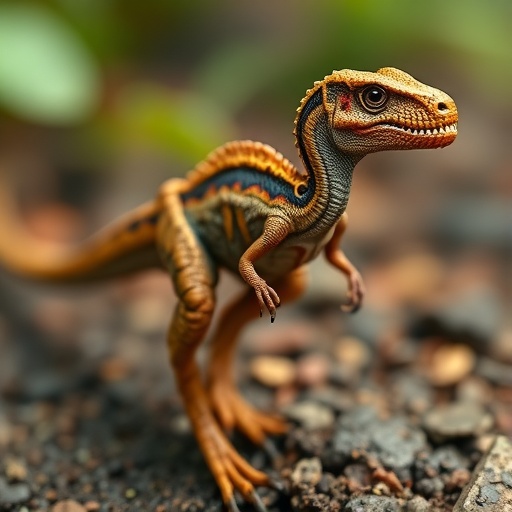
Dinosaurs are remembered as Earth’s giants: towering sauropods that outweighed dozens of elephants, and predators such as Tyrannosaurus rex that dominated ancient food webs. Yet a new study suggests that one of the most revealing questions about dinosaur evolution may concern the animals that never appeared. Despite more than 170 million years of diversification, non-avian dinosaurs seem never to have evolved into truly tiny creatures comparable to mice, shrews, sparrows, or hummingbirds. The researchers argue that this gap was probably not caused by physiology alone. Instead, competition with small-bodied mammals may have prevented dinosaurs from occupying the smallest ecological niches.
The study, published in Evolution by scientists from the American Museum of Natural History and Princeton University, examines how body size evolved across vertebrates. Body size influences nearly every aspect of an animal’s biology, including metabolism, growth rate, reproduction, movement, vulnerability to predators, and the amount of food required for survival. Using mathematical models based on energy intake and reproductive output, the researchers tested whether physiological constraints could predict the range of body sizes found in different animal groups. The models successfully reproduced the size distributions of mammals, birds, and turtles, but they failed to explain why non-avian dinosaurs remained so much larger than expected.
The smallest known non-avian dinosaurs weighed approximately 450 grams, or about one pound—roughly the size of a large rabbit. That may sound small compared with a multi-ton Apatosaurus, but it is enormous by the standards of modern vertebrate diversity. The bee hummingbird, the world’s smallest bird, weighs only about 1.75 grams, while the Etruscan shrew, the smallest living mammal, weighs approximately 1.8 grams. A dwarf gecko can weigh as little as 0.15 grams. Around 75 percent of living mammal species and 90 percent of living bird species are smaller than the smallest known non-avian dinosaur.
The apparent absence of mouse-sized dinosaurs cannot be dismissed simply as a failure of fossil preservation. Very small animals are often difficult to discover because their skeletons are fragile and easily destroyed before burial. However, many fossil deposits that preserve dinosaur remains also preserve delicate bones belonging to mammals, lizards, amphibians, and other small vertebrates. If tiny dinosaurs had occupied these environments in significant numbers, researchers would expect at least some of their fossils to appear alongside those of other small animals. The fossil record instead suggests that genuinely miniature non-avian dinosaurs were uncommon or absent.
To investigate this pattern, the researchers used models describing how natural selection might shape body size according to the efficiency with which animals acquire energy and convert it into offspring. These models account for physiological relationships such as metabolic demands, growth, and reproductive investment. In principle, a species should evolve toward body sizes that provide the greatest reproductive advantage under its environmental conditions. The fact that these models could explain the size ranges of some vertebrate groups but not dinosaurs indicates that additional forces were operating. Ecology, rather than biology’s energy budget alone, appears to have imposed a lower limit.
One likely force was competition. Early mammals had already evolved small-bodied forms by the time dinosaurs became ecologically dominant. These mammals could exploit food resources, shelter, and lifestyles that may have been difficult for dinosaurs to enter without displacing established competitors. Small animals also tend to have rapid generations, specialized diets, and the ability to live in protected spaces such as burrows or dense vegetation. In this view, mammals may have occupied the miniature-animal niches so effectively that dinosaurs were prevented from evolving into equivalent forms. Dinosaurs, in turn, appear to have restricted mammals from reaching the largest body sizes for much of the Mesozoic.
This ecological separation may help explain why body size distributions were so uneven during the age of dinosaurs. Non-avian dinosaurs occupied a vast range of sizes, from roughly rabbit-sized animals to species weighing more than 80 tons, but the lower end of that range remained surprisingly high. Predation and habitat structure may also have reinforced the pattern. Small dinosaurs could have been vulnerable to predators, while larger bodies may have provided advantages in competition, mobility, or access to food. The researchers emphasize that no single explanation has yet been proven, but their findings show that physiological models alone cannot account for the pattern.
The study also sheds light on the remarkable emergence of birds. Birds evolved from theropod dinosaurs, yet modern birds include species far smaller than any known non-avian dinosaur. The transition happened relatively rapidly after the first birds appeared during the Early Cretaceous. According to the researchers, powered flight may have changed the rules governing dinosaur body size. Flight allowed early birds to exploit aerial habitats, move through environments inaccessible to terrestrial animals, and use new food sources and nesting sites. By escaping the ecological competition that constrained ground-dwelling dinosaurs, birds may have gained the freedom to evolve miniature bodies.
The findings offer a broader lesson about evolution: the organisms present in nature are shaped not only by what their bodies can physically achieve, but also by which ecological opportunities are available. Dinosaurs were biologically capable of producing descendants that became very small, as demonstrated by birds, and their distant ancestors included small-bodied forms. Yet for most of dinosaur history, competition, predation, and habitat structure appear to have blocked that evolutionary path. Understanding why certain body sizes flourish while others remain vacant could help scientists explain the structure of modern biodiversity—and reveal that evolutionary absences can be as informative as spectacular giants.
Web References: https://doi.org/10.1093/evolut/qpag117
References: Evolution, DOI: 10.1093/evolut/qpag117
Cite Scienmag News
Gavin Prescott. (August 6, 2026). New study investigates whether tiny dinosaurs existed, challenging evolutionary assumptions. Scienmag. https://scienmag.com/new-study-investigates-whether-tiny-dinosaurs-existed-challenging-evolutionary-assumptions/
Gavin Prescott. "New study investigates whether tiny dinosaurs existed, challenging evolutionary assumptions." Scienmag, 6 August 2026, https://scienmag.com/new-study-investigates-whether-tiny-dinosaurs-existed-challenging-evolutionary-assumptions/. Accessed 4 September 2026.
Gavin Prescott. "New study investigates whether tiny dinosaurs existed, challenging evolutionary assumptions." Scienmag. August 6, 2026. https://scienmag.com/new-study-investigates-whether-tiny-dinosaurs-existed-challenging-evolutionary-assumptions/


