


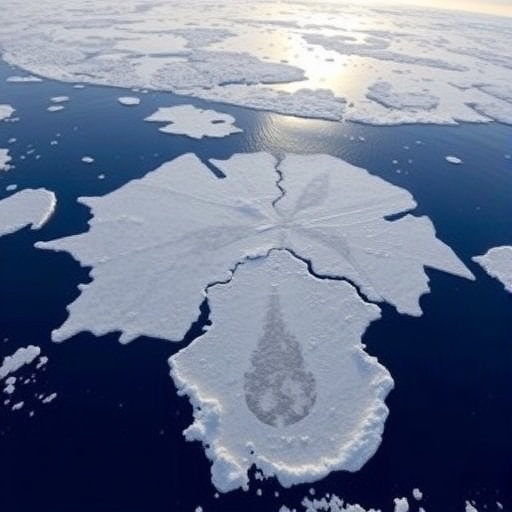
In a groundbreaking new study poised to reshape our understanding of marine ecosystems in Earth’s recent geological past, researchers have uncovered compelling evidence that fluctuations in sea ice cover during the Late Quaternary period—spanning roughly the last 2.6 million years—played a pivotal role in driving significant shifts in marine biodiversity. This meticulously detailed research, recently published in Communications Earth & Environment, highlights the profound interconnectedness between climate-driven changes in polar ice and the evolution, migration, and turnover of marine species over millennia. As global climate continues to change rapidly today, these insights from the Late Quaternary offer an urgent window into the mechanisms governing marine life responses to environmental transformations.
The Late Quaternary period is marked by cyclic glaciations and interglacials, characterized by substantial variations in sea ice extent, ocean temperatures, and sea levels. The researchers, including De Schepper, Cordier, and Skaar among their collaborators, employed multidisciplinary techniques, integrating paleoclimatology, paleoceanography, and paleobiology, to reconstruct how abrupt changes in sea ice coverage influenced marine biodiversity patterns. Using sediment cores extracted from multiple polar and subpolar margins, the team was able to detail shifts in species assemblages, extinction events, and the emergence of new ecological niches in response to sea ice dynamics.
Sea ice not only acts as a physical barrier to marine movement but also modulates light penetration, primary productivity, and nutrient cycling. As ice cover recedes and advances, it has cascading effects on marine food webs, profoundly altering habitats and resource availability. The researchers discovered that during periods of reduced sea ice extent, warmer surface waters allowed for temperate and subtropical species to penetrate polar regions previously inaccessible. Conversely, ice expansion forced cold-adapted species to retreat or face extinction. Such ecological pressures triggered rapid and sometimes dramatic changes in community composition.
One of the study’s key revelations concerns the timing and tempo of biodiversity shifts. Unlike gradual evolutionary changes, the researchers documented abrupt biological turnovers tightly linked to episodic climate events like Heinrich and Dansgaard-Oeschger events, known for their rapid temperature fluctuations. These pulses of climate variability corresponded with swift retreats or expansions of sea ice, driving commensurate responses in marine species distributions. This pattern suggests that marine ecosystems were highly sensitive to transient climate oscillations, highlighting vulnerabilities that may be mirrored in today’s warming world.
The Late Quaternary’s glacial-interglacial transitions provide a natural laboratory for understanding the interplay between ice cover and marine life. In particular, the study identifies periods when extensive sea ice loss caused a “biodiversity mixing” phenomenon, where species from different latitudes overlapped, creating complex ecological interactions. These temporary biodiversity hotspots, while rich in species, also exposed ecosystems to heightened competition, predation, and susceptibility to environmental stressors, influencing evolutionary trajectories.
Methodologically, the study leveraged advanced geochemical proxies such as foraminiferal isotopes, biomarker lipids, and sediment grain size analysis to reconstruct past sea ice conditions with unprecedented resolution. High-throughput DNA sequencing from ancient sediments further unveiled shifts in community genetic diversity, offering a molecular perspective on species turnover. This integration of paleoenvironmental data with genetic insights allowed for a nuanced interpretation of how marine organisms tracked or failed to track their optimal habitats amid changing ice regimes.
The broader implications of these findings extend beyond academic curiosity, especially in light of contemporary global warming trends. Polar sea ice is retreating at record rates, altering ocean circulation patterns and biogeochemical cycles, posing existential threats to modern marine biodiversity. By contextualizing recent observations within a deep-time framework, the researchers provide a cautionary tale: marine ecosystems have historically undergone rapid restructuring under ice cover changes, with consequences for ecosystem services and food security.
Moreover, this work underscores the importance of preserving and expanding ice-related paleoclimate archives. These records serve as invaluable benchmarks for calibrating predictive models of future biodiversity responses, enabling better-informed policy decisions regarding marine conservation. The temporal and spatial patterns documented also offer clues about potential refugia—areas where species may find sanctuary during environmental upheavals—and corridors facilitating migration, informing targeted protection efforts.
Critically, the study challenges assumptions of resilience and stability in cold marine ecosystems. While some species exhibited remarkable adaptability, others succumbed to the changing conditions, leading to local or global extinctions. This unevenness in response emphasizes the need for nuanced ecological forecasting that accounts for species-specific traits and interspecies interactions, rather than relying on broad generalizations.
Intriguingly, the research also touches on the role of sea ice as an agent of evolutionary innovation. Periods of fluctuating ice cover created dynamic environmental gradients, imposing new selective pressures that may have accelerated speciation and diversification in certain clades. This perspective aligns with contemporary evolutionary theory positing that environmental heterogeneity fosters biodiversity through diversification and niche partitioning.
The study’s robust dataset, spanning multiple ocean basins and a range of latitudes, bolsters its generalizability, moving beyond regional case studies to present a global narrative of Late Quaternary marine biodiversity dynamics. This comprehensive approach helps reconcile discrepancies in previous paleoecological reconstructions and builds a cohesive framework for understanding past and future marine biodiversity shifts.
As sea ice continues its decline due to anthropogenic climate forcing, lessons from the Late Quaternary become increasingly salient. The intricate feedbacks between ice, ocean, and life revealed in this research affirm that safeguarding marine biodiversity necessitates integrated strategies addressing climate, habitat, and species interactions concurrently. Continued interdisciplinary efforts will be essential to unravel the complexities of these systems and to anticipate marine ecosystem responses amidst unprecedented environmental change.
In conclusion, the pioneering work by De Schepper, Cordier, Skaar, and their colleagues reveals that changing sea ice cover during the Late Quaternary was a fundamental driver of marine biodiversity shifts, shaping ecological landscapes through direct and indirect mechanisms. Their findings paint a picture of a dynamic, responsive marine biosphere, deeply entwined with cryosphere fluctuations. This study not only enriches our understanding of Earth’s climatic and biological history but also provides invaluable insights for navigating the uncertain waters of future global change.
Cite Scienmag News
Violet Maxwell. (June 4, 2026). Sea Ice Changes Drove Late Quaternary Biodiversity Shifts. Scienmag. https://scienmag.com/sea-ice-changes-drove-late-quaternary-biodiversity-shifts/
Violet Maxwell. "Sea Ice Changes Drove Late Quaternary Biodiversity Shifts." Scienmag, 4 June 2026, https://scienmag.com/sea-ice-changes-drove-late-quaternary-biodiversity-shifts/. Accessed 3 September 2026.
Violet Maxwell. "Sea Ice Changes Drove Late Quaternary Biodiversity Shifts." Scienmag. June 4, 2026. https://scienmag.com/sea-ice-changes-drove-late-quaternary-biodiversity-shifts/


