


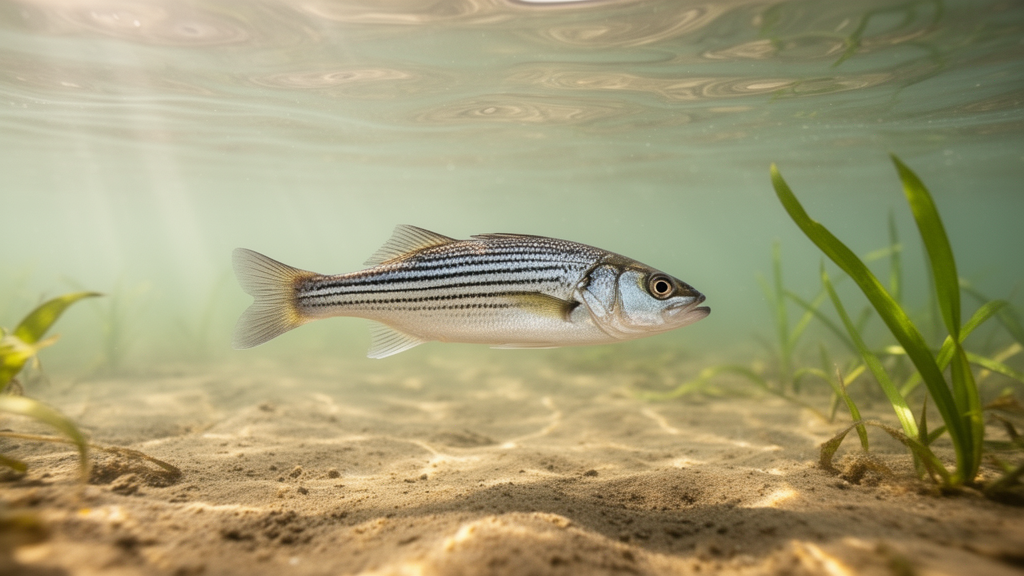
Young-of-year striped bass in the Virginia tributaries of the Chesapeake Bay posted an average year class in 2026, according to preliminary results from the Juvenile Striped Bass Seine Survey conducted by William & Mary’s Virginia Institute of Marine Science. The survey recorded a mean of 9.52 juvenile striped bass per seine haul in Virginia waters, a marked improvement over the 5.12 fish per haul documented in 2025 and closely aligned with the historical average of 7.77 fish per haul for the region. Because striped bass serve as one of the Chesapeake Bay’s most important apex predators and anchor a fishery valued by both commercial and recreational anglers, the annual index carries weight far beyond the survey beaches where it is collected. The fish hatched this spring will not reach fishable sizes for another three to four years, but their abundance today sets the trajectory of the fishery in the late 2020s.
The 2026 result fits a pattern that survey scientists have observed across more than five decades of monitoring. Years of below-average recruitment, meaning the survival of young fish into the juvenile stage, have historically been followed by years of average to above-average production. The weak year classes of 1999, 2002, 2012 and 2024 were each succeeded by stronger showings in 2000, 2003, 2013 and now 2025 and 2026. Jack Buchanan, a marine scientist at VIMS and chief scientist of the seine survey, noted that while this year’s class is considered average in terms of abundance, it represents a significant increase from 2024. He emphasized that striped bass recruitment can swing considerably from year to year, and that a single year of poor production can be partially offset by the output of the previous or following year, a dynamic that helps stabilize the overall population and the fisheries it supports.
The survey’s methodology is deliberately simple and rigorously standardized, which is what allows comparisons across 59 years of data. Scientists sample 18 index sites distributed across the Rappahannock, York and James River systems, the three major Virginia tributaries where striped bass spawn. Each site is visited five times between mid-June and early September, and on every visit researchers deploy a 100-foot seine net from the shore, drawing it through the shallow water where juvenile striped bass congregate. Captured fish are counted, measured and returned alive to the river. At this time of year, young striped bass typically measure between 1.5 and 4 inches long. In 2026, the team measured 2,648 juvenile striped bass at the Virginia index sites, a sample size large enough to characterize the year class with statistical confidence.
The Virginia survey has been run annually since 1967, when the state’s fisheries managers first recognized the need for a consistent index of spawning success. It is conducted for the Virginia Marine Resources Commission and feeds directly into coastwide stock assessments for striped bass managed along the Atlantic seaboard. Because the same sites, the same gear and the same seasonal window are used every year, the resulting index functions as a sensitive barometer of reproductive success, absorbing the noise of individual hauls and revealing the underlying signal of how many fish survived from egg to juvenile. That continuity is rare in marine science and makes the Chesapeake Bay dataset one of the longest-running juvenile fish surveys in the world.
The story of striped bass in the Chesapeake Bay is also a story of recovery, collapse and recovery again. The population fell to historic lows in the late 1970s and early 1980s, driven down by a combination of overfishing and environmental stress. In response, Delaware, Maryland and Virginia enacted fishing bans in the mid- to late-1980s, giving the species a reprieve during which spawning stocks could rebuild. The recovery was dramatic enough that by the mid-1990s striped bass in the Bay and along the Atlantic Coast were declared recovered, a milestone often cited as one of the great successes in American fisheries management. The moratorium years demonstrated that the species could rebound when given the chance, but they also set the stage for decades of heavy fishing that followed.
That renewed fishing pressure eventually caught up with the stock. Scientists determined that the striped bass population had again become overfished, with fishing-related mortality exceeding sustainable levels. The Atlantic States Marine Fisheries Commission, the interstate body that manages the species coastwide, addressed the situation in its 2024 Atlantic Striped Bass Stock Assessment Update Report, which concluded that the stock remains overfished but is no longer experiencing overfishing. In practical terms, that means the population is still below the threshold managers consider healthy, but the rate of removals has been brought down to a level that no longer prevents rebuilding.
Since 2022, a suite of management measures has been rolled out to push fishing mortality lower and rebuild the stock by 2029. Those measures include size limits on the recreational fishery, bag limits, gear restrictions and reductions in commercial quotas. Each tool targets a different segment of the fishery, and together they are designed to let more fish survive to spawning age and to give the 2025 and 2026 year classes room to grow into the breeding population. The 2026 juveniles measured this summer will begin recruiting to the recreational fishery in three to four years, meaning the success or failure of the rebuilding timeline will depend in part on how many of these fish survive their first years in the Bay.
Recruitment in striped bass is famously variable, and the reasons are complex. Young-of-year survival depends on the timing of spawning, water temperature, freshwater flows, the availability of zooplankton prey for larvae, and the abundance of predators in the nursery tributaries. Because so many factors interact, the index can swing from a few fish per haul to well over 20 in consecutive years without any change in the adult spawning stock. This is why fisheries scientists treat multi-year averages rather than single-year results as the meaningful metric, and why the alternating pattern of poor and strong year classes observed in the Virginia data is considered a normal feature of the population rather than a warning sign.
The picture across the state line is less encouraging. The Maryland Department of Natural Resources conducts a parallel seine survey in Maryland’s portion of the Chesapeake Bay, and in 2026 it recorded a below-average year class, the eighth consecutive year of below-average production in that jurisdiction. The divergence between the two states’ indices is not unusual, since the Maryland tributaries, particularly the upper Bay and the Choptank River system, respond to different environmental drivers than the Virginia rivers. Taken together, however, the two surveys provide the coastwide assessment with a Bay-wide index of spawning success, and the contrast between an average Virginia year class and a below-average Maryland one will factor into how managers weigh the strength of the overall 2026 cohort.
For now, the 2026 Virginia result offers a measure of reassurance for a fishery that has been under intense scrutiny. An average year class will not by itself rebuild the stock, but paired with the stronger 2025 class and the ongoing management restrictions, it suggests that the population is holding its ground while the rebuilding plan runs its course. Anglers, managers and scientists alike will be watching the 2027 survey to see whether the alternating pattern holds and whether the fish hatched this spring survive to bolster the spawning stock that the 2029 rebuilding deadline depends upon.
Subject of Research: Juvenile striped bass recruitment and population monitoring in the Chesapeake Bay
Article Title: Juvenile striped bass maintain average abundance in Virginia waters in 2026
Article References: Juvenile striped bass maintain average abundance in Virginia waters in 2026. Original publication (Bibliographic details unavailable.)
Image Credits: AI Generated
DOI: Not provided
Keywords: striped bass, Chesapeake Bay, Virginia Institute of Marine Science, seine survey, juvenile fish recruitment, fisheries management, Atlantic States Marine Fisheries Commission, stock assessment, year class, Maryland DNR, Juvenile, striped
Cite Scienmag News
Violet Maxwell. (October 19, 2026). Juvenile Striped Bass Hold Steady at Average Abundance in Virginia Waters for 2026. Scienmag. https://scienmag.com/juvenile-striped-bass-hold-steady-at-average-abundance-in-virginia-waters-for-2026/
Violet Maxwell. "Juvenile Striped Bass Hold Steady at Average Abundance in Virginia Waters for 2026." Scienmag, 19 October 2026, https://scienmag.com/juvenile-striped-bass-hold-steady-at-average-abundance-in-virginia-waters-for-2026/. Accessed 19 October 2026.
Violet Maxwell. "Juvenile Striped Bass Hold Steady at Average Abundance in Virginia Waters for 2026." Scienmag. October 19, 2026. https://scienmag.com/juvenile-striped-bass-hold-steady-at-average-abundance-in-virginia-waters-for-2026/


