


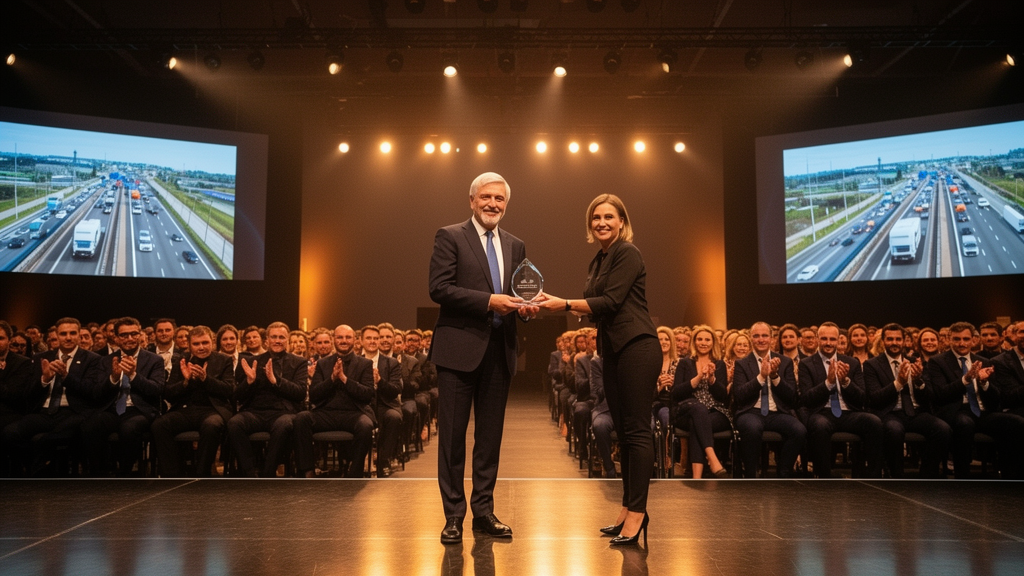
In a ceremony held on October 19, 2026, at the 32nd ITS World Congress in Gangneung, Korea, Dr. Steve Dellenback, vice president of Southwest Research Institute’s Intelligent Systems Division, received the ITS World Congress Hall of Fame’s 2026 Lifetime Achievement Award. The honor places Dellenback among a select group of luminaries recognized since the Hall of Fame was established in 2010 for individuals judged outstanding leaders within their organizations, thought leaders in the intelligent transportation systems field, and champions of the vision that connected, data-driven infrastructure can fundamentally transform how people and goods move through the world.
The ITS World Congress itself is the premier annual gathering for the intelligent transportation community, rotating its focus across the Americas, Europe, and the Asia-Pacific region and drawing together transportation agencies, researchers, and industry developers working on traffic management, advanced mobility, and transportation networks. A Lifetime Achievement Award from this body is therefore not merely a corporate accolade; it is an acknowledgment from the international ITS community that an individual’s career has shaped the technical direction of the field itself. For Dellenback, whose career spans more than four decades across systems integration, operating systems, artificial intelligence, programming languages, and project management, the recognition arrived at a moment when the technologies he helped pioneer are becoming central to transportation policy worldwide.
“It is an incredible honor to be recognized for a lifetime of work in the ITS field,” Dellenback said upon receiving the award. “I absolutely see this as recognition of the Institute and the talented staff who help develop and manage ITS software for the traveling public.” That framing, deflecting personal credit toward the institution and its engineering teams, reflects the collaborative character of a research division that today comprises approximately 250 engineers and analysts developing software, cybersecurity, artificial intelligence, and robotics and automation solutions for a broad range of industries, with transportation systems standing among its most consequential areas of focus.
Dellenback’s connection to intelligent transportation systems dates to 1993, when Southwest Research Institute began supporting the Texas Department of Transportation’s traffic management center with ITS software, an engagement that effectively founded the Institute’s ITS program. In the early 1990s, traffic management centers were just beginning to adopt computerized control systems capable of monitoring roadway conditions, coordinating signal timing, and disseminating traveler information in real time. Building software for such centers required integrating sensing infrastructure, communication networks, and decision-support tools into platforms that public agencies could operate reliably at scale, a challenge that demanded both deep systems engineering expertise and an understanding of the operational realities of state transportation departments.
Under Dellenback’s leadership over the following three decades, that initial Texas engagement grew into an internationally recognized software development enterprise. The Institute’s flagship ActiveITS platform has now been deployed by 15 state agencies across the United States, a footprint larger than that of any other transportation management system in the country. The significance of that market position extends beyond raw deployment numbers: by providing a common software architecture across so many agencies, ActiveITS creates a de facto standard for the ITS industry, allowing states to pool resources and share in the development of innovative functionality rather than duplicating effort in isolated, incompatible systems. In an industry where interoperability has historically been the exception rather than the rule, that shared-platform model represents a quiet but profound shift in how transportation technology is built and maintained.
The Institute’s recent work illustrates how that architectural foundation is being extended into new technical territory. Southwest Research Institute developed the Florida Department of Transportation’s Data Exchange Platform for Operational Technologies, known as DEPOT, a system designed to move real-time operational data between agencies and applications. DEPOT has recently been extended to other states, enabling real-time data sharing that improves safety, mobility, and efficiency across jurisdictional boundaries. The technical premise is straightforward but powerful: when a traffic incident, weather event, or roadway hazard generates data in one state’s system, that information can flow instantly into neighboring systems and third-party applications, giving drivers, fleet operators, and emergency services earlier and more accurate warnings than siloed systems could ever provide.
Beyond data exchange, the Institute has positioned itself at the intersection of automation and connectivity, two trends now reshaping transportation engineering. As a developer of automated driving systems, SwRI integrates vehicle-to-everything, or V2X, technology into a variety of ITS and safety-mobility applications. V2X allows vehicles to communicate directly with other vehicles, roadside infrastructure, and pedestrians’ devices, exchanging kinematic data and hazard alerts with latencies far below what cloud-based systems can achieve. The Institute also develops sensing technologies and automated vehicles for both on-road and off-road applications, work that spans the full technical stack from perception sensors and machine-learning algorithms to vehicle control systems and the cybersecurity measures required to protect safety-critical code from tampering.
“By working on so many different projects in the transportation and mobility space, we get to help government and industry integrate new technology into systems that benefit the public,” Dellenback said. That integration role, bridging emerging research and deployed infrastructure, is also reflected in his service on numerous boards, where he provides an experienced voice to discussions about technology integration supporting government and industry planning. He serves as the International Program Chair for ITS America and is a member of the World Congress Board of Directors, the very organization whose Hall of Fame now bears his name. He previously served on the ITS America Board of Directors for seven years, building the institutional relationships that connect national transportation policy with the international research community.
Dellenback’s advisory work has extended directly into United States federal transportation policy. He was appointed to the U.S. Department of Transportation’s Transforming Transportation Advisory Committee, where he served as chair of the AI Subcommittee from 2024 to 2025. That appointment coincided with a period of intense federal interest in how artificial intelligence should be incorporated into transportation systems, from traffic signal optimization and incident detection to the safety assurance frameworks governing automated vehicles. Chairing the AI Subcommittee placed Dellenback in a position to shape recommendations on how the Department of Transportation should evaluate, regulate, and deploy machine-learning technologies across the national transportation network, drawing on the practical experience of an organization that has been building and operating such systems for state agencies since the early 1990s.
His academic credentials trace the intellectual lineage of the field he now leads. Dellenback earned a bachelor of arts in computer science from the University of Texas and master’s and doctorate degrees in computer science from the University of Kansas, completing his formal training just as the computing revolution that would eventually enable intelligent transportation was gathering momentum. Over the following four decades, he accumulated more than 40 years of experience in systems integration, operating systems, artificial intelligence, programming languages, and project management, the core competencies that underpin every layer of modern ITS software, from the low-level operating systems running traffic management centers to the artificial intelligence algorithms now optimizing them. As the intelligent transportation community gathered in Gangneung to honor his career, the award served as a reminder that the connected, automated mobility systems now spreading across the globe rest on decades of patient engineering work, and that the individuals who built the software standards and institutional frameworks of the field deserve recognition alongside the technologies themselves. Additional information about the Institute’s intelligent transportation systems research is available at its.swri.org.
Subject of Research: Lifetime Achievement Award in intelligent transportation systems awarded to Southwest Research Institute executive Dr. Steve Dellenback
Article Title: SwRI’s Dr. Steve Dellenback wins ITS World Congress Lifetime Achievement Award
Article References: SwRI’s Dr. Steve Dellenback wins ITS World Congress Lifetime Achievement Award. Original publication (Bibliographic details unavailable.)
Image Credits: AI Generated
DOI: Not provided
Keywords: intelligent transportation systems, ITS World Congress, Southwest Research Institute, Steve Dellenback, traffic management, vehicle-to-everything, automated driving systems, ActiveITS, transportation technology, lifetime achievement award, artificial intelligence, data sharing
Cite Scienmag News
Denise Maddox. (October 19, 2026). Southwest Research Institute’s Steve Dellenback Receives ITS World Congress Lifetime Achievement Honor. Scienmag. https://scienmag.com/southwest-research-institutes-steve-dellenback-receives-its-world-congress-lifetime-achievement-honor/
Denise Maddox. "Southwest Research Institute’s Steve Dellenback Receives ITS World Congress Lifetime Achievement Honor." Scienmag, 19 October 2026, https://scienmag.com/southwest-research-institutes-steve-dellenback-receives-its-world-congress-lifetime-achievement-honor/. Accessed 19 October 2026.
Denise Maddox. "Southwest Research Institute’s Steve Dellenback Receives ITS World Congress Lifetime Achievement Honor." Scienmag. October 19, 2026. https://scienmag.com/southwest-research-institutes-steve-dellenback-receives-its-world-congress-lifetime-achievement-honor/


