


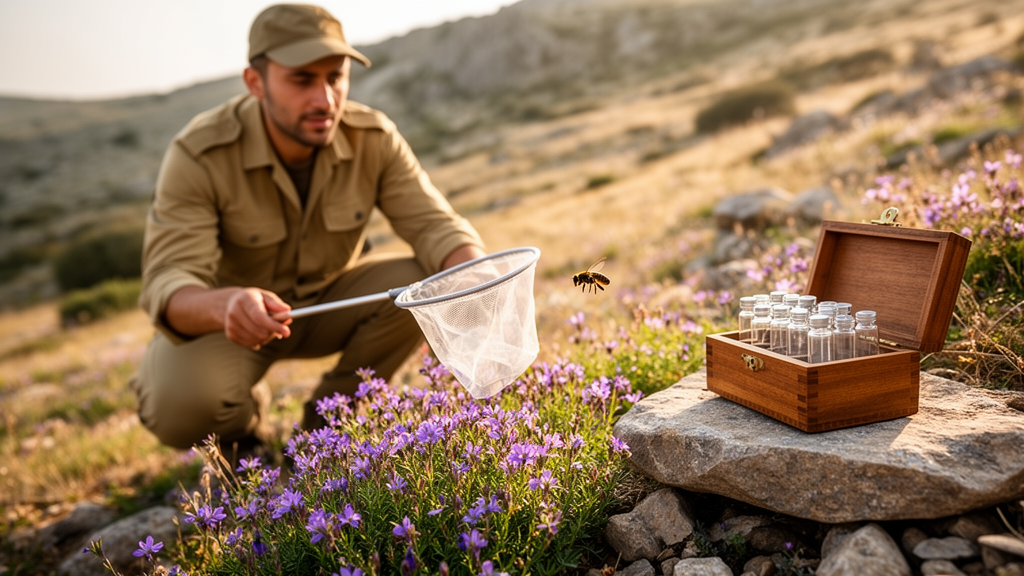
A ten-day spring expedition across southern Türkiye has yielded one of the most striking recent additions to the country’s wild bee records: 2,070 carefully pinned specimens representing 246 confidently identified species, including six species recorded for the first time from Türkiye. The findings, published in the Biodiversity Data Journal, underscore just how incomplete our knowledge remains of one of the Western Palaearctic’s richest bee faunas, even in a region that has been intensively surveyed for decades. For a country sitting at the crossroads of European and Asian faunas, the results suggest that dozens more species may still await discovery within its borders.
Türkiye hosts more than 1,800 recorded bee species, making it amongst the most diverse regions in the Western Palaearctic and a presumed centre of diversity, and possibly even a region of origin, for several bee groups. The country’s remarkable habitat diversity, spanning Mediterranean shrublands, steppes, marshes, halophilic grasslands and subalpine and alpine grasslands, combined with a high level of plant endemism, presumably supports a correspondingly high level of bee endemism. Yet despite this richness, the national fauna remains broadly incomplete, as evidenced by the dozens of species that have been described or newly reported from the country over the last years alone.
The expedition, carried out in Spring 2025, covered 42 sites distributed across southern Türkiye: 38 in the Mediterranean Region, in the provinces of Adana, Antalya, Mersin and Osmaniye, and four in the south of the Central Anatolia Region, in Karaman and Konya. Sampling sites were selected using searches in Google Maps for potential high-quality habitats, mainly sites surrounded by ample natural habitats, followed by on-site surveys to confirm the presence of sufficient floral diversity for attracting a high diversity of bees. Wild bees were collected using hand nets, with collectors prioritising species diversity by sampling on a maximum diversity of flowering plants. Sampling generally ran from 9 a.m. to 5 p.m., and specimens were killed with cyanide or ethyl acetate and pinned in collection the same day, each labelled with locality, altitude, GPS coordinates, date, collector and a unique identification code.
Species-level identification was performed in the lab by a team of 18 specialists, each responsible for particular genera or groups, including Thomas Brau for Halictus and related genera, Frédéric Carion for Nomada, Achik Dorchin for Eucera, Simone Flaminio for Lasioglossum and related genera, Guillaume Ghisbain for Bombus and Dasypoda, Michael Kuhlmann for Colletes, Andreas Müller for Chelostoma, Hoplitis and Osmia, Pierre Rasmont for Amegilla, Anthophora and related genera, Jakub Straka for Nomada and Sphecodes, Michaël Terzo for Ceratina and Xylocopa, Clément Tourbez for Megachile and related genera, and Thomas J. Wood for Andrena, Camptopoeum and Panurgus. Reference material from the collection of the Laboratory of Zoology at the University of Mons in Belgium and from each expert’s personal research collection was used to achieve the identifications. Where conflicting identifications were provided by different experts, these were specified in the identification remarks column of the dataset.
The geographical consistency of the identifications was first verified for each species using centralised resources, then additional targeted documentation was sought and a double-check of the identifications was carried out by Rémi Santerre to confirm the validity of the taxa found outside of their known range. The complete dataset covers 246 confidently identified species belonging to the six bee families present in the Palaearctic Region: Andrenidae, Apidae, Colletidae, Halictidae, Megachilidae and Melittidae. It includes another seven taxa for which the uncertain species identity is marked by the notations ‘cf.’, ‘aff.’ or ‘gr.’, indicating uncertain identification, close relationship to a mentioned species, or membership of a species-group. In addition, 112 specimens remain unidentified, representing between 27 and 42 recognisable taxonomic units, some of which may correspond to species already identified. These unidentified specimens are distributed amongst the genera Amegilla, Andrena, Anthophora, Chelostoma, Eucera, Halictus, Lasioglossum and Seladonia, with Andrena alone accounting for 26 specimens and between 10 and 23 recognisable taxonomic units.
Amongst the six species new for the fauna of Türkiye, Andrena igraeca is a recently described species whose presence in the Hatay Province was presumed due to a record in north-west Syria. It is now confirmed to occur in Türkiye by 13 specimens collected in three locations in the Nur Mountains, near to the Hatay Province, at elevations ranging from 1,346 to 1,926 metres. Anthophora dalmatica, known from south-eastern Europe and Western Asia, was represented by two males collected in a Cistus-rich shrubland near Anamur in Mersin Province. Although the boundaries of its distribution are unclear due to the unresolved taxonomy of the species-group to which it belongs, its presence in Türkiye was likely, as it occurs in the surrounding areas. Existing records of Anthophora atroalba from Türkiye might actually pertain to this species.
Anthophora subterranea, a polytypic circum-Mediterranean species with numerous synonyms, was represented by a single female collected in the Nur Mountains at 1,926 metres, at the border with Hatay Province. Despite being relatively common, none of its numerous synonym names has been reported yet from Türkiye to the best of the authors’ knowledge. Eucera parnassia, already known from several surrounding countries including neighbouring Aegean islands, was represented by five females collected in a Brassicaceae-rich meadow in a valley near İbradi in Antalya Province. Eucera parvicornis, belonging to the small subgenus Cubitalia composed of eight species of which most are primarily distributed in Western Asia, was represented by one female and four males collected near Geçimli in Mersin Province at 1,235 metres. This species is oligolectic on Boraginaceae with a preference for Anchusa and is considered Near Threatened in Europe.
Osmia jason, the sixth species new for Türkiye, belongs to the subgenus Neosmia, whose members build their nests in empty snail shells. Its complex nesting behaviour is explained in detail in earlier taxonomic work: the cell partition is made with leaf pulp and the entry is sealed with a three-layer final plug of leaf pulp, mineral materials and leaf pulp; the shell is plastered with leaf pulp, buried in the ground and covered with dried plant material. The five females were collected on flower-rich grasslands in orchards from two locations near Adana, at elevations of 107 and 140 metres. Beyond the six new country records, the expedition also highlighted species of particular conservation interest in neighbouring regions. Ammobatoides abdominalis, considered Vulnerable in Europe and distributed from Central Europe to western China and southern Siberia, was represented by a single male collected near Güzelyalı in Antalya Province. Three specimens of Melitturga syriaca, a presumed host, were found at the same location. Lasioglossum laeve, also considered Vulnerable in Europe, was represented by a single female collected in the Nur Mountains at 1,926 metres.
Several additional noteworthy species of taxonomic and biogeographical interest were documented. Andrena etesiaca, closely related to Andrena bassana and formerly considered a subspecies of it, seems to be restricted to central Türkiye, where it is known from a very limited number of specimens; the new records come from Ereğli in Konya Province at 1,112 metres. Ceratina denesi was described based on a single male specimen collected in Silifke in 1995, and no other records have been published since then apart from a putative female identified near Antalya in 2002. The four males collected near Alaçeşme are larger than the holotype, but the shape of tergum 7, the absence of concavity on the apical half of the clypeus and overall blue colouration separate it from the similar species Ceratina loewi and Ceratina cypriaca.
Perhaps the most unexpected finding was Ceratina rasmonti, previously known only from the four females constituting the type series, collected in Erçek and Ağrı in eastern Türkiye at an altitude of around 1,800 metres. The finding of this species in south-western Türkiye, at 478 metres near Beydiğin and 956 metres near İbradi, was therefore surprising. The new specimens have the tibiae less extensively white-marked than the type specimens and were first misidentified as Ceratina dallatorreana, a related and much more common species. The two species could be distinguished only after a second careful examination, Ceratina rasmonti having sparser punctation on the scutum and between the ocelli, a depressed ocello-occipital area, a carinate occipital margin and less developed wax glands on sternum 3 than Ceratina dallatorreana. This suggests that this presumably rare species might be under-recorded due to the difficulty in detecting it amongst series of Ceratina dallatorreana, a cautionary reminder that even well-collected faunas can conceal species in plain sight.
Subject of Research: Biodiversity
Article Title: New records of wild bees from a spring expedition in southern Türkiye, with six new species for the country ( Hymenoptera , Apoidea , Anthophila )
Article References: Santerre, R., Michez, D., Aytekin, A., Aytekin, S., Benrezkallah, J., Brau, T., Carion, F., Dikmen, F., Dorchin, A., Eldem, V., Flaminio, S., Hopfenmüller, S., Kamalak, E., Maugendre, A., Özenirler, Ç., Rasmont, P., Rigaut, B., Terzo, M., Tourbez, C., & Ghisbain, G. (2026). New records of wild bees from a spring expedition in southern Türkiye, with six new species for the country (Hymenoptera, Apoidea, Anthophila). Biodiversity Data Journal, 14, Article e191847. https://doi.org/10.3897/bdj.14.e191847
Image Credits: AI Generated
Keywords: wild bees, Türkiye, biodiversity, pollinators, new species records, Mediterranean, taxonomy, conservation, records, wild, bees, spring
Cite Scienmag News
Margaret Porter. (October 19, 2026). Spring Expedition in Southern Türkiye Uncovers Six Wild Bee Species New to the Country. Scienmag. https://scienmag.com/spring-expedition-in-southern-turkiye-uncovers-six-wild-bee-species-new-to-the-country/
Margaret Porter. "Spring Expedition in Southern Türkiye Uncovers Six Wild Bee Species New to the Country." Scienmag, 19 October 2026, https://scienmag.com/spring-expedition-in-southern-turkiye-uncovers-six-wild-bee-species-new-to-the-country/. Accessed 19 October 2026.
Margaret Porter. "Spring Expedition in Southern Türkiye Uncovers Six Wild Bee Species New to the Country." Scienmag. October 19, 2026. https://scienmag.com/spring-expedition-in-southern-turkiye-uncovers-six-wild-bee-species-new-to-the-country/


