


Deep in the peat bogs of southern Sweden, an astonishing menagerie of microscopic worms has been hiding in plain sight. A new survey of Store Mosse National Park has used DNA metabarcoding to catalogue the nematodes living in one of the largest bog complexes in the country, and the results are remarkable: 46 families, 76 genera and 60 species of nematodes recovered from a single sampling event, including 31 species and 21 genera never before recorded in the Swedish fauna. The study, published in the journal Metabarcoding and Metagenomics, also delivers a pointed message to ecologists: if you only sample soil, you are missing a quarter of the nematode diversity living around you.
Nematodes are among the most abundant animals on Earth. They occur in soil, litter, mosses, lichens, fungi, decomposing wood and even inside anthills, where they carry out vital roles in nutrient cycling, decomposition and food web structure. Their communities are famously sensitive to environmental conditions, which has long made them effective biological indicators. High abundance of taxa associated with late successional stages typically signals a complex, mature and stable ecosystem, whereas communities dominated by fast-reproducing colonisers point to disturbance or enrichment. Reading these signals, however, has traditionally required morphological identification, a slow and painstaking process demanding specialised expertise that few laboratories possess.
Molecular methods have transformed this picture. DNA barcoding, which discriminates species using a targeted genetic region, was the first breakthrough, but its throughput was limited. The advent of next-generation sequencing and metabarcoding removed that constraint, allowing researchers to characterise entire communities from bulk samples in a single analysis. Earlier nematode metabarcoding studies focused largely on benchmarking genomic regions and analytical pipelines, and on communities in soil, freshwater and marine sediments. What remained less well explored was the diversity harboured in habitats beyond the mineral soil fraction, habitats that often support nematode lineages seldom found in soil alone.
Store Mosse National Park, which attained protected status in 1982, covers approximately 7,682 hectares of raised bog, open swamp and fen in the county of Jönköping, standing between 160 and 170 metres above sea level. Its peat layers are believed to have accumulated over nearly 10,000 years, making the bogs a paleoarchive of environmental change. Yet, aside from paleoenvironmental studies and a handful of species lists for vascular plants and dipterans, very little biological inventory work had been done. With roughly 15 percent of Sweden’s land area protected and 30 national parks, the country has strong conservation infrastructure, but the microscopic fauna of these parks remains largely uncharted.
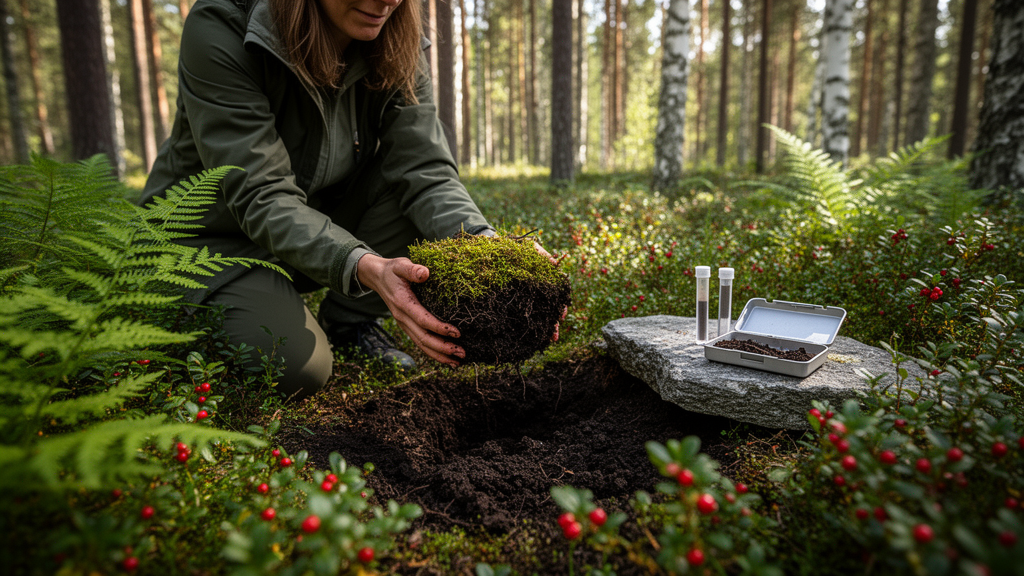
The research team collected 50 samples on two days in October 2021, spanning five vegetation types, including coniferous forest on dry land, coniferous forest on raised bog, deciduous forest, raised bog, and open swamp and fen. Crucially, they sampled nine different habitat types: soil, litter, decomposed wood, moss, fungus, lichens, anthill material, sphagnum and roots. To minimise impact on undisturbed terrain, samples were taken close to roads and hiking trails, mostly using a corer with a 16 millimetre inner diameter. Nematodes were extracted from 100 millilitres of each medium using the Whitehead tray method over 48 hours, then concentrated to a 50 microlitre suspension for genetic analysis.
The molecular workflow targeted the V7-V8 variable domain of the 18S ribosomal RNA gene, an amplicon of roughly 350 base pairs, using primers originally benchmarked for nematode community analysis and extended with Illumina adapters. Three technical replicates per sample were amplified, purified and sequenced on an Illumina MiSeq platform with paired-end 2×300 base pair chemistry. The bioinformatics pipeline, built on USEARCH, merged reads with stringent overlap criteria, filtered sequences by expected error, and clustered them with the UNOISE algorithm into zero-radius operational taxonomic units, equivalent to amplicon sequence variants. Taxonomy was assigned with the SINTAX classifier against the PR2 database, and nematode variants were then re-assigned using a custom, curated nematode-only reference database, with BLAST searches complementing assignments for families that the initial cut-off failed to resolve.
From 7,040,489 paired reads, the pipeline retained nearly six million after filtering and produced 2,569 amplicon sequence variants, of which 899 were assigned to Nematoda. Tylenchidae, a family of predominantly root- and fungus-associated nematodes, represented the largest share at 17.7 percent of nematode variants, followed closely by Aphelenchoididae. Among the bacterivores, Plectidae, Metateratocephalidae and Rhabditidae dominated across habitats. The species-level resolution was striking: genera such as Aphelenchoides and Malenchus each yielded four distinct species, and the survey detected iconic taxa including Steinernema kraussei, an insect-pathogenic nematode used commercially in biological pest control, and Prionchulus muscorum, a predatory species characteristic of mature peatland soils.
The community patterns told a clear story. Soil and litter supported the richest and most diverse nematode communities, with comparable Chao1 richness measures that significantly exceeded all other habitats combined. Fungus, lichens and decomposing wood showed low diversity, while the heavily sampled coniferous forests displayed wide variation between spots and a significant difference in alpha diversity between them. Non-metric multidimensional scaling of Bray-Curtis dissimilarities revealed clear separation of communities by habitat, confirmed statistically by PERMANOVA, but no comparable separation by vegetation type. Several species showed exclusive habitat associations: Alaimus parvus, Clarkus papillatus and Choriorhabditis cristata were detected only in soil, while Hexatylus viviparus, Mononchus truncatus, Bunonema richtersi and Steinernema kraussei appeared exclusively in litter, and Ektaphelenchoides spondylis and Potensaphelenchus stammeri were confined to decomposed wood.
The faunal analysis carried broader ecological significance. Using the NINJA tool to assign trophic groups and coloniser-persister values, the researchers found that most samples, particularly soil and litter, depicted stable communities with balanced distributions of trophic groups and very low enrichment, consistent with the pristine, undisturbed character of the park. Food web analysis placed most samples in maturing to matured states, with soil and litter concentrated in the high-structure quadrants. Lichen was the only habitat in which all samples appeared degraded and depleted, while fungus samples suggested decomposition pathways more fungal-driven than bacterial. Wood samples varied widely, reflecting the multistage nature of wood decomposition, in which late-stage material becomes increasingly similar to litter and soil.
The comparison with earlier Swedish studies is dramatic. A Scots pine forest sampled three times over 25 years, totalling 156 soil samples, supported only 36 unique nematode taxa, while a mire in northern Sweden sampled over four months yielded 24 taxa representing 17 genera, and an 85-year-old Danish beech forest studied across 12 months harboured just 41 genera. Store Mosse, in a single event, surpassed them all, a disparity the authors attribute largely to the diversity of habitat types analysed and to metabarcoding’s ability to detect immature individuals and eggs that morphology-based surveys routinely miss. The findings argue strongly for building baseline metabarcoding datasets that sample every medium where nematodes occur, including plants, fungi and animals, since such references will underpin future monitoring of ecosystem change in protected areas worldwide.
Subject of Research: Assessing the diversity of nematodes in the Store Mosse National Park (Sweden) using metabarcoding
Article Title: Assessing the diversity of nematodes in the Store Mosse National Park (Sweden) using metabarcoding
Article References: Ahmed, M., Slos, D., & Holovachov, O. (2024). Assessing the diversity of nematodes in the Store Mosse National Park (Sweden) using metabarcoding. Metabarcoding and Metagenomics, 8, Article e111307. https://doi.org/10.3897/mbmg.8.111307
Image Credits: AI Generated
Keywords: Assessing, diversity, nematodes, Store, Mosse, National, Park, Sweden, metabarcoding, scientific research
Cite Scienmag News
Chloe Pearson. (October 19, 2026). Metabarcoding reveals hidden nematode diversity in Swedish national park. Scienmag. https://scienmag.com/metabarcoding-reveals-hidden-nematode-diversity-in-swedish-national-park/
Chloe Pearson. "Metabarcoding reveals hidden nematode diversity in Swedish national park." Scienmag, 19 October 2026, https://scienmag.com/metabarcoding-reveals-hidden-nematode-diversity-in-swedish-national-park/. Accessed 19 October 2026.
Chloe Pearson. "Metabarcoding reveals hidden nematode diversity in Swedish national park." Scienmag. October 19, 2026. https://scienmag.com/metabarcoding-reveals-hidden-nematode-diversity-in-swedish-national-park/


