


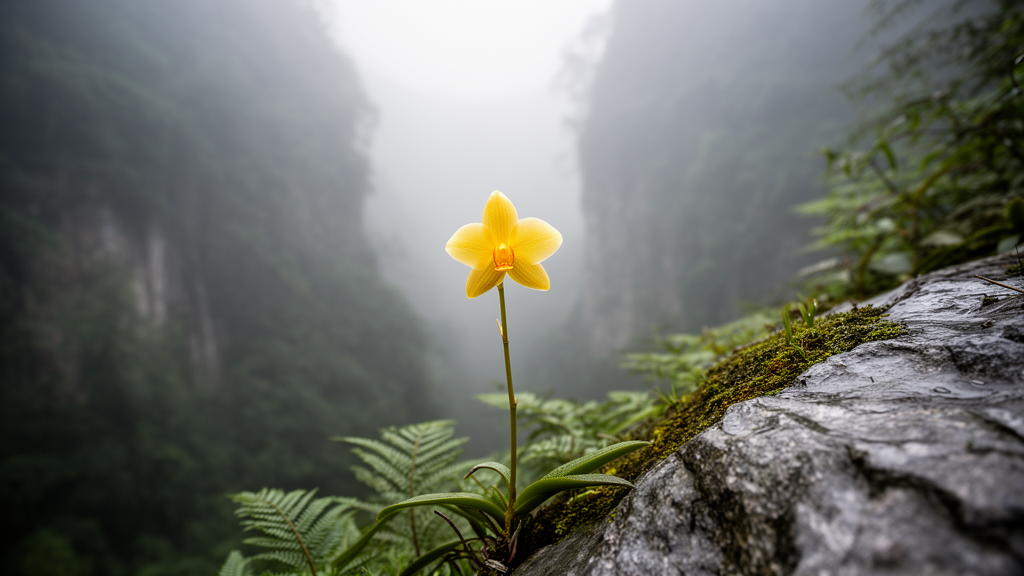
Deep in a limestone valley in southern Chongqing, botanists have found a strikingly beautiful orchid unlike any other known to science. The plant, now formally named Gastrochilus immaculatus, produces flowers of an almost pure golden yellow, completely free of the purplish-red spots that mark nearly all of its closest relatives. That spotless beauty, which inspired its scientific name, is what first caught the eye of researchers surveying the evergreen broad-leaved forests of Qijiang District in September 2025. The discovery, published in the journal PhytoKeys, adds a new branch to the orchid family tree and sounds an urgent alarm: only around 50 mature individuals are known, all confined to a single valley, placing the species squarely in the Critically Endangered category of the IUCN Red List.
The genus Gastrochilus belongs to the orchid subfamily Epidendroideae and comprises roughly 89 species distributed from tropical to warm-temperate Asia. Members of the genus are epiphytes, meaning they grow perched on tree trunks, branches, or rock faces rather than rooted in soil, drawing moisture and nutrients from the air, rain, and debris that accumulate around them. Botanists recognize Gastrochilus readily by two hallmark traits: a saccate hypochile, the lower portion of the lip that swells into a distinct pouch or spur, and two sub-globose pollinia, the compact pollen masses, attached to a slender stipe. What makes the new species remarkable is the pace of discovery in this genus. Most Gastrochilus species were described only in the past two decades, and more than 20 have been added in just the last five years, particularly from the mountainous regions fringing the Sichuan Basin in southwestern China.
The encounter happened during a field survey in Qijiang District, at elevations between 800 and 1,100 meters, in forest not far from Jinfo Mountain in neighboring Nanchuan District. The flowering plants showed the falcate-oblong, sickle-shaped leaves and the subtriangular lip lamina with a thickened central cushion characteristic of Gastrochilus sect. Acinacifolii, one of six sections into which the genus has been subdivided based on accumulated molecular and morphological evidence. But one feature stood out immediately. Where its relatives wear yellowish-green flowers decorated with purplish-red spots, these plants bore golden-yellow flowers with no deeper markings at all. The researchers hypothesized they had found a new member of the same section as the morphologically similar G. fargesii, and set out to test that idea with both morphology and DNA.
Field collections were made in Heishan Valley, where herbarium specimens and silica-gel-dried leaves were gathered from plants growing on tree trunks and rock walls. Morphological observations and measurements were performed on both living plants and dried voucher specimens, now deposited at the CDBI herbarium, with descriptive terminology following standard botanical conventions. For the genetic work, leaf samples from two individuals of the putative new species, collected from two different subpopulations, were analyzed alongside three accessions of G. fargesii, including one from an earlier study and two newly obtained samples, one from the type locality of G. fargesii in Chengkou County and another from Jinfo Mountain.
Total DNA was extracted exclusively from the silica-gel-dried leaves, and the team amplified the nuclear ribosomal internal transcribed spacer, nrITS, together with four chloroplast markers: matK, psbA–trnH, psbM–trnD, and trnL–F. These five regions, spanning both the nuclear and plastid genomes, are the standard phylogenetic toolkit for this genus, allowing comparison with sequence data for 60 species retrieved from GenBank. Before combining the datasets, the researchers checked congruence between the nuclear and plastid markers using the incongruence length difference test, which returned a P value of 0.15, confirming that the two data partitions could be safely merged. The aligned nrITS dataset comprised 687 nucleotides, of which 201 were variable, while the combined plastid dataset totaled 3,456 base pairs with 213 variable sites.
Phylogenetic trees were reconstructed using both maximum likelihood and Bayesian inference. The best-fit nucleotide substitution model, GTR+I+G, was selected based on the corrected Akaike Information Criterion. The Bayesian analysis ran two independent Markov chain Monte Carlo simulations for 20 million generations each, while the maximum likelihood analysis assessed branch support with 2,000 bootstrap replicates. Six species of Aeridinae, the orchid subtribe to which Gastrochilus belongs, served as outgroups to root the tree. The results were unambiguous. Gastrochilus was recovered as a well-supported monophyletic group, meaning all its members descend from a single common ancestor, and the clades corresponding to the six previously recognized sections received strong support, validating the existing classification.
Within that framework, the two accessions of the new species, ZJY332 and ZJY333, collected from sites separated by cliffs in a limestone valley roughly 3.5 kilometers long, formed a single well-supported lineage with maximal statistical support, a Bayesian posterior probability of 1 and a maximum likelihood bootstrap value of 100. This lineage was sister to the clade containing the three accessions of G. fargesii, supported at 1/95. The near-identical DNA sequences of plants from different sites confirmed that despite the physical barriers between them, they belong to one species. The subclade uniting the new species with G. fargesii was further nested among other members of G. sect. Acinacifolii, exactly as the morphological hypothesis predicted.
Morphologically, the new species can be distinguished from G. fargesii by a suite of stable characters. Its stems are shorter, spanning 2.0 to 8.0 centimeters compared with 3.0 to 13.0 centimeters in G. fargesii. Its leaves are broader, falcate-oblong blades measuring 0.8 to 1.5 centimeters wide, whereas G. fargesii carries narrowly falcate-linear leaves only 0.4 to 0.6 centimeters across. Most dramatically, its flowers, roughly 1.2 by 1.4 centimeters, are golden yellow without spots, while G. fargesii produces smaller yellowish-green flowers about 0.9 by 1.2 centimeters marked with purplish-red spots. The hypochile, the pouch-like base of the lip, is also taller in the new species, reaching 4.8 to 6.5 millimeters with a rather acute apex, compared with the shorter, obtuse-tipped hypochile of G. fargesii. The two species even flower at different times: the new species blooms from September to October, while G. fargesii flowers from May to June. With these differences, the team concluded the plant merits recognition as a new species, raising the number of species in sect. Acinacifolii to 13.
The biogeographic story is equally compelling. G. fargesii is the only member of its section distributed in northeast Chongqing, with its type materials collected from the Daba Mountains in Chengkou County in 1893 by the missionary botanist P. G. Farges. A review of specimens previously identified as this species led to the exclusion of its reported distributions in Sichuan and Yunnan, which stemmed from misidentifications, while confirming its presence in southern Chongqing and northern and southeastern Guizhou. The three sites of the new species lie not far from a known population of G. fargesii in Nanchuan, and the two species share both morphological and phylogenetic affinities. This pattern suggests that members of the section continued to diversify as they expanded northwards along the mountain ranges bordering the Sichuan Basin, even though most species in the group are found farther south. The authors believe further explorations in adjacent regions may reveal additional species in this section or uncover overlooked diversity among the tree-trunk epiphytic orchids of these mountains.
Conservation prospects, however, are grim. The three known subpopulations, located at Jiaozigou, Heishangu, and Houwangdong in Heishan Town, comprise a total of over 50 mature individuals, all restricted to a single valley subject to continuous anthropogenic disturbance and habitat degradation associated with tourism. The area of occupancy is estimated at just 8 square kilometers using the standard 2 by 2 kilometer grid method, and the extent of occurrence is even smaller, roughly 1.3 square kilometers. Although the total number of mature individuals exceeds 50, precluding evaluation under Criterion D, the geographical range parameters strictly meet the thresholds for Critically Endangered under Criterion B, and a continuous decline in habitat quality and extent has been observed. The species is therefore formally assessed as Critically Endangered, with the designation CR B1ab(iii)+2ab(iii). The specific epithet immaculatus refers to the spotless sepals, petals, and lip of this golden orchid, whose Chinese name, su xin peng ju lan, translates as spotless-heart Gastrochilus. Whether this luminous flower survives the pressures of its only valley will depend on how quickly its habitat can be protected.
Subject of Research: New epiphytic orchid species Gastrochilus immaculatus discovered in Chongqing, Southwest China
Article Title: Gastrochilus immaculatus ( Orchidaceae , Epidendroideae ), a new epiphytic orchid from Chongqing, Southwest China
Article References: Zhang, J.-Y., Liao, M., Yang, P.-Y., Cheng, Y.-H., Wu, J.-Z., Zhang, P.-C., Yu, D.-X., Chen, F., & Xu, B. (2026). Gastrochilus immaculatus (Orchidaceae, Epidendroideae), a new epiphytic orchid from Chongqing, Southwest China. PhytoKeys, 280, 165-179. https://doi.org/10.3897/phytokeys.280.206936
Image Credits: AI Generated
DOI: 10.3897/phytokeys.280.206936
Keywords: Gastrochilus, immaculatus, Orchidaceae, Epidendroideae, epiphytic, orchid, Chongqing, Southwest, China, scientific research
Cite Scienmag News
Margaret Porter. (October 19, 2026). Spotless golden orchid discovered in Chongqing valley is already Critically Endangered. Scienmag. https://scienmag.com/spotless-golden-orchid-discovered-in-chongqing-valley-is-already-critically-endangered/
Margaret Porter. "Spotless golden orchid discovered in Chongqing valley is already Critically Endangered." Scienmag, 19 October 2026, https://scienmag.com/spotless-golden-orchid-discovered-in-chongqing-valley-is-already-critically-endangered/. Accessed 19 October 2026.
Margaret Porter. "Spotless golden orchid discovered in Chongqing valley is already Critically Endangered." Scienmag. October 19, 2026. https://scienmag.com/spotless-golden-orchid-discovered-in-chongqing-valley-is-already-critically-endangered/


