


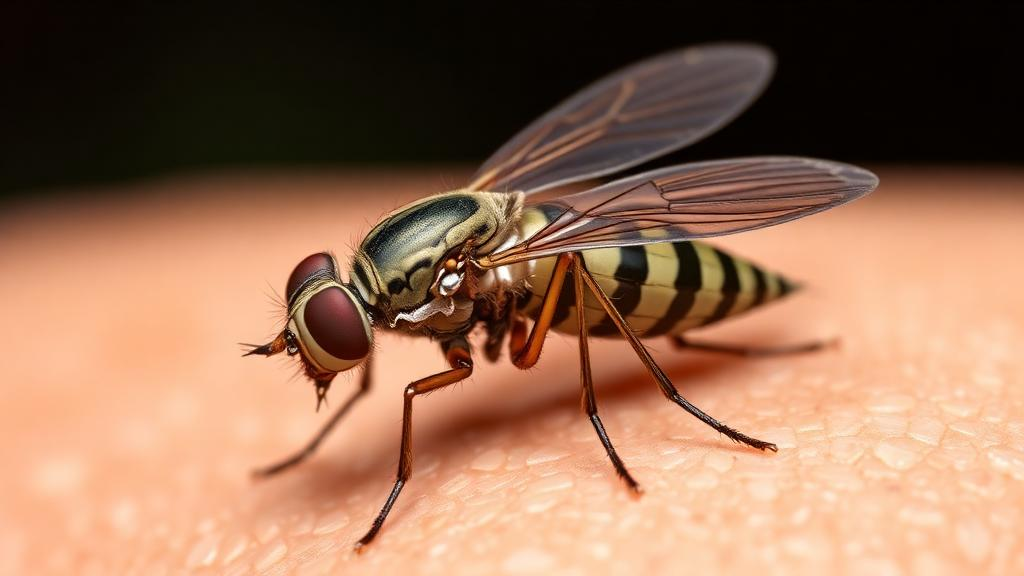
A sand fly species that serves as the principal vector of cutaneous leishmaniasis across a vast swathe of Asia, the Middle East and the Mediterranean has been recorded in China for the first time, according to a study published in PLOS Neglected Tropical Diseases. The species, Phlebotomus sergenti, was captured during field investigations in the Kizilsu Kirghiz Autonomous Prefecture of the Xinjiang Uygur Autonomous Region, a mountainous area on China’s border with Kyrgyzstan. The discovery closes a conspicuous gap in the known distribution of a medically important insect and raises pressing questions about how the species arrived in the country and what it might mean for the local transmission of a disfiguring parasitic disease.
Leishmaniasis is caused by single-celled parasites of the genus Leishmania, which are passed between hosts in the saliva of female sand flies when they take a blood meal. The clinical spectrum of the disease ranges from visceral leishmaniasis, a potentially fatal infection of the internal organs, to cutaneous leishmaniasis, which produces chronic skin ulcers that can leave lifelong scars. Phlebotomus sergenti is a principal vector of Leishmania tropica, the parasite responsible for anthroponotic cutaneous leishmaniasis, meaning that humans, rather than animals, serve as the reservoir of infection. That form of the disease is endemic across the Mediterranean basin, North Africa, South Asia and West Asia, where P. sergenti has long been documented. China, by contrast, had never reported the species, even though Xinjiang is a well-recognized focus of visceral leishmaniasis and has recorded sporadic cases of the cutaneous form.
The research team, led by Haowei Dong and Yajun Ma, carried out fieldwork at two sites in Kizilsu Kirghiz Autonomous Prefecture: Artux City in July 2023 and Akto County in August and September 2024. Both localities lie close to the Chinese border with Kyrgyzstan, placing them on a plausible corridor for insect dispersal between Central Asia and western China. The investigators deployed light traps inside livestock pens and in residential areas, habitats where sand flies congregate because they offer blood sources from sleeping animals and people as well as sheltered resting sites. Over the two field seasons the team collected a total of 2,013 sand fly specimens, a substantial sample that allowed them to characterize the composition of the local sand fly fauna with unusual thoroughness.
Identifying sand flies to species is demanding work. The insects are minute, typically only a few millimeters long, and reliable identification depends on the detailed examination of internal structures under a microscope. The researchers dissected and examined 319 of the captured specimens, studying the pharynx, the spermathecae, the sperm-storage organs of females, and the genitalia, which together carry the diagnostic characters that separate closely related Phlebotomus species. Morphology alone, however, can be ambiguous in groups where species look superficially alike, so the team complemented the microscopic work with molecular analysis. They sequenced two mitochondrial genes, cytochrome c oxidase subunit I, commonly abbreviated COI, and cytochrome b, both of which are widely used barcoding markers that accumulate mutations quickly enough to distinguish sister species.
The combined morphological and genetic evidence identified 145 of the examined specimens as Phlebotomus sergenti, with 36 individuals from Artux City and 109 from Akto County. This is the first time the species has ever been confirmed on Chinese territory. The finding is significant not merely as an addition to a checklist: because P. sergenti is the main vector of Leishmania tropica, its presence establishes the ecological precondition for anthroponotic cutaneous leishmaniasis transmission in a region that had not previously harbored this particular vector. Whether the parasite itself is present remains an open question, but the arrival of its vector is the kind of event that public health authorities monitor closely.
The phylogenetic analysis added an important biogeographical dimension to the discovery. When the researchers compared the COI and cytochrome b sequences of the Chinese specimens with sequences from P. sergenti populations elsewhere, the Chinese flies clustered with populations from neighboring countries, including Afghanistan. In other words, the newly discovered Chinese populations are genetically continuous with the Central and West Asian populations of the species rather than representing a distinct, long-isolated lineage. The analysis also found no significant genetic differentiation between the two sampling localities within China, suggesting that the Artux and Akto populations are either part of a single recent colonization or remain connected by ongoing gene flow.
That pattern points toward a likely origin for the Chinese populations: transboundary dispersal from adjacent endemic areas. Kizilsu Prefecture sits at the western edge of China, where trade routes, livestock movement and human travel connect communities on either side of the border with Kyrgyzstan and, more broadly, with the endemic belt that stretches through Afghanistan and the wider Central Asian region. Sand flies are weak fliers, but they can be transported passively in vehicles, cargo and livestock shelters, and populations can expand gradually along suitable habitats. The genetic similarity between the Chinese flies and those from Afghanistan is consistent with such a pathway, although the study did not pinpoint the exact route or timing of the species’ arrival.
To assess whether the captured flies were carrying pathogens, the team performed metagenomic screening on pooled samples. The screening detected Wolbachia endosymbionts, bacteria that live inside the tissues of many insects and are of interest because certain strains can interfere with pathogen transmission. Crucially, however, the analysis found no evidence of Leishmania, Trypanosoma or Bartonella in the collected P. sergenti specimens. The absence of detectable parasites means that the newly discovered populations are not, at present, confirmed to be transmitting disease, but it does not rule out future transmission, since infection prevalence in sand fly populations is often low and a single screening campaign can miss infections that occur seasonally or in unsampled locations.
The epidemiological implications of the finding are considerable. Anthroponotic cutaneous leishmaniasis spreads wherever an infected human, a competent vector and susceptible people overlap, and the introduction of P. sergenti into Xinjiang supplies the vector component that was previously missing. Xinjiang already experiences endemic visceral leishmaniasis transmitted by other sand fly species, and sporadic cutaneous cases have been documented there, so the local health system has some familiarity with leishmaniasis. Yet the arrival of a new principal vector of L. tropica could change the transmission landscape, particularly in rural communities where houses and livestock pens provide the peridomestic habitats that P. sergenti favors. The authors emphasize that the occurrence of the species in the China-Kyrgyzstan border region underscores the need for enhanced surveillance and cross-border collaborative efforts to monitor the spread of leishmaniasis and other vector-borne diseases across Central Asia.
More broadly, the study illustrates how gaps in entomological surveillance can conceal the movements of disease vectors until they are well established. A species capable of transmitting a chronic, stigmatizing disease had apparently crossed into one of the world’s most populous countries without being noticed, and only targeted trapping combined with molecular barcoding revealed its presence. As climate change alters temperature and rainfall patterns across Central Asia, and as trade and travel intensify along historic corridors, the ranges of sand flies and the parasites they carry are expected to shift in ways that are difficult to predict. The first Chinese record of Phlebotomus sergenti is therefore both a specific warning for Xinjiang’s public health authorities and a general reminder that the maps of vector-borne disease risk are redrawn continuously, often at borders where cooperation between neighboring surveillance systems determines whether an introduction is caught early or discovered only after transmission has begun.
Subject of Research: First record of the leishmaniasis vector sand fly Phlebotomus sergenti in Xinjiang, China
Article Title: First record of Phlebotomus sergenti (Diptera: Psychodidae) in China and its potential epidemiological implications
Article References: Dong, H., Yang, A., Shan, W., Zhao, C., Li, X., Rui, B., Zhao, J., Wumaier, M., Peng, H., & Ma, Y. (2026). First record of Phlebotomus sergenti (Diptera: Psychodidae) in China and its potential epidemiological implications. PLOS Neglected Tropical Diseases, 20(10), e0014726. https://doi.org/10.1371/journal.pntd.0014726
Image Credits: AI Generated
DOI: 10.1371/journal.pntd.0014726
Keywords: Phlebotomus sergenti, sand flies, leishmaniasis, Leishmania tropica, Xinjiang, vector-borne disease, COI barcoding, phylogenetics, Wolbachia, surveillance, Central Asia, public health
Cite Scienmag News
Ophelia Keating. (October 10, 2026). Invasive Sand Fly Species Behind Cutaneous Leishmaniasis Found in China for the First Time. Scienmag. https://scienmag.com/invasive-sand-fly-species-behind-cutaneous-leishmaniasis-found-in-china-for-the-first-time/
Ophelia Keating. "Invasive Sand Fly Species Behind Cutaneous Leishmaniasis Found in China for the First Time." Scienmag, 10 October 2026, https://scienmag.com/invasive-sand-fly-species-behind-cutaneous-leishmaniasis-found-in-china-for-the-first-time/. Accessed 10 October 2026.
Ophelia Keating. "Invasive Sand Fly Species Behind Cutaneous Leishmaniasis Found in China for the First Time." Scienmag. October 10, 2026. https://scienmag.com/invasive-sand-fly-species-behind-cutaneous-leishmaniasis-found-in-china-for-the-first-time/


