


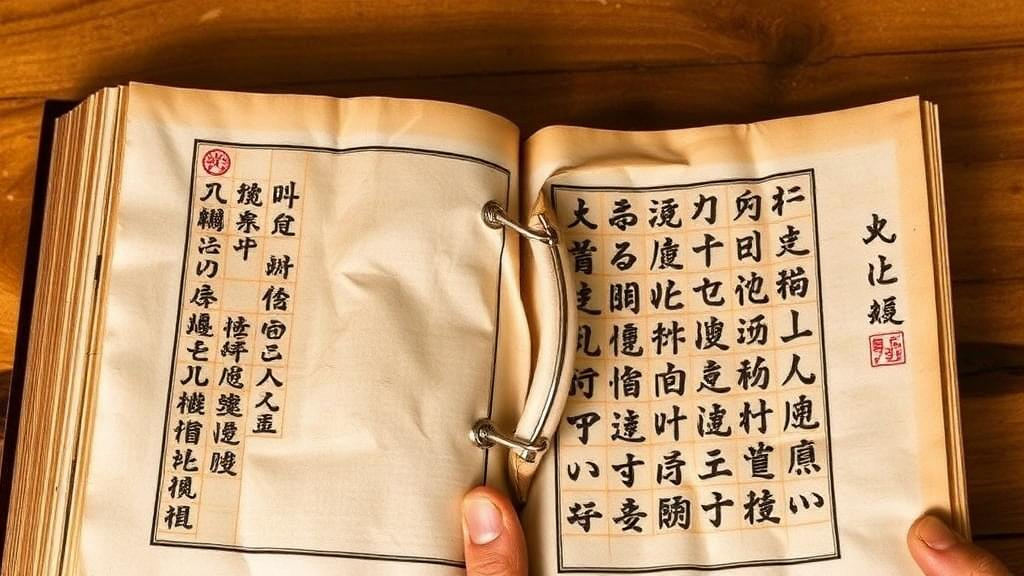
In a conservation laboratory in China, a fragile medical text printed in 1739 has become the testing ground for a quiet revolution in heritage science. The book, Yi Men Pu Du, arrived at restorers’ hands in a state that Chinese heritage standards classify as Grade 1, the most critical category of damage, meaning the object was at imminent risk of irreversible loss. Rather than relying solely on the accumulated intuition of master restorers, the team behind a new study in PLOS One chose to subject every stage of the restoration to systematic laboratory measurement, from the microscopic identity of the paper fibers to the acidity of each leaf and the tensile strength of the repair materials.
The stakes in ancient book conservation are high and unforgiving. Paper made in imperial China was typically produced from plant fibers such as bamboo, bark, and hemp, and over centuries these materials succumb to acidification, insect attack, and mechanical wear. Acid hydrolysis severs the cellulose chains that give paper its strength, turning once-supple leaves brittle and discolored. Traditional restoration in China has long been celebrated for its craftsmanship, but its decisions, which repair paper to use, how much adhesive pulp to apply, when and how to deacidify, have historically been guided by experience passed down through apprenticeship rather than by quantitative data. The researchers, Chen Li, Sijia Gao, and Meng Li, set out to show that the two approaches can be fused into a single evidence-based workflow.
Their subject, Yi Men Pu Du, is a Chinese medical text whose title can be translated as a popular guide to medicine, and its condition made it an ideal case study. Before any intervention, the team carried out a comprehensive characterization of the book’s papers. Fiber composition was identified by optical microscopy following the Chinese national standard GB/T 4688–2020, a technique that exploits the distinctive morphology of different plant fibers when stained and viewed under magnification. The results were unambiguous: the cover was made of 100 percent bark fiber, while the text leaves were composed entirely of bamboo fiber. This distinction mattered enormously, because matching repair paper to original paper in fiber type, and therefore in aging behavior and response to humidity, is a central principle of compatible conservation.
Beyond fiber identification, the researchers measured a battery of physical and chemical properties for both the original leaves and candidate repair papers. Grammage, the mass per unit area of paper, was determined according to ISO 536:2012, while thickness was measured under GB/T 451.3-2008 and tensile strength under GB/T 22898–2008. Acidity was assessed in two complementary ways: surface pH, which probes the condition of the sheet’s exterior, and cold-extraction pH, which reflects the bulk chemistry of the paper, using the standards GB/T 13528–2015 and GB/T 1545–2008. Together these measurements produced a quantitative portrait of a book in distress, replacing vague descriptions of fragility with numbers that could be tracked over time.
The chemical picture was grim. Pre-restoration surface pH values ranged from 5.1 to 5.4, confirming severe acidification well below the neutral point of 7. Paper at this acidity loses strength steadily as cellulose molecules break down, and without intervention the leaves would continue to degrade even in careful storage. To reverse the damage, the team applied a deacidification protocol based on calcium hydroxide, prepared at a ratio of 1 gram of Ca(OH)2 to 200 milliliters of solution and delivered in three successive stages. Calcium hydroxide neutralizes the acids embedded in the paper and leaves behind alkaline calcium compounds that act as a reservoir against future acid buildup, a strategy widely used in paper conservation.
The staged treatment worked, and the numbers proved it. By the end of the protocol, surface pH had climbed to a range of 7.4 to 7.7, shifting the book from an actively corrosive state into a mildly alkaline one that favors long-term preservation. This kind of before-and-after quantification is precisely what the study argues traditional practice has lacked. A restorer working by feel might judge a treatment successful by the look and handling of the leaves, but only measurement can confirm that the chemistry has actually changed, and by how much, and whether further treatment is needed or would risk overshooting into damaging alkalinity.
Not every decision in the project went smoothly on the first attempt, and it is here that the experimental approach revealed its full value. During the restoration, thickness monitoring of the treated leaves showed a post-restoration measurement of 195 micrometers, a value the team judged excessive for the repair. The culprit was identified as an overly concentrated repair pulp, the slurry of paper fibers used to reinforce weakened leaves. By reducing the pulp ratio from 5 grams per 400 milliliters of water to 0.5 grams per 400 milliliters, a tenfold dilution, the restorers brought the added thickness back under control. Without routine measurement, the problem might have gone unnoticed until the book’s spine no longer closed properly or the repaired leaves stood out stiffly from their neighbors.
Material selection was likewise put on a quantitative footing. The team compared the mechanical performance of bamboo and bark repair papers and found that the bamboo papers exhibited 29.95 percent to 36.66 percent higher tensile strength in the longitudinal direction than their bark counterparts. Since the text leaves themselves were bamboo fiber, this data pointed clearly toward bamboo repair paper for the body of the book, aligning both chemical compatibility and mechanical robustness. The finding illustrates a broader principle: repair papers that look similar to the naked eye can differ substantially in strength and aging behavior, and only standardized testing can reveal which candidate will truly serve the object best.
The authors conclude that systematic experimental analysis transformed what would otherwise have been an experience-based restoration into an evidence-based practice, providing quantitative guidance for material selection, deacidification, and process optimization. In effect, the laboratory instruments became an extension of the restorer’s senses, detecting acid levels invisible to the eye and strength differences imperceptible to the fingertip. Crucially, the team emphasizes that this methodological framework is transferable to other ancient book conservation projects, meaning the case study is less a one-off success story than a template that other institutions can adapt for their own collections.
The significance of the work extends beyond a single 1739 medical text. Libraries and archives across the world hold millions of deteriorating volumes, and the field of conservation is under growing pressure to justify its interventions with reproducible data, both to improve outcomes and to secure funding in an era of competing cultural priorities. By embedding standardized national and international test methods directly into the traditional restoration workflow, before, during, and after treatment, this study offers a practical demonstration that scientific rigor and artisanal craft are not rivals but partners. For Yi Men Pu Du, the result is a medical classic stabilized for future generations of readers and researchers; for the discipline, it is a measurable step toward making every restoration as accountable as it is artful.
Subject of Research: Experimental paper analysis integrated into the restoration of the ancient Chinese medical book Yi Men Pu Du
Article Title: Integrating experimental paper analysis into traditional ancient book restoration: A case study of the Chinese medical text Yi Men Pu Du
Article References: Li, C., Gao, S., & Li, M. (2026). Integrating experimental paper analysis into traditional ancient book restoration: A case study of the Chinese medical text Yi Men Pu Du. PLOS One, 21(10), e0360242. https://doi.org/10.1371/journal.pone.0360242
Image Credits: AI Generated
DOI: 10.1371/journal.pone.0360242
Keywords: ancient book restoration, paper conservation, Yi Men Pu Du, deacidification, fiber analysis, pH measurement, tensile strength, cultural heritage, Chinese medical text, evidence-based conservation, calcium hydroxide, PLOS One
Cite Scienmag News
Mark Graham. (October 10, 2026). Science Meets Craft: Lab Tests Rescue a Critically Damaged 1739 Chinese Medical Book. Scienmag. https://scienmag.com/science-meets-craft-lab-tests-rescue-a-critically-damaged-1739-chinese-medical-book/
Mark Graham. "Science Meets Craft: Lab Tests Rescue a Critically Damaged 1739 Chinese Medical Book." Scienmag, 10 October 2026, https://scienmag.com/science-meets-craft-lab-tests-rescue-a-critically-damaged-1739-chinese-medical-book/. Accessed 10 October 2026.
Mark Graham. "Science Meets Craft: Lab Tests Rescue a Critically Damaged 1739 Chinese Medical Book." Scienmag. October 10, 2026. https://scienmag.com/science-meets-craft-lab-tests-rescue-a-critically-damaged-1739-chinese-medical-book/


