


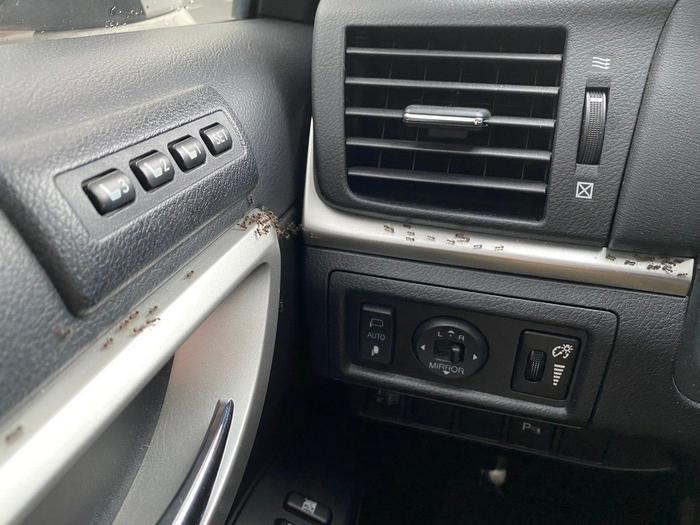
Insects are masters of transportation and get around by flying, crawling, swimming, burrowing, and even gliding. Now, ants have been observed using a new method of getting around: hitchhiking. These social insects pack up the whole family, including their queen, and hop in the car for an opportunistic ride to a new area where they can set up a home.

Credit: Photo by Scotty Yang for Virginia Tech.
Insects are masters of transportation and get around by flying, crawling, swimming, burrowing, and even gliding. Now, ants have been observed using a new method of getting around: hitchhiking. These social insects pack up the whole family, including their queen, and hop in the car for an opportunistic ride to a new area where they can set up a home.
Scotty Yang, assistant professor in the Virginia Tech Department of Entomology within the College of Agriculture and Life Sciences, recently published a paper in Ecological Entomology describing this automotive phenomenon. His observations of this ant behavior spanned from 2017-23, when he observed nine species of ants hitchhiking on personal vehicles. Of these nine species, seven were considered invasive to the places they were found.
It has been well documented that insects can hitch a ride on vehicles, but typically the research focuses on agricultural machinery or the trucking industry. Yang’s work is the first to look at ants hitching on everyday vehicles.
Yang’s study was a citizen science effort that incorporated social media reports from people throughout Taiwan. The work primarily studied ant populations and their hitchhiking on the island, and it included examples of species such as the ghost ant and the black cocoa ant. In the study, factors such as the time of year, weather, type of car, location, duration of stay, and number of ants were examined to better understand the patterns which gave rise to a successful hitchhiker colony.
“We saw social media posts where people were devastated about finding their cars covered in ants,” Yang said. “Although we felt sorry for them, we wanted to examine whether these events had anything in common.”
Ants can hitch a ride on the inside or outside of your vehicle and can even hang out under the hood.
Based on the data collected, Yang learned that hitchhiking ants need three main things to succeed: The ants must be able to climb the surface of the vehicle, the ants must be exhibiting foraging/colonizing behaviors, and the ants must be able to withstand the temperature of the part of the vehicle they settle in.
Tracking invasive insects and how they spread is an important subject for entomologists because these creatures can represent threats to native species of plants and animals. The spread of invasive ants was previously thought to occur primarily through the transport of agricultural, arboreal, and horticultural materials such as logs, plants, and dirt. The impact of noncommercial transport of ants was poorly understood.
Most personal vehicles offer no real food or shelter, but when ants live in overcrowded colonies, they look to leave and find a new, bigger home. Native species of ants tend to face these pressures less frequently, meaning invasive species are more likely to hitchhike, further dispersing these insects into new areas.
As an entomologist based at Virginia Tech, Yang explained how this study could have broad impact in Virginia and the Eastern United States. Of the 100 worst invasive species in the world, five are species of ants and two of these are already established in Virginia: the red imported fire ant and the Argentine ant. These ants have been found in increasingly northern territories, potentially drawn to rising seasonal temperatures over the past decade.
Yang suggests that hitchhiking events will provide more chances for these ants to arrive in new locations, speeding the ants’ spread. He hopes to implement a similar citizen science program in Virginia to the one he conducted in Taiwan, with the goal of tracking the spread of invasive ants and their connection to personal vehicles.
Journal
Ecological Entomology
Article Title
Free ride without raising a thumb: A citizen science project reveals the pattern of active ant hitchhiking on vehicles and its ecological implications
Article Publication Date
29-Apr-2024
Cite Scienmag News
Russell Cooper. (June 27, 2024). Invasive ants spread by hitchhiking on everyday vehicles. Scienmag. https://scienmag.com/invasive-ants-spread-by-hitchhiking-on-everyday-vehicles/
Russell Cooper. "Invasive ants spread by hitchhiking on everyday vehicles." Scienmag, 27 June 2024, https://scienmag.com/invasive-ants-spread-by-hitchhiking-on-everyday-vehicles/. Accessed 3 September 2026.
Russell Cooper. "Invasive ants spread by hitchhiking on everyday vehicles." Scienmag. June 27, 2024. https://scienmag.com/invasive-ants-spread-by-hitchhiking-on-everyday-vehicles/

