


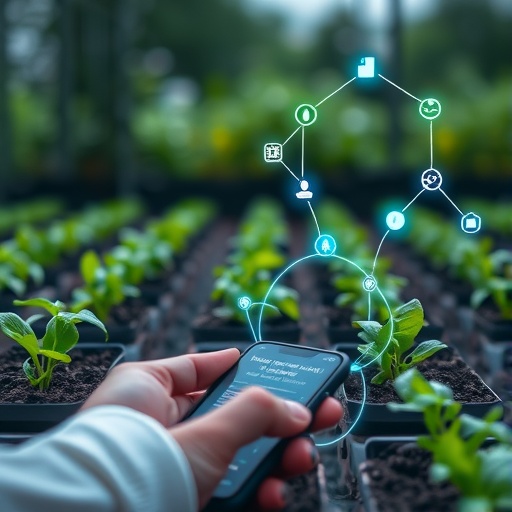
Researchers have unveiled a comprehensive new blueprint for the future of agriculture, introducing a concept called the Farming of Things (FoT) — a five-layer cyber-physical architecture that promises to transform farms into intelligent, self-regulating ecosystems where sensors, smartphones, edge servers, and cloud-hosted artificial intelligence work in seamless concert. The study, published in Smart Agricultural Technology by Chayon Kumar Das, Suvro Kumar Das, Jul Jalal Al-Mamur Sayor, and Md. Toukir Ahmed, addresses one of the most persistent shortcomings of modern smart farming: the fragmentation of intelligence across disconnected systems that either lean too heavily on distant cloud servers, lack robust security, or fail to integrate sensing, communication, and decision-making into a coherent whole. By distributing computation intelligently across every tier of the agricultural technology stack, the authors argue, farming systems can finally achieve the real-time responsiveness, scalability, and resilience that large-scale deployments demand.
At the heart of the proposal lies a recognition that modern farms are drowning in heterogeneous data. Soil moisture probes, temperature and humidity sensors, nutrient analyzers, pH meters, rainfall gauges, and smartphone cameras collectively generate enormous volumes of telemetry that must be processed continuously for tasks ranging from irrigation control to crop disease detection. Existing Internet of Things (IoT) based agricultural systems, the researchers note, typically funnel this data to centralized cloud platforms, introducing communication latency and creating dangerous dependencies on network connectivity — a fatal flaw in rural environments where connections are often intermittent. Moreover, many current systems offer little in the way of lightweight security mechanisms suited to resource-constrained microcontrollers, leaving rural networks vulnerable to data injection, spoofing, and eavesdropping. The FoT architecture was designed explicitly to close these gaps through a unified hierarchical framework.
The five layers of the FoT architecture — Perception, Transmission, Ingestion, Cognition, and Execution — each handle a distinct stage of the cyber-physical pipeline. The Perception layer deploys ESP32-based microcontroller nodes interfaced with soil moisture, DHT22 environmental, NPK nutrient, and pH sensors, alongside smartphone cameras that capture high-resolution crop imagery. These nodes perform local signal conditioning, including noise filtering, outlier removal, calibration, and moving-average smoothing, and employ adaptive, threshold-driven transmission logic so that only significant environmental changes are relayed upstream — a strategy that dramatically conserves bandwidth and battery life. The Transmission layer then orchestrates secure, low-latency communication using a hybrid protocol stack: Message Queuing Telemetry Transport (MQTT) as the lightweight publish-subscribe backbone, HTTP and HTTPS over TLS for larger payloads such as imagery, and Bluetooth Low Energy for proximity-based connections between smartphones and field sensors.
Perhaps the most distinctive technical contribution in the communication tier is the custom Lightweight Secure Data Transmission (LSDT) protocol. Rather than deploying heavier generic standards such as DTLS 1.3, TLS-PSK, EDHOC, or OSCORE — all of which impose computational or certificate-management burdens that challenge ultra-low-power devices — LSDT applies scaled integer conversion and threshold-based event filtering before cryptographic encapsulation. This preliminary data reduction counterbalances the payload expansion caused by AES-128 encryption and HMAC-SHA256 signature generation. In deployment, the protocol achieved an average cryptographic overhead of just 0.94 milliseconds and only a 1.5 percent communication overhead, with secure packets growing modestly to roughly 305–325 bytes — a result the authors describe as acceptable even for the most constrained IoT farming applications.
Above the communication backbone sits the Ingestion layer, an edge computing substrate that processes high-velocity sensor streams near their source. Edge servers execute real-time stream processing, sliding-window temporal aggregation, anomaly detection, and feature engineering, transforming raw, noisy telemetry into analysis-ready data before anything is sent onward. The Cognition layer, hosted in the cloud (emulated in the testbed by a local high-performance server), carries the system’s deepest intelligence: a Tri-Tier AI Stack combining TinyML models running on smartphones, an EfficientNet-B4 convolutional neural network running on edge servers for crop disease classification, and a quantized Qwen 2.5-3B large language model performing contextual agronomic reasoning in the cloud. A knowledge base of historical agronomic data grounds the LLM through retrieval-augmented generation, mitigating hallucination and ensuring machine-generated recommendations adhere to established agricultural science.
The mathematical machinery underlying the system is among its most rigorous aspects. The researchers formulated the end-to-end latency and energy consumption of the entire pipeline analytically, then tackled the joint optimization problem — a non-convex Mixed-Integer Non-Linear Program — using an iterative Dual-Decomposition Block Coordinate Descent (BCD) technique. Two closed-form solutions emerge from the analysis: an optimal edge CPU frequency derived by setting the first derivative of a convex cost function to zero, and an optimal uplink transmission power obtained by solving a transcendental equation through the principal branch of the Lambert W function. Crucially, to eliminate runtime computational overhead, the system pre-computes these optimizations and stores them in look-up tables indexed via uniform grid hashing, allowing O(1) retrieval of cached decisions when new telemetry arrives — effectively granting sophisticated mathematical optimization with practically zero added latency.
Validation came through two complementary pathways. The physical testbed integrated two smartphones (a Google Pixel 6 and a Vivo Y91C), ten ESP32 nodes split between sensing and actuation duties, a D-Link router serving as gateway, an ASUS laptop as edge server, and an Acer system with an NVIDIA GTX 1650 GPU emulating the cloud. On this hardware, the TinyML Random Forest crop recommendation model — trained on a 2,200-sample Crop Recommendation Dataset spanning 22 crop classes — achieved 99.32 percent accuracy with inference latencies between roughly 17 and 31 milliseconds and energy costs as low as 12.65 millijoules per prediction. The EfficientNet-B4 disease classifier, fine-tuned on the PaddyDoctor dataset of ten rice-leaf condition classes, reached 97.13 percent accuracy with edge-server inference times around 0.22 to 0.35 seconds. The cloud-hosted LLM completed reasoning tasks in intervals ranging from under a second to just over four seconds depending on token count.
The Execution layer closes the cyber-physical loop by translating digital decisions into physical action: solenoid valves regulate irrigation via PWM-driven pumps under closed-loop soil-moisture feedback, while microcontroller-driven dosing pumps apply fertilizers and agrochemicals using variable-rate application calibrated against live pH, NPK, and humidity readings. Watchdog timers, fail-safe actuator states, redundant actuation pathways, and emergency shutdown protocols guard against cascading failures, ensuring that an intermittent network outage cannot leave the farm in an unsafe condition. This deterministic, safety-aware design transforms what is often a loose association of smart gadgets into a genuine closed-loop cyber-physical control system.
Large-scale SimPy and Monte Carlo simulations — 30 iterations per scenario with 10,000 total iterations for statistical confidence — then tested the architecture under stress. The FoT-Dynamic offloading strategy kept end-to-end latency bounded below 0.2 seconds up to a task arrival rate of 30, and continued to scale stably to arrival rates of 60 under heavy load, where Mobile-Only, Edge-Only, and Cloud-Only baselines degraded far more quickly. A one-way ANOVA on physical hardware telemetry (N=100 per tier) confirmed highly significant performance differences across the mobile, edge, and cloud tiers, validating the core premise that intelligent task placement, rather than raw hardware power, is the decisive factor in real-time agricultural responsiveness.
What emerges from the study is less a single gadget than an operating philosophy for the connected farm: intelligence should live everywhere, but the right intelligence must live in the right place. A farmer’s phone can decide crop suitability in milliseconds without touching the network; an edge server can spot rice blast disease before the infection spreads; and a cloud-hosted language model can synthesize season-long agronomic strategy from global data fusion. By welding these capabilities together with a security protocol that costs less than a millisecond of delay and an optimization engine that runs on pre-computed look-up tables, the Farming of Things offers a genuinely unified vision of Agriculture 5.0 — one in which the field, the edge, and the cloud behave less like separate systems and more like a single, thinking organism. As climate volatility and labor shortages intensify pressure on global food production, architectures of this kind may soon define the difference between farms that merely collect data and farms that truly act on it.
Cite Scienmag News
Alan Morgan. (September 8, 2026). Internet of Things Transforms Modern Agriculture into Smart Farming. Scienmag. https://scienmag.com/internet-of-things-transforms-modern-agriculture-into-smart-farming/
Alan Morgan. "Internet of Things Transforms Modern Agriculture into Smart Farming." Scienmag, 8 September 2026, https://scienmag.com/internet-of-things-transforms-modern-agriculture-into-smart-farming/. Accessed 8 September 2026.
Alan Morgan. "Internet of Things Transforms Modern Agriculture into Smart Farming." Scienmag. September 8, 2026. https://scienmag.com/internet-of-things-transforms-modern-agriculture-into-smart-farming/


