


The Yellow River Delta, one of the most dynamic sedimentary environments worldwide, continues to be a critical area for research in microbial ecology. The relentless deposition of sediment near the river’s estuary has resulted in a unique environmental gradient that stretches from the terrestrial landscape into the marine realm. This gradient not only influences mineral and nutrient availability but also fosters complex interactions among diverse microbial communities. However, research focusing specifically on methane-metabolizing microorganisms in estuarine soils has been surprisingly limited, prompting new investigations into their distribution and ecological roles.
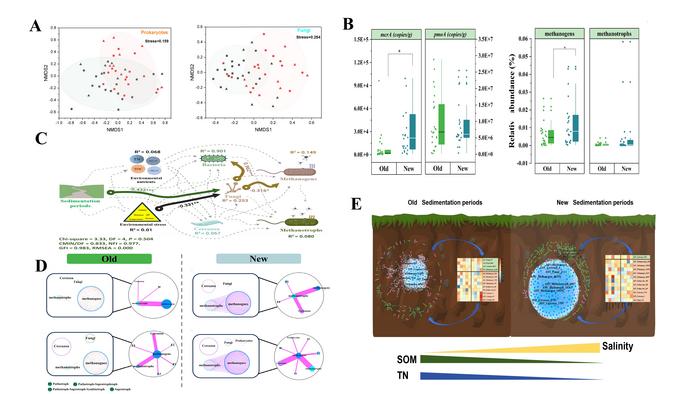
Researchers have turned their attention to understanding the multifaceted relationships between microbial communities and the essential driving mechanisms at play within these sedimentary environments. In a recent study published in "Soil Ecology Letters," scientists evaluated methane-metabolizing microorganisms across varying sedimentation gradients, encompassing both old and young deposition zones. The research not only illuminates the spatial distribution of these communities but also identifies significant differences in their functional capacity in relation to sediment age.
Focusing on communities of prokaryotes, fungi, and protists, the research identified that substantial community shifts occurred more prominently between the distinct deposition age regions than within varying soil depths. This finding implies that the accretion of soil organic matter represents a crucial external force influencing community succession. This newfound understanding presents exciting opportunities for scientists and environmental managers alike, highlighting the importance of sedimentary age in shaping microbial dynamics.
Among the salient discoveries, the study underscores the pronounced influence of methanogens—microorganisms that produce methane—within the sediment profiles. Methanogens demonstrated greater sensitivity to environmental changes, when compared to methanotrophs, organisms that consume methane. This dynamic suggests a delicate balance within the microbial framework, where the response of methanogens might dictate not only community structure but also broader ecological implications concerning greenhouse gas emissions.
The findings of this research can further be contextualized by the ongoing environmental changes the Yellow River Delta experiences. Accelerated sediment deposition due to riverway shifts not only shapes the landscape but also alters microbial habitats. Consequently, understanding these microbial community dynamics could provide insights into their roles in biogeochemical cycles—particularly regarding carbon storage and greenhouse gas emissions.
A comparison of microbial interactions across various sedimentation zones sheds light on the intricate web of relationships that define coastal wetland ecosystems. The establishment of a self-developed inter-domain ecological network platform, named INAP2, allowed researchers to delve deeper into these interactions, unveiling how methanogens emerge as modular hubs in microbial networks. These hubs are pivotal in facilitating inter-trophic interactions among various microbial populations, forming a complex yet harmonious ecological framework.
The role of environmental factors, such as soil organic matter and sediment composition, further intensifies in significance as they dictate the presence and functional performance of these microorganisms. The study hints at a broader ecological narrative where disturbances—triggered by factors such as climate change or human activities—could disrupt these intricate microbial networks. Particularly, alterations in temperature and inundation patterns can induce shifts in microbial interactions, thereby affecting the overall health and functionality of the ecosystem.
Highlighting the relevance of these findings goes beyond academic interest. The implications of microbial dynamics in environments like the Yellow River Delta encompass crucial concerns regarding biodiversity, water resources, and carbon cycling—elements directly tied to global climate patterns. As global warming intensifies and human encroachment on natural habitats expands, understanding these ecological interactions becomes imperative for sustainable management practices and conservation strategies.
In complement to the research team’s findings, the broader implications touch upon global efforts to mitigate climate change. The role of wetlands in carbon sequestration and their contribution to the global carbon cycle cannot be overstated. Thus, this detailed examination of microbial communities within estuarine systems offers a roadmap for future studies aimed at enhancing ecosystem resilience against ongoing environmental alterations.
Ye Deng and his research team at the CAS Key Laboratory for Environmental Biotechnology have been central figures in unearthing these ecological relationships. Their pioneering studies have propelled the understanding of microorganisms within the Yellow River Delta to the forefront of scientific inquiry, further enriching the dialogue around environmental preservation and restoration. By highlighting the interconnectedness of microbial life and sediment processes, these researchers underscore a vital dimension of ecosystem health that resonates with efforts geared toward biodiversity conservation.
As we move forward, continued exploration into the nuances of microbial ecology will undoubtedly yield new insights that can be harnessed for practical applications in environmental science and ecological management. In situ studies, combined with laboratory analyses, pave the way for more holistic approaches to understanding these complex ecosystems, ensuring that even as we grapple with anthropogenic challenges, we can still champion and cherish the enchanting intricacies of our biosphere.
Ultimately, the journey to comprehend the microbial world in the Yellow River Delta exemplifies the profound connections between life, environment, and climate—a narrative that is ever-relevant as we navigate through the uncertainties of the Anthropocene.
Keywords
Environmental sciences, microbial ecology, methane metabolism, sediment dynamics, Yellow River Delta.
Cite Scienmag News
Morgan Morrow. (March 28, 2025). Inter-Trophic Networks Highlight Methanogens’ Key Role in Estuarine Soil Deposits. Scienmag. https://scienmag.com/inter-trophic-networks-highlight-methanogens-key-role-in-estuarine-soil-deposits/
Morgan Morrow. "Inter-Trophic Networks Highlight Methanogens’ Key Role in Estuarine Soil Deposits." Scienmag, 28 March 2025, https://scienmag.com/inter-trophic-networks-highlight-methanogens-key-role-in-estuarine-soil-deposits/. Accessed 3 September 2026.
Morgan Morrow. "Inter-Trophic Networks Highlight Methanogens’ Key Role in Estuarine Soil Deposits." Scienmag. March 28, 2025. https://scienmag.com/inter-trophic-networks-highlight-methanogens-key-role-in-estuarine-soil-deposits/


