


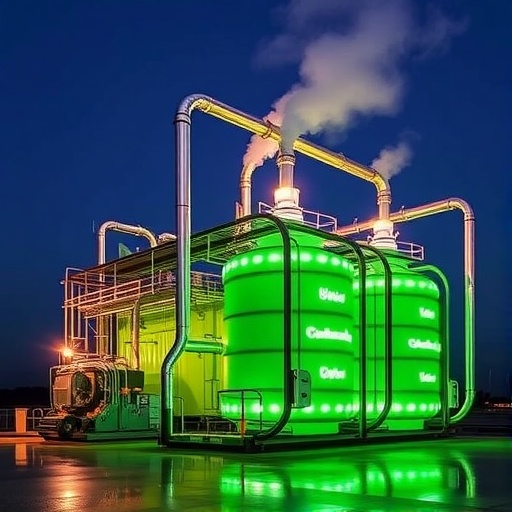
In a groundbreaking advancement poised to redefine the future of sustainable energy storage, an international team spearheaded by Bruce Logan, Director of Penn State’s Institute of Energy and the Environment, has unveiled a revolutionary reactor system that efficiently converts carbon dioxide and renewable electricity into methane. This innovation, documented in the prestigious journal Water Research, represents a major leap in scaling microbial electrosynthesis technology while maintaining performance metrics seldom achieved at larger volumes.
The persistent challenge of storing renewable energy over extended periods—critical for balancing supply fluctuations inherent in solar and wind power—has traditionally been addressed by mechanical means such as pumped hydro storage. However, these systems are geographically constrained and unsuitable for seasonal storage demands. The novel approach presented by Logan and his colleagues circumvents these limitations by chemically storing renewable energy in the form of methane, a storable, transportable, and widely utilized fuel.
At the core of this technology is a sophisticated reactor that harnesses electricity from renewable resources to electrolyze water, producing hydrogen gas onsite. Specialized microorganisms called methanogens then utilize this hydrogen as a metabolic substrate to reduce carbon dioxide into methane. This biologically mediated process effectively upgrades low-value greenhouse gases and surplus electricity into a high-energy-density fuel compatible with existing natural gas infrastructures.
What sets this new system apart is the reactor’s “zero-gap” design—a configuration where the electrodes are positioned merely microns apart, separated only by a membrane. This innovative layout drastically reduces internal resistance, enabling more efficient electron transfer and significantly improving the energy conversion efficiency of the microbial electrosynthesis process. By expanding the electrode surface area roughly tenfold and elongating the fluid flow path to nearly 12 inches, the researchers successfully scaled the reactor without sacrificing critical efficiency parameters.
Conventional microbial electrosynthesis platforms typically struggle with diminished performance when scaled due to diffusion limitations and increased internal resistance. The Penn State team’s reactor overcomes these hurdles by ingeniously integrating multiple flow ports that ensure the uniform distribution of gases and liquids throughout the reactor volume. This design innovation maintains consistent environmental conditions vital for sustaining active microbial consortia and maximizing methane yields.
Laboratory tests conducted at a stable temperature of 30°C demonstrated remarkable production rates, achieving up to 6.9 liters of methane per liter of reactor volume per day. Such volumetric productivity is unprecedented in scaled microbial electrosynthesis systems. Equally impressive is the reactor’s coulombic efficiency surpassing 95%, indicating that the overwhelming majority of supplied electrons are channeled into methane synthesis rather than undesirable side products.
The system’s energy efficiency metrics, hovering around 45%, place it among the highest performing microbial electrosynthesis reactors reported to date. This signifies that nearly half of the electrical energy input is faithfully conserved in the chemical energy of methane, a feat that elevates the technology closer to practical, large-scale deployment. Bruce Logan highlighted this milestone as a compelling demonstration of transforming electrons and carbon dioxide into usable fuel with minimal losses.
Fundamentally, the reactor operates via an indirect electron transfer pathway mediated by hydrogen. Instead of microbes pulling electrons directly from the electrode—a mechanism linked to lower current densities—the system capitalizes on water electrolysis-derived hydrogen that immediately fuels methanogenic metabolism. This hydrogen-dependent mechanism substantially enhances electron flux and accelerates methane formation rates, bridging electrochemical activity and microbial biology in a highly synergistic manner.
Looking forward, these findings suggest a viable route to integrate biological methane generation plants adjacent to renewable energy installations such as solar farms and wind parks. This proximity eliminates transmission losses associated with grid distribution and allows for real-time conversion of fluctuating electricity into storable methane. Methane generated onsite can then be injected into existing gas pipelines, providing a flexible and carbon-neutral energy reservoir adaptable to long-term storage requirements.
Despite promising technical achievements, widespread commercial adoption hinges on economic factors, particularly the availability of low-cost renewable electricity. Continued improvements in catalyst robustness, reactor longevity, and system automation will also be imperative. Additionally, precautionary measures to mitigate methane leakage must be prioritized to ensure genuine climate benefits since methane’s global warming potential is considerably higher than carbon dioxide.
Ultimately, this development represents a paradigm shift in carbon management and energy storage, transforming industrial carbon dioxide emissions from waste into a valuable energy resource. By leveraging established natural gas infrastructure and innovative bioelectrochemical processes, Logan’s team demonstrates a compelling vision where decarbonization and energy sustainability converge through microbial ingenuity and electrochemical engineering.
This milestone underscores a future path where the extraction of fossil methane becomes obsolete, replaced by a circular economy of carbon dioxide reuse powered by the sun and wind. As Bruce Logan aptly emphasizes, the ability to convert captured carbon dioxide directly into methane marries environmental stewardship with energy security, marking a pivotal moment in the journey toward net-zero emissions and resilient power systems.
Keywords
Carbon capture, Microbial electrosynthesis, Methane production, Renewable energy storage, Electrochemical reactor, Zero-gap cell, Hydrogen metabolism, Methanogens, Energy efficiency, Sustainable fuels
Cite Scienmag News
Faith Mcneil. (May 15, 2026). Innovative Reactor Converts Carbon Dioxide into Renewable Methane. Scienmag. https://scienmag.com/innovative-reactor-converts-carbon-dioxide-into-renewable-methane-2/
Faith Mcneil. "Innovative Reactor Converts Carbon Dioxide into Renewable Methane." Scienmag, 15 May 2026, https://scienmag.com/innovative-reactor-converts-carbon-dioxide-into-renewable-methane-2/. Accessed 3 September 2026.
Faith Mcneil. "Innovative Reactor Converts Carbon Dioxide into Renewable Methane." Scienmag. May 15, 2026. https://scienmag.com/innovative-reactor-converts-carbon-dioxide-into-renewable-methane-2/


