


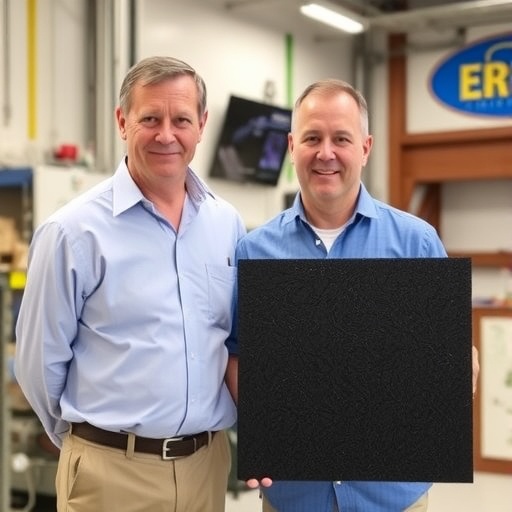
The transformation of carbon-rich pitch substances into cutting-edge materials like synthetic graphite and carbon fiber marks a significant advancement in manufacturing critical to energy, transportation, and defense sectors. At the core of this progress lies a pioneering collaboration between ACP Technologies and the Department of Energy’s Oak Ridge National Laboratory (ORNL), which has transitioned innovative pitch materials from conceptual research into a fully operational pilot-scale production facility. This development is poised to enhance the United States’ capacity to manufacture essential components domestically, fostering supply chain resilience and technological leadership.
Pitch, a complex carbonaceous material derived primarily from petroleum and coal, serves as a precursor to carbon materials with extraordinary mechanical and electrical properties. The ability to convert pitch into isotropic and mesophase forms enables the production of fibers that exhibit remarkable strength-to-weight ratios, vital for aerospace engineering, high-performance vehicles, and energy storage solutions. ACP Technologies’ recent inauguration of a pilot plant capable of producing 75 pounds of pitch-derived fiber per hour in Ashland, Kentucky, exemplifies a critical scaling milestone. This plant builds on years of rigorous research and process optimization fostered through extensive collaboration with ORNL.
The alliance between ACP Technologies and ORNL traces back nearly a decade, driven by the quest to refine lower-cost, higher-performing pitch-based carbon fibers. ORNL’s long-standing expertise in alternative carbon fiber precursors provided the foundational knowledge and experimental rigor necessary for overcoming processing challenges inherent to pitch materials. Early-stage laboratory trials focused on characterizing the intricate chemistry of pitch, a heterogeneous blend of multiple polyaromatic hydrocarbons, whose properties cannot be singularly predicted by simple measures such as softening point or viscosity. Instead, nuanced assessments and iterative refinements were essential to advancing fiber spinnability and overall material performance.
One of the pivotal breakthroughs emerged from detailed observations beyond conventional bulk property measurements. The appearance of microscopic particulates within the pitch matrix, which did not significantly affect standard viscosity readings, was found to be detrimental during fiber spinning due to filtration blockages. This insight underscored the necessity for comprehensive analytical techniques to guide the refinement of pitch batches, ensuring consistency during prolonged manufacturing runs. Such meticulous, feedback-driven development epitomizes the symbiosis between ORNL’s scientific acumen and ACP’s practical process engineering.
Beyond the raw material formulation, the stabilization process—an oxygen-rich heat treatment critical for preserving fiber morphology during high-temperature carbonization—received extensive scrutiny. Variations in thermal ramp rates and atmospheric conditions were systematically explored to optimize stabilization uniformity and reduce cycle times, directly impacting the commercial viability of the final product. This careful balance between thermal processing parameters and material integrity was a cornerstone of scaling efforts, marking the transition from laboratory feasibility to industrial reproducibility.
As material formulations matured, the partnership expanded its scope into the Department of Energy’s Carbon Fiber Technology Facility (CFTF) at ORNL. This pilot-scale environment serves as an indispensable bridge between bench-scale experiments and full-scale commercial production. Equipped with melt-spinning lines and downstream processing capabilities, the CFTF allowed ACP Technologies to validate their processes under conditions that closely mimic industrial settings. Such scale-up trials are essential for demonstrating consistent product quality and informing the engineering decisions necessary for capital investment in larger manufacturing plants scheduled to commence operations by 2029.
The CFTF’s integrated approach encompasses the entire fiber production pipeline—from precursor synthesis through stabilization, chopping, and handling—providing ACP with a comprehensive perspective on manufacturing design. This holistic understanding is invaluable when configuring commercial facilities, as it anticipates bottlenecks and variability that may not be evident in isolated process steps. The synergy of cutting-edge research infrastructure and industry partnership exemplifies the applied research mission of national laboratories, translating fundamental discoveries into tangible economic and strategic advantages.
Looking beyond carbon fiber composites, pitch-derived materials hold promise across multiple high-value sectors. Mesophase pitch, for instance, can be converted into synthetic graphite utilized in lithium-ion battery anodes, an area witnessing exponential demand growth in electric vehicles and grid storage applications. The strategic importance of developing domestic sources of such materials cannot be overstated, given geopolitical complexities and supply chain vulnerabilities linked to foreign sourcing of critical minerals and advanced manufacturing capabilities.
The Department of Energy’s Critical Minerals and Energy Innovation Office plays a pivotal role in supporting this technology maturation pathway, channeling resources through the Advanced Materials and Manufacturing Technologies Office and the Transportation Technologies Office. By fostering collaborations that accelerate pilot-scale development and reduce commercialization risk, these programs bolster U.S. competitiveness in strategically vital industries. The research at ORNL, in conjunction with pilot-scale demonstrations at the CFTF, exemplifies how targeted investment in applied R&D translates into jobs, industrial growth, and enhanced national security.
In the broader socio-economic context, the establishment of new pilot and commercial-scale manufacturing facilities in rural communities underscores the inclusive impact of advanced materials innovation. These developments not only pivot cutting-edge science into market realities but also generate sustained economic value, reinforcing the critical linkage between national laboratory capabilities, industrial advancement, and community revitalization.
The story of ACP Technologies and ORNL is emblematic of the transformative power of collaborative innovation in material science. It illustrates how deep scientific insight, combined with strategic development infrastructure, can surmount the formidable challenges of scaling novel materials and processes. As the energy landscape evolves and demands for lightweight, high-performance materials intensify, such pioneering endeavors pave the way for a resilient, dynamic, and technologically sovereign domestic manufacturing sector.
Cite Scienmag News
Denise Maddox. (June 4, 2026). ORNL Collaboration Advances ACP Technologies’ Graphite and Carbon Fiber Materials Development. Scienmag. https://scienmag.com/ornl-collaboration-advances-acp-technologies-graphite-and-carbon-fiber-materials-development/
Denise Maddox. "ORNL Collaboration Advances ACP Technologies’ Graphite and Carbon Fiber Materials Development." Scienmag, 4 June 2026, https://scienmag.com/ornl-collaboration-advances-acp-technologies-graphite-and-carbon-fiber-materials-development/. Accessed 6 September 2026.
Denise Maddox. "ORNL Collaboration Advances ACP Technologies’ Graphite and Carbon Fiber Materials Development." Scienmag. June 4, 2026. https://scienmag.com/ornl-collaboration-advances-acp-technologies-graphite-and-carbon-fiber-materials-development/


