


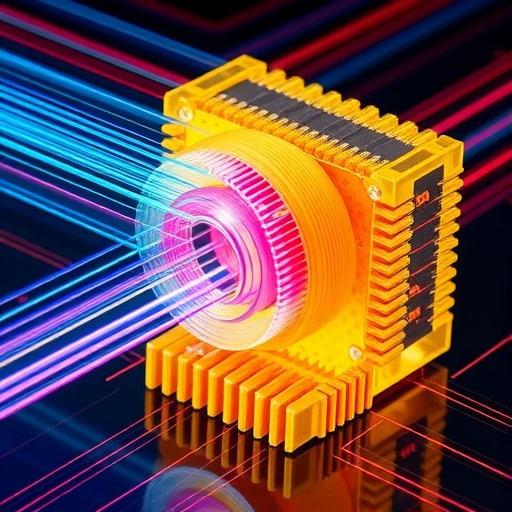
In a groundbreaking development set to redefine the landscape of precision photonics, researchers have presented an insightful comparison of phase noise and stability performance between fiber-loop and integrated-waveguide coupling methodologies within optomechanical crystal oscillators. These remarkable findings not only pave the way for significant enhancements in oscillator design but also unlock new potentials for applications requiring ultra-stable light sources, such as quantum computing, sensing, and telecommunications.
Optomechanical crystal oscillators have increasingly attracted attention due to their exceptional ability to couple photons with mechanical vibrations at the nanoscale, enabling the generation of highly coherent oscillations with minimal energy loss. Central to optimizing these devices is the efficient transfer and coupling of optical signals, which directly influences the oscillator’s phase noise — a crucial parameter dictating the purity and temporal stability of the signal.
The recent comparative study meticulously evaluates two prominent coupling techniques: fiber-loop and integrated-waveguide coupling. Fiber-loop coupling employs a micro-scale optical fiber loop to interface with the optomechanical cavity, while integrated-waveguide coupling incorporates lithographically fabricated waveguides directly onto the chip hosting the oscillator. Although both methods serve the purpose of guiding light with minimal attenuation, their influence on overall system stability and noise characteristics reveals nuanced yet impactful differences.
The investigators deployed state-of-the-art characterization tools to measure the phase noise spectra across a broad frequency range for optomechanical crystal oscillators configured with either fiber-loop or integrated-waveguide coupling. Their empirical analysis unveiled that fiber-loop couplers tend to introduce excess phase noise attributed to environmental perturbations such as mechanical vibrations and thermal fluctuations affecting the fiber segment. These challenges manifest as increased instability in the oscillator’s output, hindering its suitability in demanding precision settings.
Conversely, devices utilizing integrated-waveguide coupling demonstrated significantly lower phase noise levels. This advantage stems from the inherent monolithic design of integrated waveguides, which offers superior mechanical robustness and thermal stability relative to their fiber counterparts. The seamless integration reduces parasitic back-reflections and scattering losses, enabling consistent coupling efficiency and thereby enhancing the fidelity of optomechanical oscillations.
Furthermore, the integrated-waveguide approach facilitates scalable fabrication techniques, promising economical mass production without sacrificing performance. This attribute is particularly attractive for future photonic circuits aiming to exploit the unique dynamics of optomechanical oscillators within compact architectures. The prospect of integrating these oscillators alongside other photonic components on a single chip heralds a new era of multifunctional, miniaturized devices.
One of the most striking implications of this research lies in its relevance to quantum information sciences. As quantum technologies demand ultra-stable oscillators to maintain coherence over extended periods, minimizing phase noise becomes paramount. Integrated-waveguide coupled optomechanical oscillators offer a pathway towards realizing such stable sources, critical for advancing quantum networks and sensors.
The study also explored the thermal noise contributions in both coupling schemes, acknowledging that temperature fluctuations remain a formidable obstacle in nanoscale devices. Integrated-waveguides, benefiting from thermal conduction through the substrate and on-chip thermal management techniques, exhibited enhanced resilience against temperature-induced noise. Meanwhile, fiber-loop systems remained vulnerable due to their suspended configuration, which exposes them more directly to ambient temperature variances.
This research extends beyond theoretical investigations by providing practical design guidelines for future optomechanical systems. By elucidating the trade-offs between coupling methodologies, it empowers engineers to tailor device architectures according to application-specific noise and stability requirements. Such insights can drive targeted innovations in fields ranging from ultra-sensitive biosensing to secure optical communication networks, where the quality of the oscillator profoundly impacts system performance.
Critically, the paper discusses the compatibility of integrated-waveguide couplers with emerging materials such as silicon carbide and diamond, known for their exceptional mechanical and optical properties. Integration with these substrates could further enhance durability and performance, suggesting a fertile avenue for subsequent research endeavors.
Moreover, the authors emphasize the complementary roles of feedback control systems in tandem with low-noise coupling techniques, underlining that coupling optimization is a crucial piece within a broader puzzle of stabilizing optomechanical oscillators. Implementing advanced feedback loops and laser locking mechanisms alongside integrated coupling can open new horizons in achieving quantum-limited oscillator performance.
In summary, this pioneering work sharply delineates the advantages of integrated-waveguide couplers over traditional fiber-loop counterparts in reducing phase noise and improving stability within optomechanical crystal oscillators. The alignment of practical engineering solutions with fundamental nanophotonic principles showcased herein marks a significant leap forward for photonics research and technology.
As the photonics community steadily marches towards the realization of fully integrated quantum-optomechanical systems, these findings serve as both a benchmark and a beacon, spotlighting the critical role of coupling strategies in shaping the future of coherent nanoscale light sources. The ripple effects of this research are poised to influence multiple sectors, from metrology to communications, promising a wave of innovations harnessing the subtle interplay of light and mechanics.
The journey toward mastering low-noise, stable optomechanical oscillators is far from over, but with insights such as these, scientists and engineers are better equipped than ever to decode the complexities of photon-phonon interactions. This path forward underscores the power of interdisciplinary collaboration, where materials science, quantum optics, and nanofabrication unite to forge the next generation of technological marvels.
The publication of these results exemplifies a major stride in nano-optomechanics and inspires a reimagining of how integrated photonic structures can transform oscillatory behavior at fundamental limits. The intricate balance between optical coupling, mechanical architecture, and environmental control remains a frontier of exploration brimming with scientific and practical potential.
As global investment in photonic technologies accelerates and the demand for ultra-precise timing and sensing solutions intensifies, the insights from this study promise to catalyze more efficient designs and robust implementations, heralding a new epoch in high-performance optomechanical oscillators.
Cite Scienmag News
Katie Riggs. (June 4, 2026). Fiber-Loop vs. Integrated Waveguide: Optomechanical Oscillator Stability. Scienmag. https://scienmag.com/fiber-loop-vs-integrated-waveguide-optomechanical-oscillator-stability/
Katie Riggs. "Fiber-Loop vs. Integrated Waveguide: Optomechanical Oscillator Stability." Scienmag, 4 June 2026, https://scienmag.com/fiber-loop-vs-integrated-waveguide-optomechanical-oscillator-stability/. Accessed 4 September 2026.
Katie Riggs. "Fiber-Loop vs. Integrated Waveguide: Optomechanical Oscillator Stability." Scienmag. June 4, 2026. https://scienmag.com/fiber-loop-vs-integrated-waveguide-optomechanical-oscillator-stability/


