


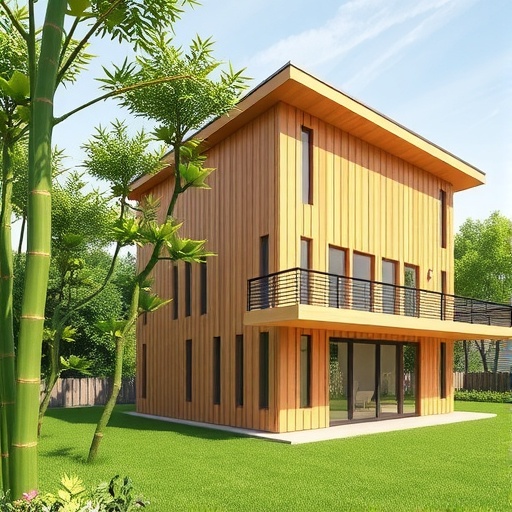
As the global construction industry intensifies its search for sustainable and low-carbon materials, the integration of biomass into cement-based composites emerges as a compelling solution with considerable challenges. Traditional incorporation of natural fibers into cement frameworks has been persistently hindered by weak interfacial bonding and structural inconsistencies, limiting their potential in practical construction applications. A groundbreaking study published in the Journal of Bioresources and Bioproducts introduces a novel method leveraging bamboo processing waste to overcome these issues, ultimately advancing the performance and ecological credentials of thermal insulation composites.
Bamboo, known for its rapid growth and mechanical resilience, generates substantial byproducts during industrial processing. Approximately 35% to 50% of bamboo biomass becomes waste, often relegated to landfill or incineration, thereby representing a significant underutilized resource. Repurposing these residues not only addresses environmental disposal concerns but also opens pathways to creating high-performance building materials that align with circular economy principles. The study centers on this rationale, aiming to transform bamboo scraps into valuable composite components within magnesium oxychloride cement (MOC) matrices.
MOC itself is attracting renewed attention as a low-carbon alternative to conventional Portland cement. Unlike Portland cement, which requires energy-intensive calcination processes and emits large quantities of CO2, MOC forms through reactions involving magnesium oxide and magnesium chloride at relatively low temperatures, yielding a cementitious material with a fraction of the carbon footprint. However, MOC suffers from characteristic drawbacks, notably its brittleness and moisture sensitivity, which have historically constrained its widespread use in construction scenarios demanding durability and toughness.
Addressing these limitations necessitates innovative strategies to improve composite toughness and moisture resistance while preserving insulating properties. This recent investigation proposes a mild chemical modification of bamboo scraps through ammonium carbonate treatment prior to their incorporation into the MOC matrix. Diverging from conventional strong alkali treatments, which aggressively degrade fiber structures and create toxic effluents, this gentle method selectively removes non-cellulosic components such as lignin and hemicellulose, preserving the primary cellulose fibers critical for mechanical reinforcement.
This carefully balanced chemical modulation imparts dual benefits within the composite system. First, the treatment softens the rigid bamboo fibers’ structure, mitigating their disruptive effect on pore formation during foam composite fabrication. The rigidity of untreated fibers often leads to pore collapse and uneven distribution, which in turn generate stress concentration points prone to mechanical failure. Second, the exposure of hydrophilic groups on the bamboo fiber surface fosters enhanced chemical affinity and bonding between the organic fibers and the inorganic MOC matrix.
On a microstructural level, the ammonium carbonate-treated bamboo facilitates the growth of needle-like magnesium oxychloride crystalline phases that penetrate fiber surface micropores, effectively “anchoring” the organic and inorganic phases together. This interfacial bonding mechanism significantly augments composite toughness and mechanical coherence. Electron microscopy images reveal that untreated bamboo fibers disrupt foam pore morphology, leading to irregular and compromised cellular structures. Conversely, treated fibers sustain pore integrity, promoting homogeneously distributed pores throughout the composite volume.
The enhanced pore architecture contributes substantially to both mechanical and thermal performance. Uniform pores reduce localized stress concentrations and overall composite brittleness while simultaneously restricting conduction pathways for heat transfer, yielding improved insulation characteristics. Quantitative performance evaluation under optimized treatment parameters demonstrated a remarkable 45% increase in compressive strength, an enhancement in the softening coefficient by 12%, and a 15% reduction in thermal conductivity compared to untreated bamboo composites. These concurrent improvements underscore the feasibility of balancing lightweight structural strength with effective thermal insulation, a critical requirement for modern energy-efficient buildings.
Beyond mechanical and thermal gains, the environmental footprint of the treatment process was also assessed. The ammonium carbonate approach yields wastewater with significantly reduced chemical oxygen demand (COD) relative to traditional sodium hydroxide treatments, lessening water pollution risks. Moreover, residual ammonia from the reaction can be captured and recycled as agricultural fertilizer, exemplifying a closed-loop process that enhances resource efficiency and minimizes industrial waste streams.
In synthesizing these findings, the research delineates a sustainable pathway for valorizing bamboo processing residues into high-quality building materials that effectively integrate organic fibers with inorganic cement matrices. This advancement marks a significant stride toward overcoming the compatibility challenges inherent in biomass-cement composites and aligns with global imperatives to decarbonize the construction sector without compromising material performance.
Potential practical applications for the developed composites encompass thermal insulation panels, structural fillers, and fire-resistant building components. Each of these serves critical roles in reducing energy consumption, optimizing resource use, and improving safety in residential and commercial constructions. By harnessing agricultural waste and environmentally benign chemical treatments, this work lays the groundwork for novel materials that could reshape sustainable architecture and civil engineering paradigms.
The broader implications of this research underscore the transformative potential of moderate chemical treatments applied judiciously to biomass resources. By preserving essential fiber structures while enhancing interfacial adhesion with mineral phases, such methodologies can unlock new avenues for composite materials that combine ecological responsibility with high mechanical and thermal functionality.
Future research directions may probe the scalability of the ammonium carbonate treatment process in industrial settings, investigate long-term durability under various environmental stresses, and explore integration with other low-carbon cementitious materials. Additionally, life cycle analyses and techno-economic assessments will be crucial to validating the commercial viability and environmental advantages of these composites on a broad scale.
In summary, light chemical component modulation of bamboo scraps emerges as a compelling strategy to enhance interfacial compatibility and strength in thermal insulation composites, exemplifying how innovative material science can contribute to sustainable construction technologies with global impact.
News Publication Date: 15-Apr-2026
Web References:
Journal of Bioresources and Bioproducts
DOI: 10.1016/j.jobab.2026.100252
Keywords
Bamboo, biomass, magnesium oxychloride cement, interfacial bonding, thermal insulation composites, sustainable construction, chemical modification, ammonium carbonate treatment, pore structure, composite materials, low-carbon cement, mechanical strength
Cite Scienmag News
Denise Maddox. (April 21, 2026). Innovative Bamboo Waste Treatment Enhances Strength and Insulation in Sustainable Building Composites. Scienmag. https://scienmag.com/innovative-bamboo-waste-treatment-enhances-strength-and-insulation-in-sustainable-building-composites/
Denise Maddox. "Innovative Bamboo Waste Treatment Enhances Strength and Insulation in Sustainable Building Composites." Scienmag, 21 April 2026, https://scienmag.com/innovative-bamboo-waste-treatment-enhances-strength-and-insulation-in-sustainable-building-composites/. Accessed 3 September 2026.
Denise Maddox. "Innovative Bamboo Waste Treatment Enhances Strength and Insulation in Sustainable Building Composites." Scienmag. April 21, 2026. https://scienmag.com/innovative-bamboo-waste-treatment-enhances-strength-and-insulation-in-sustainable-building-composites/


