


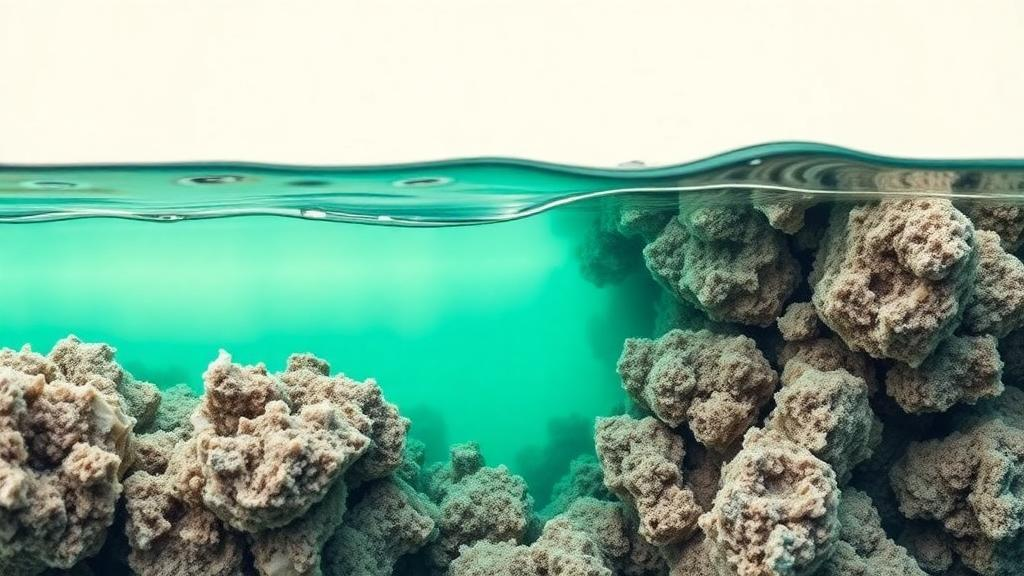
A dye-stained river is one of the most visible signatures of industrial pollution, and one of the hardest to undo. Methylene blue, a synthetic cationic thiazine dye used extensively in textile, paper, and chemical manufacturing, is prized for its intense coloration and chemical stability — the very qualities that make it an environmental menace. Its heterocyclic aromatic structure resists biodegradation, allowing it to persist in aquatic environments, and industrial wastewater streams commonly carry concentrations between 10 and 200 milligrams per liter. Even at low levels, the dye reduces light penetration, inhibits photosynthesis, and lowers dissolved oxygen, while prolonged exposure has been linked to skin irritation, respiratory problems, neurological disturbances, and cellular damage. Now, a team of researchers led by Fatemeh Oshani, Mostafa Mahinroosta, and Ebrahim Ghasemi has reported in Results in Engineering a remarkably practical answer: a porous geopolymer adsorbent built almost entirely from industrial byproducts that strips more than 93 percent of methylene blue from water in just one hour.
The material belongs to a family of substances known as geopolymers — amorphous, metastable aluminosilicates first developed by Joseph Davidovits in 1970. They are synthesized by reacting an aluminosilicate precursor, such as calcined clay, fly ash, or natural pozzolans, with an alkaline activator like sodium hydroxide at temperatures below 100 degrees Celsius. At the molecular level, the result is an anionic framework of corner-sharing SiO4 and AlO4 tetrahedra, into which charge-balancing cations such as sodium or potassium are incorporated from solution. This architecture gives geopolymers a set of properties that make them unusually attractive for water treatment: low-cost and abundant precursors, tunable porosity, chemical stability, and a synthesis route that is gentle on the environment. Their adjustable surface chemistry and robust structural framework also support adsorption efficiency and recyclability, addressing two of the biggest weaknesses of conventional adsorbents.
What distinguishes the new work is its dual pore-generation strategy and its systematic exploration of precursor composition. The team calcined kaolin from Zettlitz in the Czech Republic at 700 degrees Celsius for three hours to produce metakaolin, then blended it with silica fume — an ultrafine byproduct of ferrosilicon and silicon metal production, containing more than 96 percent amorphous silica and a surface area of roughly 20,000 square meters per kilogram. Silica fume replaced metakaolin at proportions ranging from 0 to 25 weight percent, serving as a reactive silica source within the alkaline activator system. To open up the internal architecture, the researchers added hydrogen peroxide at 5 weight percent as a foaming agent, which decomposes to generate gas-induced pores, and corn oil at 1 weight percent as a templating phase that promotes interconnected voids. The paste was cured at 60 degrees Celsius for 12 hours, followed by hydrothermal curing for another 24 hours, before being crushed, sieved to particles below 100 micrometers, washed with hot water, and dried.
The screening experiments revealed a striking optimum. When six adsorbent formulations were tested against a 10 milligram per liter methylene blue solution at natural pH with a dosage of 1 gram per liter, both adsorption capacity and removal efficiency climbed as silica fume content rose to 10 percent, where the S(10) formulation achieved roughly 90 percent removal. Beyond that threshold, performance declined. The explanation lies in the structural evolution of the geopolymer: at 10 weight percent, the additional reactive silica facilitates more complete polycondensation, producing a robust and well-distributed sodium aluminosilicate hydrate gel with a balanced silicon-to-aluminum ratio that maximizes negatively charged surface sites for cationic attraction. Above that level, particle agglomeration reduces available surface area, partially blocks mesoporous channels, and increases paste viscosity — which hinders uniform distribution of the hydrogen peroxide foam and yields a less interconnected pore structure riddled with physical defects.
With the optimal composition identified, the researchers mapped how operating conditions shape performance. Increasing the adsorbent dosage from 0.5 to 2.5 grams per liter raised removal efficiency from 60 to 93 percent, though the amount adsorbed per gram of material fell from 11.52 to 3.84 milligrams as sites began to overlap and aggregate. pH proved decisive: removal efficiency rose from 58.5 percent at pH 1 to 93 percent at pH 7, then slipped slightly to 90.5 percent at pH 9. The chemistry is intuitive — under acidic conditions, the geopolymer surface is surrounded by hydrogen ions and acquires a positive charge, electrostatically repelling the cationic dye, while neutral conditions maximize the attraction between dye cations and the negatively charged surface. Notably, the optimum coincides with the material’s point of zero charge, and because real textile effluents often require expensive pH adjustment before treatment, the ability to perform best at near-neutral conditions could meaningfully cut operational costs. Contact time experiments showed 73.05 percent removal within the first 30 minutes, reaching equilibrium at 60 minutes with 93.6 percent removal.
Kinetic modeling pointed to a chemical rather than purely physical binding process. The pseudo-second-order model fit the data with a correlation coefficient of 0.99, far outperforming the pseudo-first-order model at 0.84 and the Elovich model at 0.7 — a signature of chemisorption, in which electron sharing or exchange between adsorbent and adsorbate governs the rate. The intraparticle diffusion model fit poorly, and its non-zero intercept confirmed that pore diffusion is not the sole rate-limiting step; boundary layer resistance and film diffusion also contribute to mass transfer. On the equilibrium side, the Langmuir isotherm described the data best with a correlation coefficient of 0.98, ahead of the Freundlich model at 0.94 and the Temkin model at 0.92. Together, the kinetic and isotherm analyses indicate monolayer chemisorption on energetically equivalent sites, with a maximum adsorption capacity of 12.30 milligrams per gram and a separation factor of 0.064 confirming favorable adsorption.
Spectroscopic and microscopic analyses supplied direct evidence of how the dye molecules attach. Fourier transform infrared spectroscopy showed a reduction and shift of the primary silicon-oxygen-aluminum vibration band between 850 and 1200 wavenumbers after dye uptake, alongside the appearance of methylene blue-specific signals near 1243, 1100, and 1400 wavenumbers, attributed to C–N and N–N stretching and aromatic ring deformations. Changes in the broad hydroxyl stretching region near 3400 wavenumbers suggested hydrogen bonding between surface hydroxyl groups and the dye. X-ray diffraction revealed the characteristic broad amorphous hump of the N-A-S-H gel, which broadened slightly after adsorption but returned to its original profile after regeneration, confirming structural stability. Nitrogen sorption measurements classified the material as mesoporous, with a Type IV isotherm and H3-type hysteresis loop indicating slit-like or ink-bottle-shaped pores, a specific surface area of 12.515 square meters per gram, and an average pore diameter of 31.7 nanometers — dimensions that facilitate rapid transport of dye molecules to internal active sites. Scanning electron microscopy showed pores partially coated and filled after adsorption, with elemental mapping revealing increased carbon and nitrogen content that vanished after regeneration.
The adsorption mechanism that emerges is a layered one. Negatively charged siloxo and alumoxo sites on the geopolymer surface attract the cationic dye electrostatically, while charge-balancing sodium ions within the pores undergo direct ion exchange with methylene blue cations. The dye molecule adopts a more planar configuration, lying flat on the surface, which facilitates π–π interactions between its aromatic rings and silanol groups, and the presence of aluminum and sodium ions combined with the dye’s conjugated structure may induce additional n–π interactions. Hydrogen bonding with surface functional groups further enhances uptake. Initial capture is assisted by van der Waals forces, dipole–dipole interactions, and physical pore filling within the mesoporous network, but the rate is ultimately governed by the abundance of accessible surface sites rather than diffusion alone.
Perhaps most importantly for real-world deployment, the adsorbent proved reusable. Over five adsorption–desorption cycles, removal efficiency declined from 93.6 percent to approximately 73 percent when regenerated with hydrochloric acid and to about 80 percent when regenerated with ethanol. Ethanol proved the superior regenerant: its lower dielectric constant weakens the electrostatic grip between dye cations and the negatively charged surface, while it competes for silanol and aluminol binding sites through hydrogen bonding and solvates the dye’s aromatic rings. The residual capacity loss stems from irreversible chemisorption at high-energy sites and partial pore masking in narrow mesopores, where dye molecules bound through strong chemical interactions resist displacement. Even so, retaining 80 percent efficiency after five cycles is a commendable result that addresses the common criticism that adsorption merely transfers pollutants from water to a solid that must then be discarded.
The researchers are candid about the material’s limits. Its maximum capacity of 12.30 milligrams per gram trails some highly porous commercial adsorbents and engineered materials, a consequence of the relatively modest surface area and the absence of additional surface functionalization. Yet the comparison that matters may be economic rather than absolute: the removal efficiency of 93.6 percent rivals that of far more elaborate systems, and the synthesis route relies on low-cost, widely available industrial wastes — silica fume from ferroalloy furnaces and calcined clay — while operating at mild temperatures without energy-intensive processing. The team suggests that surface tailoring, chemical modification, or the incorporation of carbon-based materials, metal oxides, or nanoscale additives could push performance further, and that testing under real wastewater conditions, long-term reuse, and continuous-flow systems will be needed to establish broader applicability. For now, the study demonstrates that two industrial waste streams, a splash of hydrogen peroxide, and a spoonful of cooking oil can be transformed into a working water-cleaning material — a small but compelling example of circular chemistry aimed at one of the world’s most persistent pollution problems.
Subject of Research: Porous metakaolin–silica fume geopolymer adsorbents for removing methylene blue dye from contaminated water
Article Title: Eco-friendly production of porous metakaolin–silica fume geopolymer for adsorptive removal of methylene blue from water
Article References: Oshani, F., Mahinroosta, M., & Ghasemi, E. (2026). Eco-friendly production of porous metakaolin–silica fume geopolymer for adsorptive removal of methylene blue from water. Results in Engineering, 32, Article 113419. https://doi.org/10.1016/j.rineng.2026.113419
Image Credits: AI Generated
DOI: 10.1016/j.rineng.2026.113419
Keywords: geopolymer, methylene blue, adsorption, silica fume, metakaolin, wastewater treatment, dye removal, porous materials, chemisorption, water purification, industrial byproducts, sustainability
Cite Scienmag News
Denise Maddox. (October 14, 2026). Industrial Waste Transformed Into Porous Sponge That Scrubs Toxic Dye From Water. Scienmag. https://scienmag.com/industrial-waste-transformed-into-porous-sponge-that-scrubs-toxic-dye-from-water/
Denise Maddox. "Industrial Waste Transformed Into Porous Sponge That Scrubs Toxic Dye From Water." Scienmag, 14 October 2026, https://scienmag.com/industrial-waste-transformed-into-porous-sponge-that-scrubs-toxic-dye-from-water/. Accessed 14 October 2026.
Denise Maddox. "Industrial Waste Transformed Into Porous Sponge That Scrubs Toxic Dye From Water." Scienmag. October 14, 2026. https://scienmag.com/industrial-waste-transformed-into-porous-sponge-that-scrubs-toxic-dye-from-water/


