


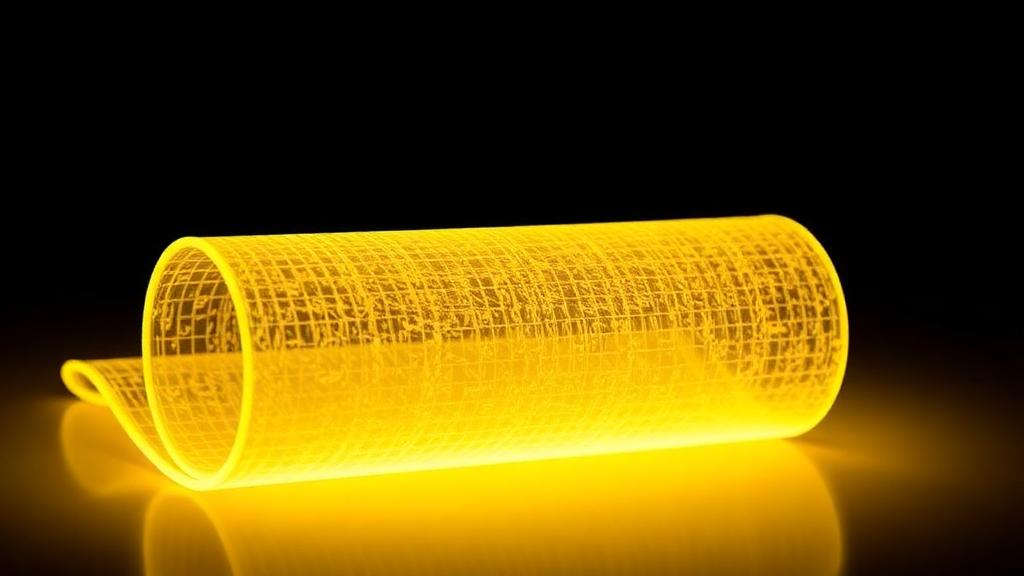
Imagine taking a single atom-thick sheet of hexagonal boron nitride and rolling it up like a tiny carpet. The result is a nanoscroll, an open-ended spiral structure that is neither a flat sheet nor a sealed nanotube, and it may hold unexpected promise for converting waste heat into electricity. A new theoretical study published in Results in Physics by Elham Samadpour, Daryoosh Dideban, and Hossein Karamitaheri examines how the way these scrolls are rolled, known as their chirality, influences their thermoelectric performance in the ballistic transport regime, where electrons move through the structure without scattering.
Thermoelectric materials have long been pursued as a route to sustainable energy because they can harvest waste heat directly and turn it into useful electrical power. The efficiency of such a material is captured by a dimensionless quantity called the figure of merit, ZT, which demands a delicate balance: low thermal conductivity, high electrical conductivity, and a high Seebeck coefficient, the voltage generated per unit of temperature difference. The catch is that these three properties are interdependent, so improving one often degrades another. Nanoscale engineering, particularly through quantum confinement effects, offers a way to weaken these correlations and push performance upward.
Hexagonal boron nitride is a fascinating candidate for such engineering. Structurally it resembles graphene, with boron and nitrogen atoms arranged in a honeycomb lattice, but the two different atomic species give it fundamentally different behavior. Where graphene is a zero-band-gap semimetal, h-BN is a wide-band-gap semiconductor, and it combines exceptional chemical and thermal stability, high resistance to oxidation, and better biocompatibility and lower toxicity than carbon-based nanomaterials. Its nanomaterials are already used industrially as powders, ceramics, coatings, and chemical vapor deposition layers, yet its thermoelectric properties at the nanoscale remain far less explored than those of graphene.
Nanoscrolls themselves have an intriguing history. Scroll structures were first proposed by Bacon in 1960, confirmed decades later once imaging techniques caught up, and successfully synthesized in 2003 through a chemical route to carbon nanoscrolls. Unlike nanotubes, which form closed cylinders, nanoscrolls retain an open-ended morphology, sharing some properties with multi-walled nanotubes but differing in ways that matter for electron transport. Depending on which crystallographic direction is chosen as the rolling axis, zigzag, armchair, or chiral scrolls can be produced, and the geometry is described by a polar equation in which the radial distance grows with the rolling angle and the interlayer spacing.
The research team modeled five zigzag h-BN nanoscrolls, labeled (15,0) through (19,0), across a temperature range of 200 to 700 kelvin. They employed a nearest-neighbor tight-binding method to calculate the electronic band structure, adapting the framework originally developed for graphene. Because h-BN contains two distinct atoms, the onsite energies at nitrogen and boron sites differ, opening a band gap where graphene has none. The open geometry of the scroll required a further modification: instead of the strict periodic boundary condition that applies to nanotubes, the researchers introduced a phase shift into the circumferential boundary condition, treating these phase shifts as effective parameters adopted from prior graphene nanoscroll work rather than independently optimized values for h-BN.
The band structure calculations revealed something striking: all five scroll chiralities are wide-band-gap semiconductors with nearly identical gaps of roughly 4.74 electron volts, regardless of how tightly or loosely they are rolled. Changing the chirality does not significantly influence the band gap; it only alters the number and energy of the sub-bands that emerge from the rolled geometry. This curvature independence echoes earlier findings for boron nitride nanotubes, suggesting that for h-BN nanostructures, helicity in the atomic arrangement has a negligible effect on the fundamental gap.
Where chirality does matter is in the fine structure of electron transport. Using the Landauer-Büttiker formalism, the team calculated the transmission function, which counts the conducting channels available at each energy. At around 2.37 electron volts, transmission jumps from zero to two channels for chiralities where the index n is a multiple of three, but only from zero to one for the others. These differences cascade through the thermoelectric parameters. Electrical conductance, which depends on the overlap between the transmission function and the thermal broadening of the Fermi-Dirac distribution, rises first and fastest for the (19,0) scroll, whose transmission increases in larger, more uniform steps, while the (16,0) scroll, despite having the smallest band gap, lags because its second channel opens only at higher energies.
The Seebeck coefficient, by contrast, showed only negligible differences among chiralities at room temperature, reflecting the similar asymmetry of the transmission functions around the Fermi level. To compare the materials fairly, the team evaluated all parameters at reference Fermi energies where the power factor peaks, near 2.35 electron volts. Raising the temperature from 200 to 700 kelvin increased electrical conductance by a factor of roughly 2.1 to 2.6, as the broadening function expanded to admit higher-energy sub-bands into conduction, while the Seebeck coefficient declined slightly, by about 3 to 10 percent, for most chiralities. The (17,0) and (18,0) scrolls bucked this trend above 600 kelvin, where the growing asymmetry contribution to the Seebeck numerator slightly outweighed the rising conductance in the denominator.
The headline result concerns the electronic figure of merit. Although the (19,0) scroll delivers the highest power factor across the entire temperature range, it is the (15,0) scroll that achieves the highest ZT at lower temperatures, reaching 4.22 at 200 kelvin and 3.4 at 300 kelvin, before falling to 2.07 at 700 kelvin, the lowest value in the study. The (19,0) and (16,0) scrolls proved the most temperature-stable, with their figures of merit holding nearly constant at about 2.5 above 400 and 500 kelvin respectively. The overall decline of ZT with temperature stems from electron thermal conductance climbing 8.5 to 13.5 times faster than the power-generating term in the figure of merit, a consequence of the Wiedemann-Franz-like coupling between electrical and electronic thermal conductance.
The authors are careful to frame these numbers as ideal upper limits. The calculations describe defect-free scrolls under purely ballistic transport, with no accounting for electron-phonon scattering, structural disorder, or finite device length, all of which become increasingly important at elevated temperatures. The tight-binding model was also not calibrated against first-principles calculations for these specific geometries, so the trends, not the absolute values, carry the most weight. Even so, the study opens a genuinely new window: it is the first extensive look at how the rolling geometry of boron nitride nanoscrolls shapes thermoelectric behavior, and it suggests that choosing the right chirality could one day help engineers tune these biocompatible, thermally robust spirals into working components of waste-heat recovery devices.
Subject of Research: Chirality-dependent ballistic thermoelectric properties of zigzag hexagonal boron nitride nanoscrolls
Article Title: Comparative investigation of chirality-dependent thermoelectric performance in hexagonal boron nitride nanoscrolls under ballistic transport regime
Article References: Samadpour, E., Dideban, D., & Karamitaheri, H. (2026). Comparative investigation of chirality-dependent thermoelectric performance in hexagonal boron nitride nanoscrolls under ballistic transport regime. Results in Physics, Article 108768. https://doi.org/10.1016/j.rinp.2026.108768
Image Credits: AI Generated
DOI: 10.1016/j.rinp.2026.108768
Keywords: hexagonal boron nitride, nanoscrolls, thermoelectrics, chirality, ballistic transport, figure of merit, tight-binding model, Landauer-Büttiker formalism, Seebeck coefficient, band structure, waste heat recovery, nanomaterials
Cite Scienmag News
Denise Maddox. (October 14, 2026). Rolled-Up Boron Nitride Scrolls Show Chirality Shapes Their Thermoelectric Promise. Scienmag. https://scienmag.com/rolled-up-boron-nitride-scrolls-show-chirality-shapes-their-thermoelectric-promise/
Denise Maddox. "Rolled-Up Boron Nitride Scrolls Show Chirality Shapes Their Thermoelectric Promise." Scienmag, 14 October 2026, https://scienmag.com/rolled-up-boron-nitride-scrolls-show-chirality-shapes-their-thermoelectric-promise/. Accessed 14 October 2026.
Denise Maddox. "Rolled-Up Boron Nitride Scrolls Show Chirality Shapes Their Thermoelectric Promise." Scienmag. October 14, 2026. https://scienmag.com/rolled-up-boron-nitride-scrolls-show-chirality-shapes-their-thermoelectric-promise/


