


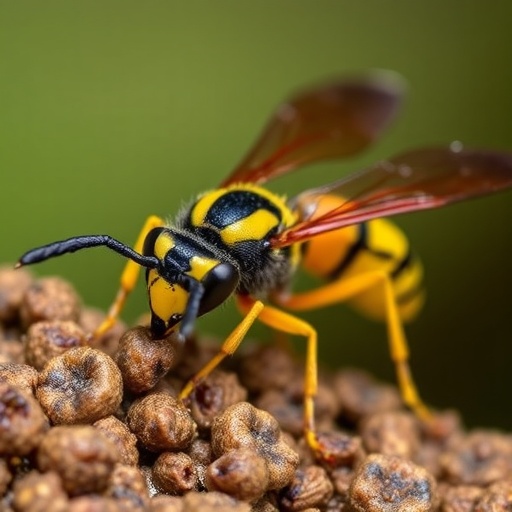
Wasps are often portrayed as solitary villains of the picnic table, but inside their bodies they host complex microbial communities that may influence how they digest food, resist disease and adapt to their environments. A new comparison of four polistine wasp species from India has found that the bacteria living in these insects’ guts are shaped strongly by diet—but not always in the way researchers expected. The study, published in Microbial Ecology, shows that populations of the same species collected from different regions could possess more similar microbiota than closely related species living side by side. The result challenges a simple assumption in animal microbiome research: that geography and shared surroundings necessarily dominate the microbial communities carried by neighboring animals.
The researchers examined the bacterial microbiota of the social wasp Polistes wattii from northern and eastern India, along with Polistes indicus from northern India and Polistes olivaceous and Ropalidia spatulata from eastern India. These insects belong to Polistinae, a subfamily of Vespidae that includes familiar paper wasps. Many polistine species have been studied for their behavior, genetics, physiology and ecology, yet far fewer have been investigated through the lens of their resident microorganisms. That gap matters because microbes can perform essential biological functions for their hosts, including breaking down nutrients, producing metabolic compounds and interacting with the immune system. Comparing related wasps therefore offers a way to distinguish microbial patterns linked to species identity, location, lifestyle and food.
To identify the bacteria, the team used 16S ribosomal RNA amplicon sequencing on the Oxford Nanopore platform. The 16S rRNA gene is a standard molecular barcode for bacteria: parts of the gene are conserved across bacterial lineages, while variable regions contain sequence differences that help researchers determine which groups are present in a sample. In amplicon sequencing, scientists copy selected portions of that gene and read the resulting DNA fragments, creating a profile of the bacterial community without needing to culture each organism in the laboratory. This is especially useful for microbiome research because many bacteria are difficult or impossible to grow under ordinary laboratory conditions. Oxford Nanopore sequencing reads DNA by detecting changes in electrical current as individual molecules pass through tiny biological pores, allowing rapid analysis of complex samples.
The clearest pattern emerged from P. wattii. Despite being collected in two geographically separated regions of India, its bacterial communities were more alike to one another than to those found in the other three species. In practical terms, the microbiota tracked the wasp’s species identity more strongly than the map coordinates where individual insects were collected. This does not mean that geography is irrelevant. Local temperature, vegetation, nesting materials, seasonal conditions and exposure to environmental microbes can all affect an insect’s microbiome. But the findings suggest that a host’s biology—its anatomy, behavior, immune environment or characteristic diet—may filter which bacteria persist in the gut, producing a recognizable microbial signature across locations.
The discovery becomes more surprising when the wasps are compared with one another at the same location. Species living in the same region, and potentially encountering many of the same environmental bacteria, showed more distinct bacterial profiles than the two P. wattii populations. These co-occurring, or sympatric, species may nevertheless occupy different ecological niches. They can forage on different resources, collect prey in different ways or use distinct nesting and social behaviors, all of which can alter the microbes that enter and survive in their digestive tracts. Their guts may also provide different chemical conditions, such as variations in acidity, oxygen availability or digestive enzymes. Once established, these conditions can act as a biological sieve, allowing some microbial lineages to flourish while excluding others.
The study also placed the wasp results into a broader comparison across hymenopterans, the insect order that includes wasps, ants and bees. The researchers found that polistine gut communities were more similar to those of Asian vespine wasps than to those of omnivorous ants or herbivorous bees. The resemblance between polistine and vespine wasps is notable because both groups are carnivorous. Their diets can expose them to comparable nutrients and prey-associated bacteria, while the breakdown of animal tissue may favor similar microbial functions. By contrast, ants with broad omnivorous diets and bees that rely heavily on plant-derived resources encounter very different chemical and nutritional environments. The pattern supports diet as an important determinant of bacterial microbiota across hymenopterans.
Diet may influence the microbiome through several linked mechanisms. Animal-based food is rich in proteins, fats and nitrogen-containing compounds, whereas floral diets contain substantial sugars and plant chemicals, including pollen-derived materials that require different digestive strategies. Bacteria capable of metabolizing particular nutrients may gain an advantage in one host but not another. Food also changes the physical environment of the gut by affecting pH, transit time and the availability of metabolic by-products. In social insects, diet can be especially powerful because food is sometimes exchanged among nestmates, potentially allowing microbes or microbial metabolites to move through the colony. The new findings do not prove that any single bacterial group causes a particular trait, but they point to feeding ecology as a major force organizing these communities.
The researchers’ earlier work on P. wattii had suggested that its microbiota resembled that of Vespa, a genus of vespine wasps. A single species from one geographic location, however, could not reveal whether that resemblance was a general feature of polistine wasps or merely a local coincidence. By adding multiple species and sampling P. wattii in two regions, the new study provides a wider test of the pattern. Its results indicate that microbiome research on insects can be misleading when it relies on narrow geographic sampling or on a single representative species. A host’s microbial profile may look unique until it is compared with populations elsewhere, or it may appear environmentally determined until closely related species sharing the same habitat are examined together.
The findings open a new window onto the biology of wasps, but they also come with important limits. DNA sequencing reveals which bacterial signatures are present and how communities differ; it does not by itself show what those bacteria are doing inside the insect. Some detected DNA may come from transient food, the environment or dead cells rather than stable residents. Demonstrating function will require additional work, such as measuring microbial genes and metabolites, tracking changes through the wasp’s life cycle, testing different diets and examining whether removing or restoring particular microbes alters host health. Even so, the study establishes a compelling ecological message: the invisible communities inside wasps reflect both the food they eat and the evolutionary identity of the animals that carry them. Insects that appear to share the same landscape may inhabit strikingly different microbial worlds, while distant populations of one species can remain microbiologically connected.
Cite Scienmag News
Morgan Morrow. (August 28, 2026). Indian Polistine Wasps Harbor Distinct Microbiota Across Four Species. Scienmag. https://scienmag.com/indian-polistine-wasps-harbor-distinct-microbiota-across-four-species/
Morgan Morrow. "Indian Polistine Wasps Harbor Distinct Microbiota Across Four Species." Scienmag, 28 August 2026, https://scienmag.com/indian-polistine-wasps-harbor-distinct-microbiota-across-four-species/. Accessed 3 September 2026.
Morgan Morrow. "Indian Polistine Wasps Harbor Distinct Microbiota Across Four Species." Scienmag. August 28, 2026. https://scienmag.com/indian-polistine-wasps-harbor-distinct-microbiota-across-four-species/


