


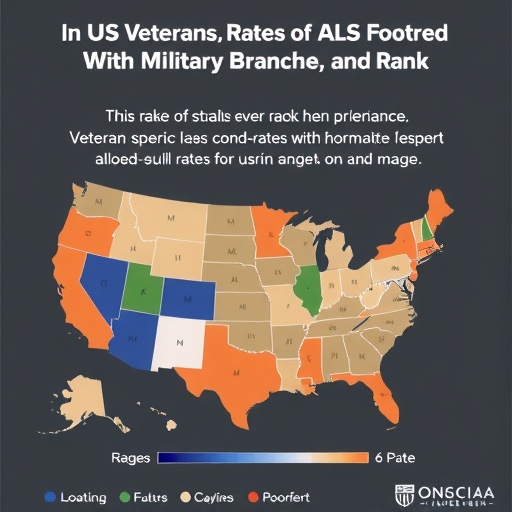
MINNEAPOLIS — Compared to Army veterans, men who are veterans of the U.S. Air Force, Navy and Coast Guard have higher rates of amyotrophic lateral sclerosis (ALS), and men who are Marine veterans have lower rates, according to a new study published July 29, 2026, in Neurology®, an official journal of the American Academy of Neurology. The study also found male and female officers had higher rates of ALS than enlisted personnel.
ALS is a rare, progressive disease characterized by the degeneration of nerve cells in the brain and the spinal cord. People with ALS lose the ability to initiate and control muscle movement, which can lead to total paralysis and death. The average life span after diagnosis is two to five years.
“Military service is a known risk factor for the development of ALS, but little is known about what factors may contribute to that risk,” said study author Marc G. Weisskopf, PhD, of Harvard T.H. Chan School of Public Health in Boston. “Our study looked at the rates of ALS among people in different branches of the U.S. military and found ALS rates varied considerably by branch and rank, with larger differences among younger veterans.”
The study included 9,157,938 men and 784,941 women who received care through the Veterans Health Administration over a 24-year period. A total of 13,935 men and 484 women had ALS.
Army veterans were the largest group, with 4,694,658 men of whom 6,660 had ALS, and 378,379 women of whom 210 had ALS. Coast Guard veterans were the smallest group with 77,023 men of whom 133 had ALS and 7,692 women of whom four had ALS.
After adjusting for age, sex and ethnicity, researchers found for men, when compared to Army veterans, Air Force veterans had a 29% higher rate of ALS, Navy veterans had a 15% higher rate and Coast Guard veterans had a 26% higher rate. Marine veterans had a 22% lower rate.
Differences among branches were most evident for men younger than 61 and were less evident among men older than 75.
Researchers also looked at rank. Weisskopf said, “Officers tend to experience more psychosocial stress, with pilots experiencing high G-forces, noise and vibration as well as circadian disruption, while enlisted personnel usually experience more extreme physical exercise, heavy weapons use and handling of fuels and solvents.”
Researchers found officers had higher rates of ALS than enlisted personnel. Among men, officers had a 64% higher rate of ALS than enlisted personnel and among women, officers had a 72% higher rate.
Researchers found that longer military service was associated with lower rates of ALS.
“Our findings suggest that officers and those serving in the Air Force, Navy or Coast Guard may have been exposed to military environments that increase risk of ALS,” said Weisskopf. “Future research should aim to identify these exposures. But it is also important to note that ALS is rare and the overall risk remains small, so even statistically significant increases associated with branch and rank represent only modest increases in risk among military personnel.” A limitation of the study was that researchers could not fully evaluate associations in women because there are fewer women in the military than men and ALS is rare.
The study was supported by the U.S. Centers for Disease Control Agency for Toxic Substances and Disease Registry, the Paralyzed Veterans of America Foundation and The ALS Network.
Discover more about ALS at Brain & Life®, from the American Academy of Neurology. This resource also offers a website, podcast, and books that connect patients, caregivers and anyone interested in brain health with the most trusted information, straight from the world’s leading experts in brain health. Follow Brain & Life on Facebook, X, and Instagram.
The American Academy of Neurology is the leading voice in brain health. As the world’s largest association of neurologists and neuroscience professionals with more than 44,000 members, the AAN provides access to the latest news, science and research affecting neurology for patients, caregivers, physicians and professionals alike. The AAN’s mission is to enhance member career fulfillment and promote brain health for all. A neurologist is a doctor who specializes in the diagnosis, care and treatment of brain, spinal cord and nervous system diseases such as Alzheimer’s disease, stroke, concussion, epilepsy, Parkinson’s disease, multiple sclerosis, headache and migraine.
Explore the latest in neurological disease and brain health, from the minds at the AAN at AAN.com or find us on Facebook, X, Instagram, LinkedIn, and YouTube.
Journal
Neurology
Natalie Conrad
American Academy of Neurology
nconrad@aan.com
Office: 612-928-6164
Renee Tessman
American Academy of Neurology
rtessman@aan.com
Office: 612-928-6137
Cell: 612-240-2531
Journal
Neurology
Tags
Cite Scienmag News
Violet Maxwell. (July 29, 2026). In US veterans, rates of ALS associated with military branch and rank. Scienmag. https://scienmag.com/in-us-veterans-rates-of-als-associated-with-military-branch-and-rank/
Violet Maxwell. "In US veterans, rates of ALS associated with military branch and rank." Scienmag, 29 July 2026, https://scienmag.com/in-us-veterans-rates-of-als-associated-with-military-branch-and-rank/. Accessed 4 September 2026.
Violet Maxwell. "In US veterans, rates of ALS associated with military branch and rank." Scienmag. July 29, 2026. https://scienmag.com/in-us-veterans-rates-of-als-associated-with-military-branch-and-rank/


