


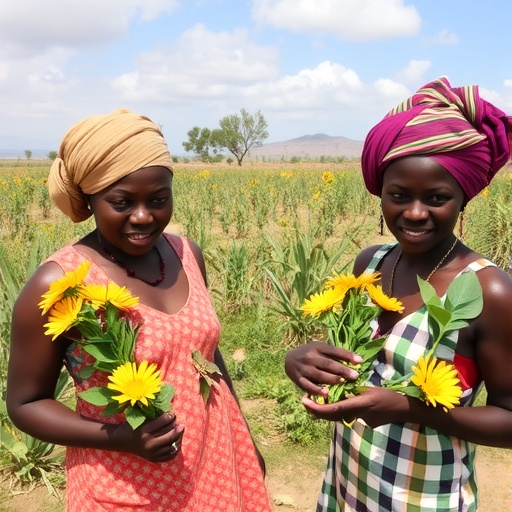
Pollinator conservation in northern Ghana may depend on a resource that formal environmental programs have routinely overlooked: women’s ecological knowledge. A study of 16 communities in the country’s semi-arid north has found that women and men often understand pollinator habitats in distinctly different ways, yet women’s expertise rarely translates into authority over conservation decisions. The findings challenge the assumption that community-based conservation automatically gives every community member an equal voice, suggesting instead that local governance can widen participation while preserving the gender and land-tenure hierarchies that determine whose knowledge is treated as credible.
The research, published in Environmental Management, examined how gendered power relations shape knowledge, conservation practices and participation in Community Resource Management Area, or CREMA, communities and in communities without CREMAs. CREMAs are decentralized arrangements designed to allow local people to manage natural resources collectively through community institutions, customary rules, training and local by-laws. In principle, such systems can connect biodiversity protection with the needs of smallholder farmers. In practice, the researchers found that the creation of a participatory institution does not necessarily erase older patterns of exclusion. A meeting may be open to a community, while leadership, decision-making and control over land remain concentrated among men or among people with stronger customary or tenure-based authority.
Pollinators are central to this question because their ecological importance is often experienced through everyday livelihood activities rather than through formal conservation science alone. Bees, butterflies and other insects transfer pollen between flowers, enabling fertilization and supporting the production of many crops. Pollination is a biological interaction: pollen produced by the anthers of one flower must reach the stigma of a compatible flower, allowing sperm cells to fertilize ovules and seeds to develop. The process can be disrupted when flowering plants disappear, habitats are burned, pesticides affect insects or harvesting damages reproductive plant structures. In semi-arid farming landscapes, where seasonal changes strongly govern vegetation and food production, observations accumulated through repeated work in fields, fallows and wild plant habitats can reveal ecological patterns that short-term surveys may miss.
The researchers worked with 128 women and men and used two qualitative methods: Photovoice and focus group discussions. Photovoice invites participants to document places, activities or environmental changes through photographs and then interpret those images in conversation. Rather than treating participants simply as subjects who answer questions designed by outsiders, the method can make their own observations the starting point for analysis. Focus groups, meanwhile, allow researchers to examine how people describe environmental practices collectively, including areas of agreement, disagreement and silence. The study was guided by Feminist Political Ecology, an approach that investigates how power, gender, labor, resource access and environmental change interact. Its central implication is that knowledge is not produced in a social vacuum: what people know is shaped by the work they do, the places they can enter and the authority they possess to make their knowledge count.
The differences between women’s and men’s ecological knowledge were striking. Women demonstrated detailed knowledge of flowering cycles, including the timing and availability of flowers that sustain pollinators across seasons. They also described harvesting practices intended to reduce harm to plants and pollinating insects. This knowledge is closely linked to livelihood activities and daily interactions with pollinator habitats. Men more frequently emphasized fire management and the retention of trees, issues associated with landscape-level management and the protection of woody vegetation. Neither knowledge system is inherently more scientific than the other. They represent different observational perspectives generated by different forms of labor and access. Knowledge of flowering periods can help identify seasonal bottlenecks for pollinators, while knowledge of fire and tree cover can help maintain nesting sites, forage and microclimates.
Yet recognizing that women possess valuable knowledge is not the same as giving them influence. The study found that women’s expertise was rarely converted into meaningful authority within conservation governance. This gap reflects a familiar problem in environmental management: participation is often measured by attendance or consultation, while power is determined by who sets agendas, interprets rules, controls resources and speaks for the community in dealings with government agencies or conservation organizations. Women may contribute labor and observations while remaining underrepresented in leadership. Their knowledge can be welcomed as anecdotal or practical but excluded from formal plans, written regulations or enforcement decisions. When that happens, conservation institutions lose information about ecological processes and simultaneously reproduce the social inequalities they were intended to overcome.
CREMA communities did appear to have greater awareness of conservation through training programs and local by-laws. These institutions can provide a framework for regulating activities such as burning, tree cutting or the use of natural resources, while creating channels through which conservation messages reach residents. But the researchers caution that institutionalization alone is not a guarantee of equity. Leadership in CREMA communities remained largely male-dominated, and decentralized governance could reproduce inequalities linked not only to gender but also to tenure. Land and resource rights influence who can participate confidently, whose claims are recognized and who can benefit from conservation decisions. A woman who has extensive knowledge of flowers and pollinators may still have limited influence if she lacks secure access to land, depends on male relatives for resource rights or is excluded from customary forums where decisions are made.
The implications extend well beyond Ghana. Pollinator conservation is frequently presented as a technical challenge involving habitat restoration, pesticide reduction, fire control and the planting of flowering species. Those interventions matter, but the study shows that their success also depends on institutional design. Conservation plans that map habitats but not power relations may overlook the people most familiar with seasonal ecological change. Training programs that invite women to learn conservation rules without placing them in leadership positions may expand awareness without redistributing authority. More effective governance would treat diverse local observations as evidence, create formal routes for incorporating them into management plans and establish fair opportunities for women to hold decision-making roles. That could include deliberately structured meetings, transparent leadership selection, recognition of women’s land and resource claims and monitoring systems that record both ecological outcomes and participation.
The study does not suggest that women and men form uniform or opposing categories, nor that all women share the same interests. Gender intersects with age, wealth, livelihood, marital status and tenure, meaning that some women may have more influence than others and some men may also be marginalized. Its broader message is that conservation works best when communities are not treated as socially homogeneous units. Pollinators respond to flowering plants, nesting conditions, fire regimes and land-use changes, but the people managing those conditions respond to institutions and power. By showing that essential ecological knowledge can coexist with political exclusion, the research turns a seemingly local question—whose observations guide pollinator protection in semi-arid Ghana?—into a global warning. Saving pollinators may require not only protecting habitats, but also transforming the rules that decide who is allowed to define environmental knowledge in the first place.
Cite Scienmag News
Margaret Porter. (August 28, 2026). In Semi-Arid Ghana, Gender Shapes Knowledge in Community Pollinator Conservation. Scienmag. https://scienmag.com/in-semi-arid-ghana-gender-shapes-knowledge-in-community-pollinator-conservation/
Margaret Porter. "In Semi-Arid Ghana, Gender Shapes Knowledge in Community Pollinator Conservation." Scienmag, 28 August 2026, https://scienmag.com/in-semi-arid-ghana-gender-shapes-knowledge-in-community-pollinator-conservation/. Accessed 3 September 2026.
Margaret Porter. "In Semi-Arid Ghana, Gender Shapes Knowledge in Community Pollinator Conservation." Scienmag. August 28, 2026. https://scienmag.com/in-semi-arid-ghana-gender-shapes-knowledge-in-community-pollinator-conservation/


