


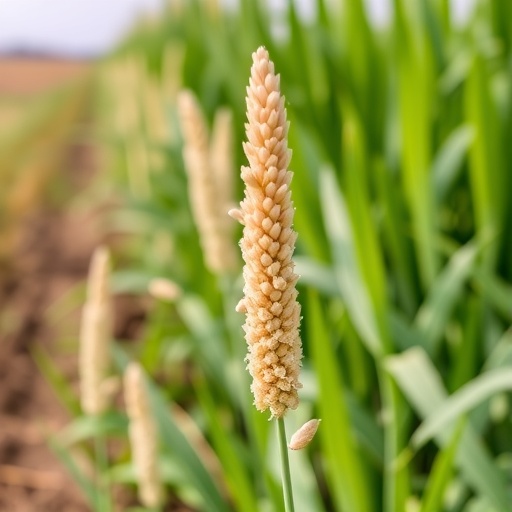
Recent studies have illuminated the impact of scheduled water stress on agricultural yields, particularly in drought-prone regions where water scarcity presents significant challenges. Notably, Fadeyi and colleagues have conducted extensive research into the agronomic responses of improved sorghum varieties, specifically focusing on Sorghum bicolor (L.) Moench. Their findings promise to reshape our understanding of both water management strategies and crop resilience in the face of climate change.
The study conducted by Fadeyi et al. offers a detailed examination of the tenacity of various sorghum varieties when subjected to targeted water stress schedules. By applying precise irrigation techniques, the research team was able to simulate conditions that mirror the unpredictable nature of rainfall in arid environments. This kind of experimentation is essential, as it helps predict how crops might respond to increasing water scarcity, thereby informing better agricultural practices.
One of the critical discoveries of this research is the identification of specific sorghum varieties that exhibit remarkable resilience under water-stressed conditions. These varieties not only maintained yield levels but also showed an impressive level of adaptation, which is crucial as global temperatures rise and water resources become more limited. The implications of these findings extend beyond local farming practices, potentially influencing agricultural policies on a global scale.
Sorghum, a staple crop in many parts of the world, especially in sub-Saharan Africa, plays a pivotal role in food security. The ability to identify drought-tolerant varieties could significantly enhance food availability, reduce dependency on irrigation, and lessen the ecological footprint of farming. Fadeyi and his team have provided crucial evidence to support the cultivation of these resilient varieties, showcasing their potential to withstand the impacts of climate change.
A significant aspect of the research involves the meticulous selection process of the sorghum varieties studied. Fadeyi et al. evaluated not only yield but also other agronomic traits such as plant height, leaf area index, and grain quality. These parameters are essential for farmers to understand the trade-offs involved in adopting new varieties, ultimately leading to more informed decision-making.
The experimental methodologies employed in this study underline the importance of agronomic research in a rapidly changing environment. By replicating stress scenarios in controlled settings, researchers can gain insights that are otherwise difficult to observe in natural settings. The consistent results obtained from these controlled experiments bolster the credibility of the findings, making them reliable for further application in field trials.
Moreover, this study emphasizes the role of agronomy in sustainable agriculture practices. As farmers seek to adapt to the changing climate, knowing which crops can thrive under challenging conditions is invaluable. The findings of Fadeyi et al. offer a ray of hope, as they point towards solutions that could mitigate the adverse effects of drought on crop production.
Another compelling dimension of the research is the socioeconomic implications of growing resilient sorghum varieties. Increased yields and reduced water dependency can contribute to higher income levels for farmers, encouraging investment in sustainable practices and technology. Ultimately, these changes could revitalise rural economies, fostering a sense of community resilience against climate variability.
Merging traditional agricultural knowledge with scientific innovation is also a theme that resonates throughout this study. Engaging local farmers with the findings and practices elucidated by Fadeyi et al. can cultivate a collaborative approach toward crop management. As farmers implement these new strategies, the success stories that emerge will serve as a catalyst for wider adoption, promoting broader agricultural reform.
As the discourse surrounding climate action intensifies, the significance of crop diversity and resilience is gaining traction. Fadeyi and his team contribute to this narrative by offering evidence that supports the cultivation of drought-resistant varieties as a feasible strategy. Their work aligns with global efforts to train farmers on sustainable practices and minimize environmental impact while meeting food demands.
The research also accentuates the need for ongoing studies in the realm of crop genetics and breeding. Understanding the genetic basis for drought tolerance could unlock further potential in sorghum and other staple crops. This quest for knowledge is essential, as it harnesses the power of biotechnology to address pressing global issues like food security, environmental sustainability, and climate resilience.
In conclusion, the insights presented by Fadeyi et al. serve as a crucial addition to the scientific literature on agricultural practices in response to climate change. Their findings provide a pathway for future research and practical applications that can help shape sustainable agricultural systems. This study is not just a piece of research; it paves the way for implementing innovative solutions to combat one of the most pressing challenges of our time.
With the ongoing threats posed by climate change, research like this will become increasingly vital. Accurate and impactful studies on crop resilience and water management strategies can lead to innovations that better equip farmers worldwide to deal with environmental stressors. So, as the world awaits further results from these promising sorghum varieties, the hope is that new agricultural paradigms will emerge, ensuring food security and sustainability for future generations.
This exploration of improved sorghum varieties offers more than just numerical data; it opens up a dialogue about adaptation, survival, and the collaborative effort required to overcome environmental challenges. It is a call to action for the agricultural community, urging them to embrace science-backed practices that could secure a more sustainable future for farming in a changing climate.
Cite Scienmag News
Alan Morgan. (November 4, 2025). Improved Sorghum Varieties Tackle Scheduled Water Stress. Scienmag. https://scienmag.com/improved-sorghum-varieties-tackle-scheduled-water-stress/
Alan Morgan. "Improved Sorghum Varieties Tackle Scheduled Water Stress." Scienmag, 4 November 2025, https://scienmag.com/improved-sorghum-varieties-tackle-scheduled-water-stress/. Accessed 5 September 2026.
Alan Morgan. "Improved Sorghum Varieties Tackle Scheduled Water Stress." Scienmag. November 4, 2025. https://scienmag.com/improved-sorghum-varieties-tackle-scheduled-water-stress/


