


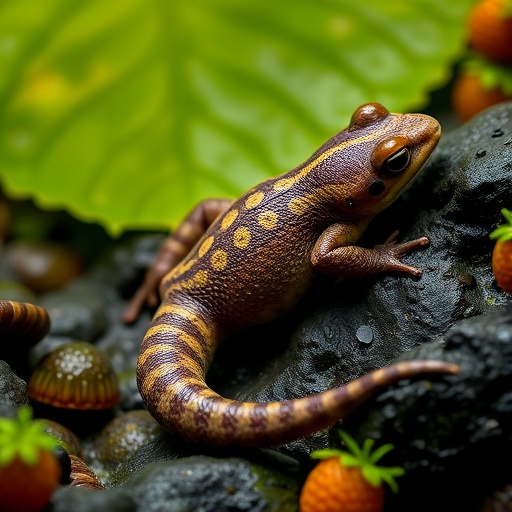
In recent years, the pervasive presence of microplastics and organophosphorus flame retardants (OPFRs) in aquatic ecosystems has raised significant environmental concerns. Although numerous studies have explored the impacts of these pollutants on various organisms, the effects on urodele amphibians remain poorly understood. Addressing this gap, a groundbreaking study from Nanjing Normal University, China, sheds light on the complex interactions between polystyrene nanoplastics (PS-NPs) and triphenyl phosphate (TPhP)—a common OPFR—unveiling their combined toxicity on the gut-liver axis of the salamander species Pachytriton granulosus.
This research undertook a rigorous experimental approach to elucidate how exposure to PS-NPs and TPhP individually and synergistically affects the delicate physiology of P. granulosus, focusing on the intricate crosstalk between gut microbiota and liver metabolism. The gut-liver axis plays a pivotal role in maintaining systemic homeostasis and responding to environmental stressors; thus, disruptions in this axis have profound implications for the organism’s health and survival.
One of the critical findings from the study was that exposure to PS-NPs led to an increase in the abundance of the gut bacterium Desulfovibrio. This genus is often associated with inflammatory responses and perturbations in gut homeostasis, suggesting that nanoplastic pollution could precipitate gut inflammation in amphibians. Such inflammation could compromise nutrient absorption and immune defenses, with downstream consequences for overall amphibian health.
Simultaneously, exposure to TPhP was shown to reduce gut microbial diversity in a dose-dependent manner. Microbial diversity is fundamental for a resilient and functional gut microbiome; its diminution potentially undermines the integrity of the gut barrier, increasing susceptibility to pathogens and toxins. This reduction exposes amphibians to heightened physiological stress and may impair their capacity to detoxify environmental contaminants.
Intriguingly, the study observed that combined exposure to PS-NPs and low-dose TPhP introduced even greater complexity to the gut microbial ecosystem, demonstrating that these pollutants do not act in isolation but interact in multifaceted ways. Metabolic analyses revealed that both contaminants disturbed oxidative stress pathways and triggered inflammatory cascades, suggesting a shared mechanism of toxicity. At the same time, defensive cellular processes, including lysosomal activation and AMP-activated protein kinase (AMPK)-mediated detoxification pathways, were upregulated, indicating an organismal attempt to counteract pollutant-induced damage.
Beyond these effects, the co-exposure scenario revealed an antagonistic interaction wherein lipid metabolism was disrupted through alterations in bile secretion. Bile acids are critical for lipid digestion and signaling molecules influencing metabolism; thus, their perturbation can cascade into metabolic dysregulation. This finding uncovers a previously unrecognized layer of toxicity that emerges only under combined pollutant stress, underscoring the limitations of single-pollutant toxicology assessments.
Leveraging multi-omics analyses—a sophisticated integration of genomics, metabolomics, and transcriptomics—the researchers were able to link specific gut bacterial taxa with markers of oxidative stress and lipid metabolism disorders. Such integrative approaches offer unprecedented insight into the molecular underpinnings of pollutant-induced toxicity, enabling a more comprehensive understanding of host-microbiome-environment interactions.
Amphibians, including urodeles like P. granulosus, are recognized as sentinel species given their sensitivity to environmental changes. Thus, elucidating how emergent contaminants like nanoplastics and OPFRs affect their internal physiology not only has ecological ramifications but also enriches our knowledge of environmental health more broadly. The study’s revelation of hidden gut-liver toxicity and non-additive pollutant interactions highlights the complexity of real-world contamination scenarios often overlooked in laboratory models that examine pollutants singly.
The findings prompt a reconsideration of current ecological risk assessment frameworks, which typically focus on individual chemicals in isolation. By demonstrating the nuanced and sometimes antagonistic interactions between co-occurring pollutants, this research advocates for incorporating mixed contaminant exposures reflective of actual environmental conditions. This perspective is vital for predicting pollutant impacts more accurately and designing effective conservation strategies for vulnerable amphibian populations.
Furthermore, the disruption of microbial diversity and metabolic pathways has far-reaching consequences for amphibian physiology, potentially affecting growth, reproduction, and immune competence. Given the global declines in amphibian populations, understanding pollutant-induced sublethal effects at the microbiome and metabolic levels is essential for formulating mitigation policies and protecting biodiversity.
The study also opens avenues for future research to explore the long-term effects of chronic low-dose exposure and to assess whether observed biochemical disturbances translate to overt pathological outcomes. Additionally, expanding this research to other amphibian species and environmental contexts will help validate the generalizability of the findings and refine ecological risk models.
In summary, this pioneering investigation into the combined effects of polystyrene nanoplastics and triphenyl phosphate on Pachytriton granulosus enriches our comprehension of environmental toxicology. It emphasizes the necessity to move beyond single-chemical paradigms and adopt holistic approaches that account for complex pollutant mixtures, offering critical insights for amphibian conservation and ecosystem health management.
Web References: http://dx.doi.org/10.1016/j.enceco.2026.05.018
Cite Scienmag News
Morgan Morrow. (June 15, 2026). Impact of Polystyrene Nanoplastics and Triphenyl Phosphate on Salamanders: New Insights into the Gut-Liver Connection. Scienmag. https://scienmag.com/impact-of-polystyrene-nanoplastics-and-triphenyl-phosphate-on-salamanders-new-insights-into-the-gut-liver-connection/
Morgan Morrow. "Impact of Polystyrene Nanoplastics and Triphenyl Phosphate on Salamanders: New Insights into the Gut-Liver Connection." Scienmag, 15 June 2026, https://scienmag.com/impact-of-polystyrene-nanoplastics-and-triphenyl-phosphate-on-salamanders-new-insights-into-the-gut-liver-connection/. Accessed 4 September 2026.
Morgan Morrow. "Impact of Polystyrene Nanoplastics and Triphenyl Phosphate on Salamanders: New Insights into the Gut-Liver Connection." Scienmag. June 15, 2026. https://scienmag.com/impact-of-polystyrene-nanoplastics-and-triphenyl-phosphate-on-salamanders-new-insights-into-the-gut-liver-connection/


