


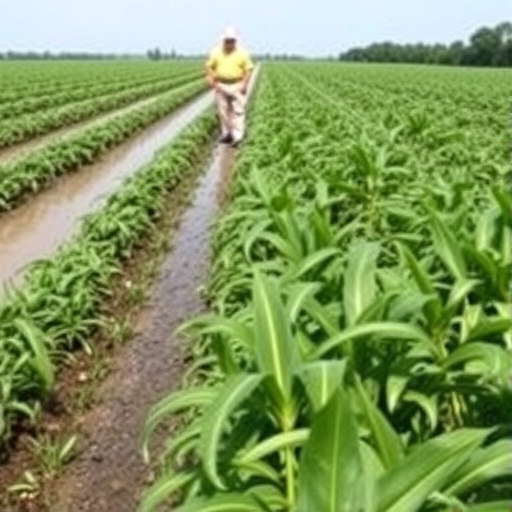
In the heartland of America, the flat expanses of Central Illinois’ agricultural fields are both a blessing and a curse. Larry Dallas, a seasoned farmer in Douglas County, knows this all too well. The region’s characteristic flatness facilitates the planting of straight rows and smooth operation of heavy machinery, yet it also invites a stubborn problem: poor drainage. Heavy rains, increasingly intense due to shifting climate patterns, leave fields waterlogged, stagnating the essential flow and creating conditions ripe for flooding.
Drainage tile systems, widely employed by farmers like Dallas, represent one of the frontline defense mechanisms against inundation. These underground channels are carefully laid out to help funnel excess water away from the roots of crops. However, in the face of extreme weather events, such as the devastating floods that swept across the Midwest in 2019, these installations are often overwhelmed, leaving farmers battling not only the physical effects of soggy fields but also the cascading economic and agronomic consequences. That year, the Midwest agricultural community faced one of its toughest seasons in living memory, with crops drowning in mud and sunlight in short supply, further exacerbating stress on the harvested grains.
The problem of field inundation extends beyond immediate farm operations and hits multiple facets of the agricultural ecosystem. Christy Gibson, an Illinois Distinguished Postdoctoral Scholar specializing in Crop Sciences at the University of Illinois Urbana-Champaign, details the profound systemic impacts flooding engenders. It delays planting schedules, diminishes soil workability, heightens erosion risks, and depletes vital nutrients crucial for crop development. More strikingly, the effects ripple through the broader food system’s economic infrastructure—flooding drives up insurance claims, shrinks profit margins, inflates sunk costs for suppliers, and reduces marketable yields due to crop spoilage and disease.
But the challenges don’t stop at economics and agronomy. Floodwaters foster environments conducive to the proliferation of pathogens and pest populations, shifting the delicate balance of soil microbiota in ways that remain poorly understood yet potentially devastating. Moreover, these environmental disruptions intertwine with human health concerns, as agricultural workers face heightened risks of anxiety and depression, compounded by threats of waterborne illnesses from contaminated floodwaters. Such multi-dimensional implications highlight the need for a holistic approach to understanding and managing field inundation.
Despite the gravity of these impacts, the academic and research communities have historically concentrated more heavily on drought conditions, investing significant resources in breeding crops for drought tolerance. Yet the insidious problem of intermittent flooding, particularly across the vast arable Midwestern landscape, demands equal attention. Gibson and her colleagues emphasize that this phenomenon undermines agricultural sustainability on multiple levels, thereby making it an urgent area for applied research and intervention.
To address this gap, a team led by Gibson has forged ahead with a collaborative, on-the-ground research effort that integrates working farms as active study sites. By installing sophisticated environmental sensors, they capture baseline data on soil moisture, nutrient levels, and other critical parameters before and after heavy rainfall events. These rapid response deployments provide timely insights into how inundation events dynamically alter the microenvironment around crops and soil. The adaptive, real-time nature of this research model aligns seamlessly with newly emerging USDA funding priorities focused on agricultural resilience to unpredictable weather phenomena.
Adding further depth to this approach, Entomology Assistant Professor Esther Ngumbi underscores the timeliness and necessity of rapid mobilization to capture data during these fleeting yet consequential events. Traditional, static agricultural studies often miss critical shifts occurring in the immediate aftermath of storms and flooding. By engaging directly with active farms, the research team can glean nuanced data that informs robust decision-making frameworks tailored to mitigating flood damage.
This initiative aspires to connect researchers and farmers across the Midwest to build a rich database of diverse farm management practices and their effectiveness under inundation stress. The ultimate goal is to develop a customizable “toolbox” of adaptive strategies, enabling farmers to implement solutions finely tuned to the unique topographical, hydrological, and climatic conditions of their lands. Given that no two fields—and certainly no two farms—are alike, such precision agriculture approaches promise more resilient and sustainable outcomes.
Beyond the technical apparatus and scientific inquiry, the project champions the paradigm of co-production of knowledge, a principle firmly rooted in land-grant university traditions. Gibson stresses the indispensable role of collaborative engagement with farmers and stakeholders who contribute invaluable experiential knowledge. This reciprocal relationship ensures that interventions are not only scientifically sound but also practically viable, preserving the integrity of agricultural systems under stress while respecting the insights of those who work the land daily.
Farmers like Frank Rademacher, who actively participate in these research partnerships, testify to the mutual benefits of such collaborations. The exchange of cutting-edge research and practical field experience enriches both scientific understanding and agricultural practice. This symbiosis enhances resilience against escalating weather-related risks, fostering innovation grounded in reality rather than theory.
As extreme weather events become more frequent and severe, establishing robust mitigation frameworks for field inundation will be critical for safeguarding food security, economic stability, and environmental health. Through comprehensive monitoring, rapid response, and farmer-researcher collaboration, this Midwest research collective is advancing toward resilient agricultural landscapes that can keep pace with the climate challenges of the 21st century.
For those interested in joining this vital initiative or learning more about how best management practices can evolve to counteract inundation threats, Christy Gibson can be contacted directly at deltac13@illinois.edu. This ongoing research invites the agricultural community to participate actively, ensuring that future solutions are adaptive, effective, and inclusive, meeting the diverse needs of the American Midwest’s farming systems.
News Publication Date: Not specified in the source material
Web References:
– Global Change Biology article: https://onlinelibrary.wiley.com/doi/10.1111/gcb.70842
– USDA AFRI rapid response funding: https://www.nifa.usda.gov/grants/programs/agriculture-food-research-initiative-afri/rapid-response-weather-events-across-food-agriculture-systems-a1712
References:
– Gibson et al., Global Change Biology, DOI: 10.1111/gcb.70842
Cite Scienmag News
Alan Morgan. (April 27, 2026). Illinois Scientists Raise Concerns About Field Inundation, Collaborate with Farmers to Develop Solutions. Scienmag. https://scienmag.com/illinois-scientists-raise-concerns-about-field-inundation-collaborate-with-farmers-to-develop-solutions/
Alan Morgan. "Illinois Scientists Raise Concerns About Field Inundation, Collaborate with Farmers to Develop Solutions." Scienmag, 27 April 2026, https://scienmag.com/illinois-scientists-raise-concerns-about-field-inundation-collaborate-with-farmers-to-develop-solutions/. Accessed 4 September 2026.
Alan Morgan. "Illinois Scientists Raise Concerns About Field Inundation, Collaborate with Farmers to Develop Solutions." Scienmag. April 27, 2026. https://scienmag.com/illinois-scientists-raise-concerns-about-field-inundation-collaborate-with-farmers-to-develop-solutions/


