


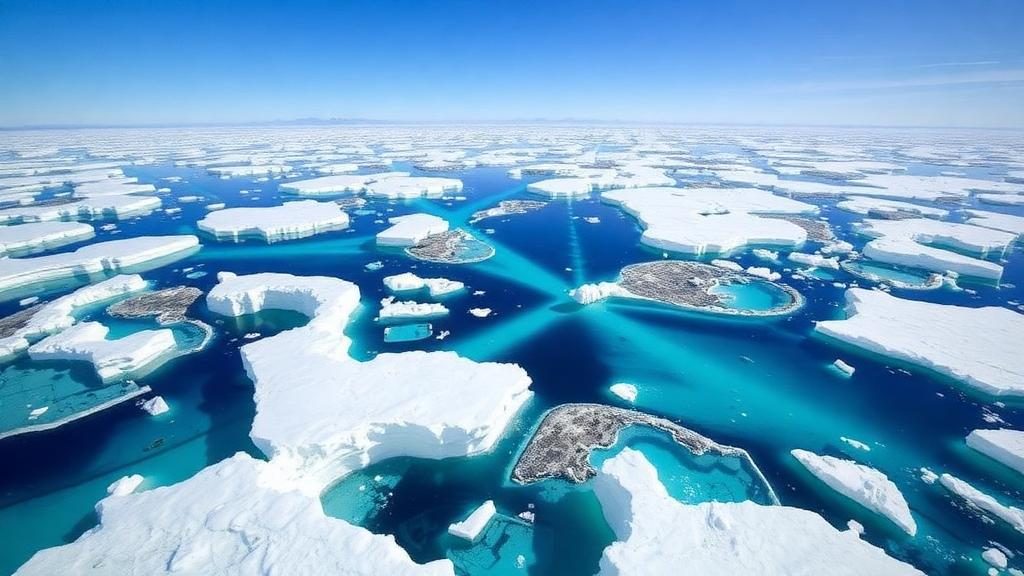
One of the most contested ideas in polar science has just received a major boost from an unlikely corner of chemistry. For decades, scientists have debated whether the Arctic Ocean and the Nordic Seas—collectively known as the Arctic Mediterranean—were periodically sealed off from the North Atlantic during the deep freezes of the late Pleistocene, transforming into a vast, brackish lake beneath a kilometers-thick ice shelf. A new study published in Communications Earth & Environment now provides some of the strongest geochemical evidence yet that this dramatic scenario really happened, not once but repeatedly, during the glacial stages known as Marine Isotope Stages 6 and 4.
The controversy began in 2021, when researchers reported widespread intervals in Arctic sediments that were barren of excess thorium-230, an isotope produced in seawater from the decay of dissolved uranium, alongside strikingly low concentrations of the cosmogenic isotope beryllium-10, which rains down from the atmosphere. The original team interpreted these signals as evidence of a freshwater-filled Arctic Ocean: without salty, uranium-bearing Atlantic water, little thorium-230 would be produced, and a permanent ice cover would starve the sea of atmospheric beryllium-10. Critics countered that sudden pulses of sediment could simply have diluted both isotopes, leaving the ocean connected after all. The debate has raged ever since, because the interpretation carries enormous implications for how the global climate system behaved during ice ages.
The new research, led by Agathe Ollive of the Alfred Wegener Institute in Bremerhaven together with colleagues from Germany and Norway, sidesteps this dispute by turning to a cleverer tracer: the ratio of two beryllium isotopes, beryllium-10 and beryllium-9, measured in the reactive fraction of seafloor sediments. The beauty of this ratio lies in its resilience. While the concentrations of each isotope individually can be skewed by changing sedimentation rates and particle scavenging, normalizing beryllium-10 against beryllium-9 largely cancels out those effects. What remains is a fingerprint of the water masses themselves—essentially a chemical tag that records which waters bathed the seafloor when the sediments were deposited.
The logic of the test is elegantly simple. Today, the Arctic Ocean is fed by two very different beryllium sources. Atlantic water carries a dissolved beryllium-10 to beryllium-9 ratio of roughly 5 to 7 times ten to the minus eight atoms per atom, while Arctic rivers deliver beryllium with ratios below 1.5 times ten to the minus eight. If North Atlantic inflow had continued during the glacial intervals in question, the sedimentary ratio should have stayed near Atlantic values. But if the Arctic Mediterranean was truly cut off and gradually freshened by river discharge, the ratio should have collapsed toward riverine signatures. The team measured 84 samples from sediment cores spanning the central Arctic Ocean, the Lomonosov Ridge, the Yermak Plateau, the Barents Sea slope, the Morris Jessup Rise, the Nordic Seas and the North Atlantic, at water depths from about 1,073 to 2,802 meters.
The result was unambiguous. During the low-thorium glacial intervals, reactive beryllium-10 to beryllium-9 ratios fell to between 0.06 and 0.64 times ten to the minus eight—uniformly low values that are not merely riverine but even below the range of modern Arctic rivers. Remarkably, this signature appeared at every site, across all the major basins of the Arctic Mediterranean, despite huge differences in water depth, sedimentation rate and sediment source. Such basin-wide homogeneity is exactly what an isolated, freshened sea would produce, and it is utterly incompatible with an active Atlantic inflow, which would have delivered beryllium with ratios one to two orders of magnitude higher. During the warm interglacial of Marine Isotope Stage 5e, by contrast, the ratios rebounded to around 4 times ten to the minus eight in the Nordic Seas and about 1.4 times ten to the minus eight in the central Arctic, matching the signatures of Atlantic-influenced waters seen in modern deep Arctic sediments.
The team then extended the story into the open Atlantic by analyzing core MD95-2016, a site today bathed in dense overflow waters spilling across the Greenland-Scotland Ridge. Because this core contains a continuous oxygen isotope record, it could be aligned precisely to global stratigraphy. Both the Atlantic core and the Nordic Seas core recorded nearly identical beryllium ratios of about 5 times ten to the minus eight during the interglacial, confirming an open connection. But during the MIS6 glaciation, both records plunged. The researchers interpret the low value in the North Atlantic core as marking the moment of reconnection, when water with an extremely low beryllium isotope ratio—stored up in the isolated Arctic during millennia of isolation—suddenly overflowed the Greenland-Scotland Ridge and flooded into the Atlantic.
Crucially, the beryllium evidence converges with entirely independent tracers. In a central Arctic core, the glacial drop in beryllium-10 to beryllium-9 coincides with shifts in neodymium, hafnium and strontium isotopes away from North Atlantic endmember values and toward compositions characteristic of Siberian rivers draining the Putorana Basalts into the Kara Sea. The absence of dinocysts and planktic foraminifera in cores from the same intervals further points to a shutdown of Atlantic water and harsh surface conditions. When multiple unrelated proxy systems all swing in the same direction at the same time, the case for a genuine circulation reorganization becomes very difficult to dismiss.
The authors also ran a steady-state mass balance model to test whether anything other than isolation could explain the numbers. Under modern conditions, the North Atlantic inflow supplies roughly 70 percent of the beryllium-10 entering the Arctic Ocean, and the model reproduces the observed water-column ratio of about 5.14 times ten to the minus eight. Reducing atmospheric deposition under permanent sea ice lowers the ratio by only about 20 percent—nowhere near enough. Closing the Bering Strait actually raises the modeled ratio slightly, because the Pacific inflow carries a relatively low signature. Even catastrophic meltwater outbursts from ice-dammed lakes such as Lake Komi and Lake Yamal, with combined volumes exceeding 30,000 cubic kilometers, could push the ratio down only to about 1.56 times ten to the minus eight. Only a complete shutdown of Atlantic inflow reproduces the measured glacial values of around 0.85 times ten to the minus eight. The team likewise ruled out hyperpycnal sediment flows, nepheloid plumes, brine rejection and benthic fluxes from seafloor diagenesis as primary drivers, each on quantitative grounds.
The combined weight of the thorium and beryllium systems points to a single coherent picture: during parts of MIS6 and MIS4, the Arctic Mediterranean was largely cut off from the global ocean, its salts progressively replaced by river freshwater within perhaps less than 10,000 years, all sealed beneath a grounded ice shelf that blocked exchange across the shallow straits of the Greenland-Scotland Ridge. Such a state would have fundamentally altered deep-water renewal, strengthened stratification and limited oxygen penetration to the deep basins—conditions consistent with geochemical hints of past anoxia in both the Canadian and Eurasian Basins. It would also have meant that a key nursery of today’s Atlantic Meridional Overturning Circulation simply switched off.
Perhaps the most tantalizing implication lies at the end of each isolation episode. When the Arctic ice shelf collapsed and the straits reopened, the enormous reservoir of low-salinity water accumulated over millennia would have been released through Fram Strait in short order. Whether such pulses were powerful enough to disrupt North Atlantic thermohaline circulation and trigger the abrupt cooling events recorded in ice cores remains an open question, and one the authors flag as a priority for future work. What is already clear is that the Arctic Ocean of the ice ages was not simply a colder version of today’s sea. It was, at times, a fundamentally different world—a giant, dark, freshwater basin sealed beneath ice, waiting for the lid to come off.
Subject of Research: Geochemical evidence for episodic isolation and freshening of the Arctic Mediterranean from the North Atlantic during late Pleistocene glaciations
Article Title: Episodic isolation of the Arctic Mediterranean from the North Atlantic during late Pleistocene glacials
Article References: Ollive, A., Geibert, W., Matthiessen, J., Loftfield, J., Lachner, J., Koll, D., Patton, H., Vogt, C., & Adolphi, F. (2026). Episodic isolation of the Arctic Mediterranean from the North Atlantic during late Pleistocene glacials. Communications Earth & Environment, 7(1), Article 821. https://doi.org/10.1038/s43247-026-04133-3
Image Credits: AI Generated
DOI: 10.1038/s43247-026-04133-3
Keywords: Arctic Ocean, North Atlantic, beryllium isotopes, thorium-230, Pleistocene glaciations, ice shelf, paleoceanography, freshwater, AMOC, Greenland-Scotland Ridge, marine sediments, climate
Cite Scienmag News
Violet Maxwell. (October 11, 2026). Ice Age Arctic Ocean Was Cut Off From the Atlantic and Filled With Freshwater. Scienmag. https://scienmag.com/ice-age-arctic-ocean-was-cut-off-from-the-atlantic-and-filled-with-freshwater/
Violet Maxwell. "Ice Age Arctic Ocean Was Cut Off From the Atlantic and Filled With Freshwater." Scienmag, 11 October 2026, https://scienmag.com/ice-age-arctic-ocean-was-cut-off-from-the-atlantic-and-filled-with-freshwater/. Accessed 11 October 2026.
Violet Maxwell. "Ice Age Arctic Ocean Was Cut Off From the Atlantic and Filled With Freshwater." Scienmag. October 11, 2026. https://scienmag.com/ice-age-arctic-ocean-was-cut-off-from-the-atlantic-and-filled-with-freshwater/


