


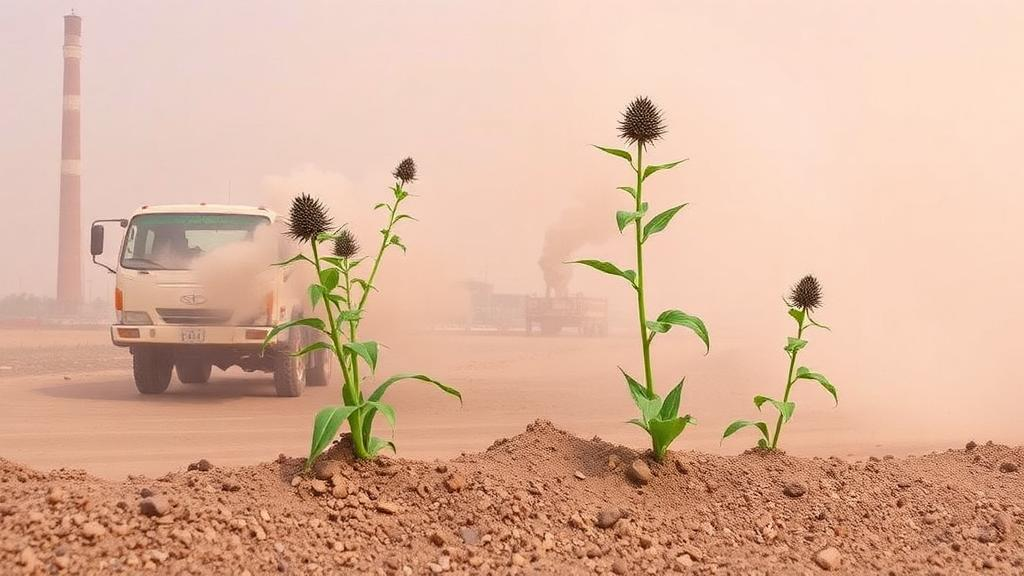
Airborne dust is far more than a cosmetic nuisance for plants. Every day, leaves in polluted regions are bombarded with fine particles carrying toxic metals such as lead, cadmium, and arsenic, and these particles settle on leaf surfaces, clog stomata, and slowly work their way into plant tissue. For farmers growing medicinal crops, this silent assault can mean reduced yields and contaminated harvests. A new study published in Environmental Monitoring and Assessment has now revealed that not all plants suffer equally: when researchers exposed four genotypes of the medicinal herb Andrographis paniculata to atmospheric dust at polluted and control sites, the differences between them were striking, pointing to a genetic basis for resilience against one of agriculture’s most overlooked stressors.
The research team, led by Sweta Yadav and Puja Khare of CSIR-Central Institute of Medicinal and Aromatic Plants in Lucknow, India, together with colleagues from the Drug Standardization Research Institute, focused on four genotypes of Andrographis paniculata, designated G1, G5, G6, and G11. This species, commonly known as king of bitters, is prized in traditional medicine for its andrographolide content, a compound with documented antiviral and anti-inflammatory properties. Because the plant is cultivated for its leaves, contamination from airborne metals is a direct threat to both productivity and the safety of the final herbal product. The researchers grew or sampled the genotypes at two polluted sites and one control site, then measured a battery of morphological, physiological, and metabolic responses.
The first key finding concerned leaf surface architecture. The two genotypes with rough and wrinkled leaf surfaces, G11 and G5, turned out to be the most vulnerable. Their epidermal cells collapsed more frequently under the burden of deposited dust, and this structural damage translated into reduced growth and higher accumulation of lead, cadmium, and arsenic in their leaves. In contrast, the smoother-leaved genotypes fared considerably better. The result underscores a principle that has emerged from other studies of particulate matter capture in urban trees and crops: microscopic surface texture largely determines how much dust a leaf traps, and trapping more dust is not a sign of health but a pathway to toxicity.
Where the metals ended up inside the leaf proved just as important as how much arrived. Using subcellular fractionation, the team tracked the distribution of toxic metals across cellular compartments, including organelles, cell walls, and soluble fractions. In the G1 genotype, the concentration of toxic metals in organelles and soluble fractions was notably lower than in the other genotypes. This matters because organelles such as chloroplasts and mitochondria are the metabolic powerhouses of the cell, and metals sequestered in vulnerable compartments disrupt photosynthesis and respiration. Genotypes that keep metals out of these sensitive regions, or exclude them altogether, can maintain function even under heavy deposition. G1’s ability to limit internal metal exposure helps explain why it accumulated less metal overall and grew better at both polluted sites.
The metabolic story centered on carbohydrate metabolism, a network of enzymes that governs how plants store and mobilize energy. The researchers measured the activities of sucrose synthase, sucrose phosphate synthase, neutral invertase, and acid invertase, enzymes that together control the synthesis and breakdown of sucrose, the main transport sugar in plants. Their activities varied across genotypes and pollution levels in a pattern the authors describe as a trade-off between energy storage and combating oxidative stress. When dust and its metal payload generate reactive oxygen species, plants must divert energy and reducing power into antioxidant defense, and the sugar-metabolism enzymes reflect this shifting priority. Soluble sugars themselves also act as protective osmolytes and signaling molecules under stress, so their total and reducing fractions provided a readout of each genotype’s metabolic state.
Multivariate statistical analysis tied these threads together. The variation in carbohydrate-metabolism enzymes and sugar pools among the genotypes was linked to the subcellular distribution of the airborne toxic metals. In other words, where a plant stores or excludes its metal burden shapes how its sugar economy responds. Genotypes that confined metals away from metabolic compartments could keep their sucrose-processing machinery running closer to normal, while those with metals invading organelles and soluble fractions showed more distorted enzyme profiles. This connection between metal localization and carbon metabolism offers breeders a potentially measurable marker: enzyme activity patterns or sugar profiles could serve as indicators of a genotype’s tolerance before expensive field trials are complete.
Nitrogen metabolism told a subtler story. The enzyme glutamate dehydrogenase, which participates in ammonia assimilation and amino acid metabolism, increased in activity across all genotypes at the low-polluted site but decreased at the highly polluted site. This dose-dependent response suggests that moderate pollution may trigger a compensatory metabolic push, perhaps to supply amino acids for stress-protein synthesis and antioxidant compounds, whereas severe pollution overwhelms the machinery, depressing nitrogen processing altogether. Nitrogen metabolism is tightly coupled to carbon metabolism, and its collapse under high pollution likely compounds the energy deficits created by damaged photosynthetic tissue, accelerating the growth declines observed in the sensitive genotypes.
The broader context makes these findings timely. Atmospheric deposition of heavy metals is a growing concern for agricultural systems worldwide, with traffic, industry, and coal combustion releasing particles that settle on croplands. Previous work by some of the same team had shown that Andrographis paniculata genotypes differ in their ability to exclude lead and cadmium taken up through roots, and that PM10-bound metals at traffic junctions affect the species’ physiology. The new study extends this picture to the foliar route, showing that the leaf surface itself is a decisive battleground. Research on Chinese cabbage, wheat, soybean, and vegetables has similarly demonstrated that foliar uptake of atmospherically deposited metals can rival or exceed root uptake, making leaf-level traits a legitimate target for crop improvement.
For medicinal plant cultivation, the practical implications are considerable. Selecting genotypes such as G1, which combines lower metal accumulation with higher growth under pollution, could allow farmers near roads or industrial zones to produce safer, more abundant harvests without relocating. The study’s identification of dust assimilation capacity, metabolic adaptability, and subcellular metal localization as the three key factors governing resilience provides a framework for screening other cultivars and even other species. It also feeds into the emerging concept of phyto-exclusion, in which crops are bred or chosen specifically to keep contaminants out of the harvested organs rather than to tolerate them internally, a strategy that directly addresses food and herbal medicine safety.
There remain open questions. The study examined four genotypes at a limited number of sites, and the relative contributions of leaf texture, cuticle chemistry, trichome density, and stomatal behavior to dust capture were not fully disentangled. Long-term experiments will be needed to determine whether the metabolic signatures observed here hold across seasons and pollution gradients, and whether the tolerant G1 genotype maintains its advantageous metal partitioning when grown on contaminated soils as well as under atmospheric exposure. Still, the central message is clear and actionable: resilience to air pollution is written into plant genomes, and understanding that variation, from the leaf surface down to the organelle, is essential for sustainable agriculture in an increasingly dusty and metal-laden atmosphere. As urbanization and industrial activity intensify across the growing regions of Asia and beyond, studies like this one transform air pollution from an unavoidable hazard into a manageable breeding challenge.
Subject of Research: Genotypic variation in morpho-physiological and metabolic responses of Andrographis paniculata to atmospheric dust and heavy metal deposition
Article Title: Differential morpho-physiological and metabolic responses of various genotypes of Andrographis paniculata to atmospheric dust stress
Article References: Yadav, S., Kashyap, S., Ansari, S. A., Khan, A. S., & Khare, P. (2026). Differential morpho-physiological and metabolic responses of various genotypes of Andrographis paniculata to atmospheric dust stress. Environmental Monitoring and Assessment, 198(10), Article 1079. https://doi.org/10.1007/s10661-026-15819-8
Image Credits: AI Generated
DOI: 10.1007/s10661-026-15819-8
Keywords: Andrographis paniculata, atmospheric dust, heavy metals, lead, cadmium, arsenic, subcellular distribution, carbohydrate metabolism, sucrose synthase, glutamate dehydrogenase, genotypic variability, medicinal plants
Cite Scienmag News
Russell Cooper. (October 11, 2026). Air Pollution Dust Hits Some Medicinal Plant Genotypes Far Harder Than Others. Scienmag. https://scienmag.com/air-pollution-dust-hits-some-medicinal-plant-genotypes-far-harder-than-others/
Russell Cooper. "Air Pollution Dust Hits Some Medicinal Plant Genotypes Far Harder Than Others." Scienmag, 11 October 2026, https://scienmag.com/air-pollution-dust-hits-some-medicinal-plant-genotypes-far-harder-than-others/. Accessed 11 October 2026.
Russell Cooper. "Air Pollution Dust Hits Some Medicinal Plant Genotypes Far Harder Than Others." Scienmag. October 11, 2026. https://scienmag.com/air-pollution-dust-hits-some-medicinal-plant-genotypes-far-harder-than-others/


