


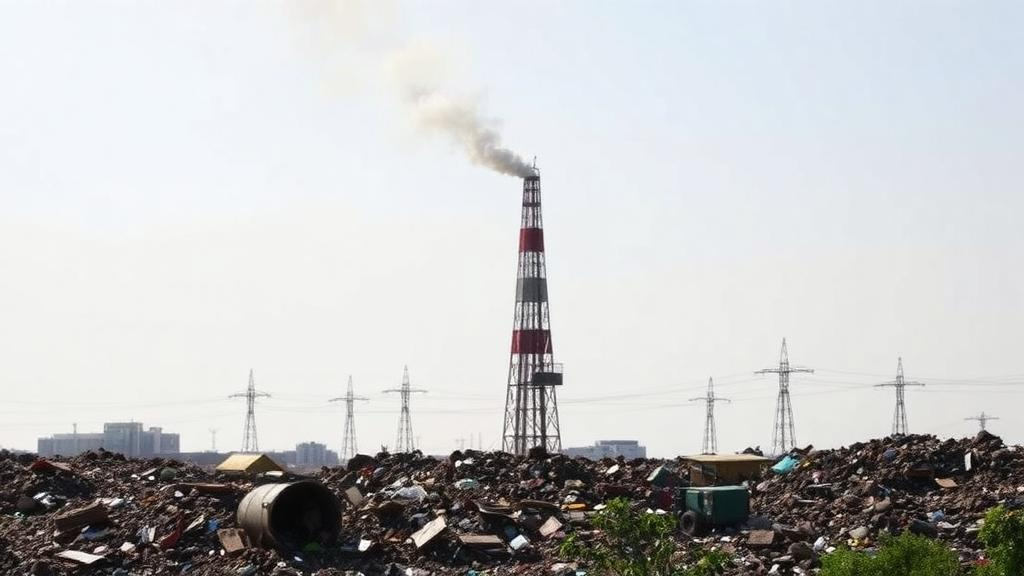
Beneath the sprawling dumpsites of Kodungaiyur and Perungudi, two of Chennai’s primary waste repositories, an invisible engine has been running for decades. Organic matter buried in these mounds decomposes slowly, releasing methane, a greenhouse gas roughly twenty-eight times more potent than carbon dioxide over a century. A new case study by Madhavaraj Muthukrishnan and Karthikeyan Kothandapani of the School of Civil Engineering at Vellore Institute of Technology, Chennai, published in Discover Sustainability, quantifies just how much energy is locked inside that escaping gas and asks whether capturing it beats the alternative of burning the city’s waste directly. Their answer carries real consequences for how one of India’s largest metropolitan areas plans its waste future.
The researchers compared two competing waste-to-energy pathways. The first, landfill gas-to-energy, involves collecting the methane-rich gas that seeps out of decomposing waste and using it to generate electricity. The second, incineration-based waste-to-energy, burns municipal solid waste directly and converts the heat into power. To make a fair comparison, the team first needed a reliable estimate of how much methane the two dumpsites actually produce, and that is where the study’s methodological core lies. They ran two of the most widely used estimation frameworks side by side: the Intergovernmental Panel on Climate Change Default Method and the First-Order Decay model.
The distinction between these two models is more than academic trivia. The IPCC Default Method treats methane generation as a relatively simple function of the waste deposited in a given year, producing a stable, near-linear trend in estimated emissions. The First-Order Decay model, by contrast, recognizes that organic waste does not all break down at once. Paper, food scraps, and garden waste each decay at their own characteristic rate, so emissions from a landfill reflect a long tail of decomposition stretching back over many years. When applied to Chennai’s dumpsites, the FOD model projected a gradual increase in methane emissions over the long term, with emissions climbing toward 2050, while the Default Method painted a flatter picture at Perungudi.
That divergence matters because the methane estimate is the foundation on which everything else is built. Using the First-Order Decay model, the researchers calculated that landfill gas recovery at the sites could yield 38,959.64 megawatt-hours per year in 2026, rising to 44,957.76 megawatt-hours per year by 2050. The Default Method produced a lower and narrower band, between 29,769.04 and 31,740.42 megawatt-hours per year. In other words, the choice of accounting model alone shifts the projected energy harvest by thousands of megawatt-hours annually, a gap large enough to change the economics of whether a capture project gets built at all.
Incineration told a different story. Among all the waste-to-energy techniques examined, burning the waste directly offered the maximum energy generation potential, ranging from 98,783.25 megawatt-hours per year in 2026 to 105,324.92 megawatt-hours per year in 2050. That is more than double the landfill gas recovery figures under either model. The physics explains why: incineration extracts the calorific value of the entire waste stream in a single pass, whereas landfill gas capture only recovers a fraction of the energy potential, since a portion of the generated methane inevitably escapes uncollected or oxidizes in the cover soil before it can be tapped.
Yet the authors are careful not to declare incineration the outright winner. Landfill gas technologies play an important role beyond electricity generation, because capturing methane delivers a significant reduction in greenhouse gas emissions. Every cubic meter of methane intercepted at the dumpsite is a cubic meter that never enters the atmosphere, and the study converts these avoided emissions into potential Certified Emission Reduction credits, the tradable units of carbon markets. Those credits represent both an environmental benefit and an economic incentive, effectively subsidizing waste-to-energy investments by monetizing the climate damage averted. For a city weighing capital costs against long-term returns, this dual value of landfill gas capture is a material consideration.
The comparative analysis led the researchers to a clear methodological verdict: the First-Order Decay model provides the strongest and most policy-relevant estimates for long-term strategy development. This conclusion has implications well beyond Chennai. National greenhouse gas inventories, carbon credit applications, and infrastructure financing decisions all depend on methane estimates, and the study demonstrates that relying on a simplified default method can systematically understate both the climate problem and the energy opportunity sitting in a landfill. As more cities in the developing world grapple with expanding waste streams, the choice of decay model becomes a quiet but consequential piece of climate policy.
The timing of the study is significant. India’s municipal solid waste generation has been rising with urbanization and consumption, and legacy dumpsites like Kodungaiyur and Perungudi have long been sources of local complaints about odor, fire, and groundwater contamination. Methane-driven landfill fires are a recurring hazard in Indian cities, and uncontrolled gas migration poses safety risks to surrounding neighborhoods. The study’s framing connects waste management directly to the United Nations Sustainable Development Goals, specifically SDG 7 on affordable and clean energy, SDG 11 on sustainable cities, SDG 12 on responsible consumption and production, and SDG 13 on climate action. By quantifying the energy and carbon stakes, the authors aim to give city planners a firmer numerical basis for decisions that have often been driven by crisis management.
What makes the findings compelling is the scale of the untapped resource. Even under the more conservative Default Method estimates, the two dumpsites hold the potential to generate on the order of thirty thousand megawatt-hours of electricity annually from gas that is currently venting into the sky. Under the First-Order Decay model, the recoverable energy grows over time as accumulated legacy waste continues to decompose, reaching nearly forty-five thousand megawatt-hours per year by mid-century. Incineration, meanwhile, could deliver over one hundred thousand megawatt-hours per year while simultaneously reducing the volume of waste requiring landfill space. For a metropolitan region facing both energy demand and shrinking disposal capacity, these are not trivial numbers.
The study, published open access on 11 October 2026, ultimately reads as a call for cities to treat their landfills as data-rich energy assets rather than liabilities to be ignored. Its central lesson is that the future of urban waste management depends as much on how we count methane as on the hardware we install to capture it. A model that captures the slow, decades-long decay of buried organic matter reveals a growing energy resource and a growing climate liability that a simpler method conceals. For Chennai, and for the many cities in similar positions across the globe, the message is that sound modeling is the first step toward turning decades of buried waste into clean electricity, carbon credits, and a measurable contribution to climate mitigation.
Subject of Research: Comparative assessment of methane-based energy recovery from landfill gas and incineration for municipal solid waste management in Chennai, India
Article Title: Comparative assessment of energy recovery from landfill gas and incineration for municipal solid waste management in Chennai, India: a case study using the IPCC default method and first-order decay model
Article References: Muthukrishnan, M., & Kothandapani, K. (2026). Comparative assessment of energy recovery from landfill gas and incineration for municipal solid waste management in Chennai, India: a case study using the IPCC default method and first-order decay model. Discover Sustainability. https://doi.org/10.1007/s43621-026-04815-0
Image Credits: AI Generated
DOI: 10.1007/s43621-026-04815-0
Keywords: landfill gas, methane emissions, waste-to-energy, incineration, municipal solid waste, first-order decay model, IPCC default method, Chennai, greenhouse gas reduction, certified emission reduction, sustainable development goals, renewable energy
Cite Scienmag News
Violet Maxwell. (October 11, 2026). Chennai’s Landfill Methane Could Power the City, but Incineration Wins on Energy. Scienmag. https://scienmag.com/chennais-landfill-methane-could-power-the-city-but-incineration-wins-on-energy/
Violet Maxwell. "Chennai’s Landfill Methane Could Power the City, but Incineration Wins on Energy." Scienmag, 11 October 2026, https://scienmag.com/chennais-landfill-methane-could-power-the-city-but-incineration-wins-on-energy/. Accessed 11 October 2026.
Violet Maxwell. "Chennai’s Landfill Methane Could Power the City, but Incineration Wins on Energy." Scienmag. October 11, 2026. https://scienmag.com/chennais-landfill-methane-could-power-the-city-but-incineration-wins-on-energy/


