


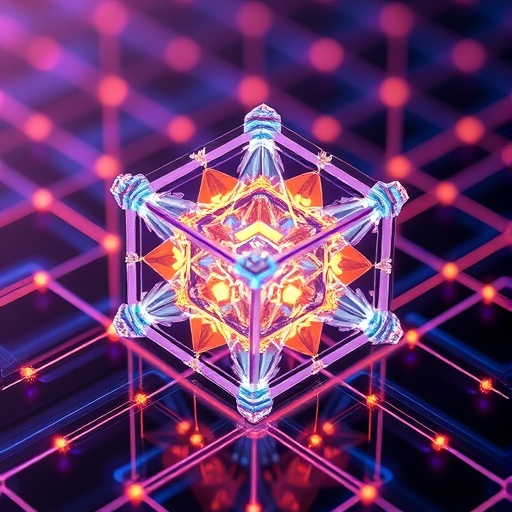
In a groundbreaking development poised to redefine the capabilities of optical materials, researchers have unveiled a novel class of photonic crystals enhanced through local-nonlocal assistance. This cutting-edge approach integrates the advantages of local and nonlocal electromagnetic interactions within photonic crystal structures, giving rise to multifunctional materials with unparalleled control over light propagation. The implications of such innovation extend far beyond traditional photonics, with potential applications ranging from advanced telecommunications to quantum information processing.
Photonic crystals, in essence, are periodically structured materials engineered to affect the motion of photons in much the same way that the periodic potential in a semiconductor crystal affects electrons. By exploiting periodic variations in refractive index, these crystals create photonic bandgaps—frequency ranges in which light propagation is forbidden—enabling exceptional manipulation of electromagnetic waves. Conventional photonic crystals primarily rely on local interactions, which limit their functionality to certain structural scales and operational bandwidths.
The novel concept of local-nonlocal assistance presents an evolutionary leap by intertwining local electromagnetic responses with nonlocal effects—where the light-matter interaction at one point within the crystal depends on the electromagnetic field at distant points. Nonlocality in photonic systems introduces spatial dispersion, enabling new degrees of freedom to modulate light behavior. Such synergy allows the design of photonic crystals with enhanced and customizable dispersion characteristics unattainable through local interactions alone.
At the core of this research is the meticulous engineering of the unit cell of the photonic crystal to incorporate materials and geometries that facilitate this dual interaction regime. Through advanced numerical simulations and precise fabrication techniques, the team demonstrated how the integration of nonlocal responses modifies band structures, influencing mode distributions and light confinement. The resulting photonic crystals posses multifunctionality, with tailored photonic bandgaps, resonant modes, and directional selectivity that can be dynamically tuned.
One of the striking outcomes of this study is the demonstration of reconfigurable photonic states that arise due to the interplay of local and nonlocal contributions. This reconfigurability heralds new opportunities for dynamic light manipulation, essential for smart optical devices and adaptive photonic systems. For example, switches, modulators, and filters with rapid tunability enhance performance in optical communication networks, improving bandwidth, speed, and energy efficiency.
Moreover, the advanced photonic crystals show promise in enhancing nonlinear optical effects, which are critical for frequency conversion, optical sensing, and quantum optical applications. The tailored field distributions arising from local-nonlocal cooperation amplify nonlinear interactions, paving the way for more sensitive sensors and lower-threshold frequency converters. The capacity to finely engineer these properties marks a significant advance over conventional photonic platforms.
In addition to their tunable optical properties, the local-nonlocal assisted photonic crystals exhibit robustness against structural imperfections and environmental fluctuations. Nonlocal interactions contribute to the stabilization of photonic modes, which counters scattering losses and unwanted mode coupling that often degrade device performance in practical environments. This robustness is vital for real-world adoption of photonic technologies outside pristine laboratory conditions.
The implications of these findings are profound in the realm of topological photonics as well. Local-nonlocal hybridization within photonic crystals facilitates the realization of unconventional band topologies, supporting edge states immune to backscattering and disorder. Such topologically protected states could revolutionize signal routing in integrated photonic circuits, reducing loss and cross-talk dramatically.
A further compelling outcome is the capability to engineer multifunctional photonic platforms that combine waveguiding, filtering, and sensing within a single integrated structure. This convergence of functionalities minimizes system complexity and promotes scalable fabrication of optical chips with multifaceted capabilities. The versatility of the approach enhances compatibility with emerging photonic integrated circuits, essential for next-generation information technologies.
The complexity of local-nonlocal interactions requires sophisticated modeling methodologies. The research team employed a combination of analytical frameworks and finite-element computational tools to capture the nuanced electromagnetic behavior in the designed crystals. These models guide the optimization process, elucidating the physical mechanisms driving the observed phenomena and facilitating targeted design strategies.
Experimentally, realization of the proposed photonic crystals capitalized on state-of-the-art nanofabrication techniques, such as electron beam lithography and chemical vapor deposition, enabling precise control over material composition and geometry at the nanoscale. Optical characterization via spectroscopic methods confirmed theoretical predictions, validating the multifunctional nature and tunability of the fabricated structures.
Looking forward, the versatility of local-nonlocal assisted photonic crystals inspires numerous future research directions. Integration with active materials could introduce gain or loss components, broadening the scope to non-Hermitian photonics. Similarly, embedding quantum emitters within these crystals could unlock enhanced light-matter interactions for quantum optics and information processing.
This pioneering work marks a significant milestone in the field of photonics, where advances often hinge on the subtle interplay of material properties and electromagnetic interactions. By harnessing local and nonlocal effects synergistically, researchers have opened a new frontier to engineer light in unprecedented ways. The convergence of theoretical insight, numerical validation, and experimental realization embodied in this study sets a robust foundation for innovative photonic devices that will shape the technological landscape of the future.
Given the rapid pace of development and interest in multifunctional photonic systems, the strategies outlined in this study are expected to stimulate intense research activity across academia and industry alike. The compelling combination of enhanced control, multifunctionality, and robustness against imperfections addresses several long-standing challenges in photonic crystal engineering, moving these materials closer to widespread application.
From telecommunications to sensing, imaging to computing, the ability to tailor photonic responses with exquisite precision and dynamic flexibility promises transformative impact. As we stand at the dawn of next-generation photonic architectures, the local-nonlocal assisted design paradigm announced in this landmark research will undoubtedly be a cornerstone for future innovations in controlling and exploiting light.
Cite Scienmag News
Denise Maddox. (May 19, 2026). Hybrid Local-Nonlocal Multifunctional Photonic Crystals. Scienmag. https://scienmag.com/hybrid-local-nonlocal-multifunctional-photonic-crystals/
Denise Maddox. "Hybrid Local-Nonlocal Multifunctional Photonic Crystals." Scienmag, 19 May 2026, https://scienmag.com/hybrid-local-nonlocal-multifunctional-photonic-crystals/. Accessed 3 September 2026.
Denise Maddox. "Hybrid Local-Nonlocal Multifunctional Photonic Crystals." Scienmag. May 19, 2026. https://scienmag.com/hybrid-local-nonlocal-multifunctional-photonic-crystals/


