


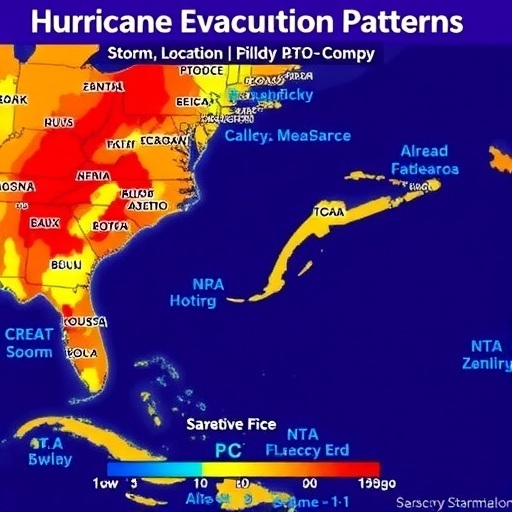
In recent years, the intensification of hurricanes fueled by climate change has not only increased concern about their frequency and destructiveness but has also drawn attention to the shifting geographic footprint of these storms. A groundbreaking observational study led by environmental health scientists at Columbia University Mailman School of Public Health provides critical insight into how populations in varied geographic regions adapt their evacuation behaviors during hurricanes. Published in the journal Environmental Research Letters, this study contrasts human mobility patterns in response to the 2024 hurricanes Helene and Milton, revealing vital distinctions between coastal and inland evacuee responses.
Hurricane Helene made landfall as a Category 4 storm near Perry, Florida on September 26, 2024, unleashing historic rainfall and flooding extending far inland through Georgia, the Carolinas, Tennessee, and Virginia. This hurricane resulted in approximately 219 fatalities and incurred $78.7 billion in damages. In comparison, Hurricane Milton, which struck Florida near Siesta Key as a Category 3 hurricane on October 9, 2024, caused 32 deaths and $34.3 billion in losses. Although Milton was slightly less deadly and destructive, its landfall primarily impacted coastal populations with frequent exposure to hurricane events, contrasting with Helene’s predominantly inland impact zones.
By analyzing aggregated cell phone mobility data during these two events, the Columbia researchers captured a nuanced picture of human adaptive behaviors in the face of impending disaster. This method allowed for real-time, population-scale mobility tracking despite intermittent cell service outages during the hurricanes. The researchers focused on relative changes in movements rather than absolute numbers, ensuring robustness against disruptions in network availability.
Remarkably, the data showed a stark difference in evacuation patterns between regions historically subjected to hurricanes and those less accustomed to such hazards. In coastal counties frequently exposed to tropical cyclones, the arrival of Hurricane Milton triggered a sharp increase in out-of-region travel—nearly 29 percent higher in the three days preceding landfall. This trend reflects ingrained social norms and risk perceptions wherein coastal residents have internalized evacuation as a necessary preemptive action.
Conversely, Hurricane Helene’s impact on inland counties induced only a modest 5 percent rise in out-of-region mobility prior to landfall, despite authorities issuing emergency declarations and mandatory evacuation orders. This discrepancy highlights a complex interplay of factors, including perceived risk, access to transportation, and socioeconomic status. Inland residents may underestimate their vulnerability due to the historical rarity of direct hurricane hits and may lack logistical resources that enable timely evacuation.
The study’s authors emphasize that infrastructure and financial capacity are critical determinants of adaptive mobility. Coastal populations typically reside in denser, wealthier areas with better accessibility to transportation networks and timely information dissemination. These advantages facilitate swift evacuation decisions and smoother execution. In contrast, inland regions are often characterized by lower income levels and dispersed populations with limited infrastructure, which may significantly hamper mobility under disaster conditions.
Significantly, the fatalities and damages from Helene underscore the growing risks hurricane-induced flooding now pose to inland communities. Unlike coastal deaths primarily driven by storm surge, inland fatalities were mainly due to river flooding, infrastructure failures, and cascading effects such as prolonged power outages and medical emergencies. This shift reflects how climate change extends hurricane hazards far beyond traditional coastal impact zones, demanding that emergency management frameworks evolve accordingly.
Qing Yao, PhD, the study’s lead author and an associate research scientist at Columbia, noted the profound influence of social norms and risk perception on evacuation behaviors. “People in coastal areas are habituated to hurricanes and are generally more responsive to evacuation orders, whereas inland residents often perceive themselves as protected from such threats,” Yao explained. This perceptual gap can dangerously delay necessary precautions in regions newly vulnerable to extreme weather.
The research carries important implications for disaster preparedness strategies. Sen Pei, PhD, Columbia Mailman assistant professor and study co-author, highlighted the urgent need to tailor mitigation plans that account for the variable demographic and geographic profiles of affected populations. “As climate change pushes hurricanes further inland, preparedness efforts must be diversified to address distinct local vulnerabilities, ensuring that emergency response systems effectively serve both coastal and inland communities,” Pei advised.
Moving forward, this study provides a crucial foundation for integrating human mobility analytics into climate resilience planning. By leveraging anonymized cell phone data, policymakers and disaster response organizations can gain actionable intelligence on evacuation dynamics, resource allocation gaps, and communication effectiveness during real-time crises. Such data-driven approaches could revolutionize how disaster risk management adapts to a changing climate landscape.
Ultimately, the research underscores that addressing the multifaceted challenges of hurricanes in a warming world requires holistic strategies that incorporate infrastructure investment, public education, and targeted outreach. Enhancing transportation options, bridging socioeconomic disparities, and fostering risk awareness will be vital to improving evacuation outcomes and reducing fatalities, especially in newly vulnerable inland regions.
The Columbia team’s investigations affirm that while climate change magnifies environmental hazards, human adaptability remains a potent factor shaping disaster outcomes. Understanding the complex interplay of geography, economics, and social behavior is paramount as scientists and policymakers strive to build communities that can not only withstand but also recover from intensifying hurricanes and their evolving risks.
News Publication Date: 1-Oct-2025
Web References:
https://doi.org/10.1088/1748-9326/ae0e39
Cite Scienmag News
Russell Cooper. (October 2, 2025). Hurricane Evacuation Patterns Vary Depending on Storm Landfall Location. Scienmag. https://scienmag.com/hurricane-evacuation-patterns-vary-depending-on-storm-landfall-location/
Russell Cooper. "Hurricane Evacuation Patterns Vary Depending on Storm Landfall Location." Scienmag, 2 October 2025, https://scienmag.com/hurricane-evacuation-patterns-vary-depending-on-storm-landfall-location/. Accessed 3 September 2026.
Russell Cooper. "Hurricane Evacuation Patterns Vary Depending on Storm Landfall Location." Scienmag. October 2, 2025. https://scienmag.com/hurricane-evacuation-patterns-vary-depending-on-storm-landfall-location/


