


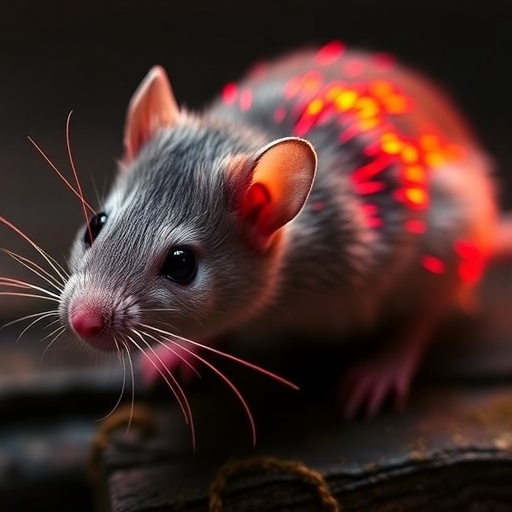
In a groundbreaking new study published in Nature Communications, researchers have unveiled a sophisticated neural mechanism underlying analgesia triggered during attention-demanding hunting behaviors in male mice. This discovery not only enriches our understanding of pain modulation but also highlights the critical role of the superior colliculus and zona incerta circuitry in orchestrating this complex physiological response. As scientists delve deeper into how animals manage pain administration during high-stakes activities, this work paves the way for novel approaches in analgesic therapies targeting similar brain circuits in humans.
The research team, led by Zhang, Liu, Yin, and colleagues, employed an innovative hunting paradigm designed to engage attention-intensive tasks in male mice. This setup involved presenting live prey that required the mice to sustain focused hunting behaviors—a scenario that demanded intense sensory processing and sustained alertness. The significance of such an experimental design is considerable; by mimicking naturalistic conditions where pain suppression is essential for survival, the study offers unparalleled insights into the neurobiological underpinnings of analgesia beyond traditional passive pain models.
Central to these findings is the superior colliculus, a midbrain structure well-known for its integrative role in visual attention and orienting responses. The study uncovers that during the hunting task, neuronal activity in the superior colliculus escalates dramatically, aligning with the behavioral urgency to detect and pursue prey. Remarkably, this elevated activity appears to initiate a cascade within connected brain regions, most notably the zona incerta, a less-studied but critically important subthalamic area implicated in sensorimotor integration and modulation of somatosensory inputs.
The zona incerta’s engagement seems to serve as a relay or modulatory hub that mediates analgesic effects during hunting. Electrophysiological recordings and optogenetic manipulations showed that the superior colliculus directly influences the zona incerta’s neuronal firing patterns, which in turn reduce nociceptive signaling. This neural crosstalk effectively blunts pain perception, thus enabling the mice to maintain focus and persistence during their predatory efforts. The precision of this circuit highlights the evolutionary advantage of integrating attention and analgesia to optimize goal-directed behaviors under potentially harmful conditions.
Importantly, the study sheds light on how attention and pain perception are intricately coupled through specific neural conduits. While previous research acknowledged top-down attentional modulation of pain, the delineation of the superior colliculus–zona incerta pathway marks a major advance in identifying concrete anatomical and functional links. This pathway illustrates that attentional systems are not merely cognitive overlays but possess dedicated neuroanatomical substrates that actively reshape sensory experiences, including painful stimuli.
To validate these findings, the scientists employed a combination of advanced methodologies. Calcium imaging enabled visualization of real-time neuronal dynamics within the superior colliculus and zona incerta during the hunting episodes. Concurrently, chemogenetic tools allowed reversible manipulation of these circuits, confirming their necessity for the observed analgesic outcomes. Behavioral assays demonstrated that when this pathway was inhibited, the mice exhibited heightened pain sensitivity and impaired hunting efficiency, underscoring the circuit’s functional relevance.
Beyond basic science, these insights hold compelling translational potential. Chronic pain remains a pervasive and challenging clinical problem, often resistant to conventional treatments. Understanding the brain circuits that naturally suppress pain in specific contexts could inspire novel neuromodulatory strategies, such as targeting homologous circuits to mimic endogenous analgesia. Furthermore, the link between attention-driven behaviors and pain modulation opens avenues to explore cognitive therapies that enhance attentional engagement to alleviate pain symptomatology.
The focus on male mice in this study is also noteworthy, reflecting growing awareness in neuroscience about sex-specific differences in pain perception and neural circuitry. Although this research primarily examines male subjects, it sets the stage for comparative studies exploring whether similar mechanisms operate in females, potentially revealing sexually dimorphic neurobiological strategies to manage pain during complex behaviors. Such comparative approaches could enrich personalized medicine frameworks in pain management.
The superior colliculus–zona incerta circuit uncovered here challenges traditional notions of the brain’s pain matrix by emphasizing the role of subcortical areas traditionally associated with sensorimotor integration and attentional processing. By shining a spotlight on these deep brain structures, the research suggests that analgesic mechanisms can be locally organized within evolutionarily ancient neural pathways, offering a more layered understanding of how pain experience is modulated in real-world environments.
Moreover, the hunting paradigm utilized in this study underscores the importance of ecological validity in neuroscience research. Many classical pain studies rely on artificial stimuli and passive conditions, which may not accurately represent how pain is modulated naturally. By anchoring their investigation in a behaviorally meaningful, attention-demanding task, the researchers bridge the gap between laboratory conditions and ethological realities, permitting a more nuanced exploration of pain neuromodulation.
The authors also touch upon the potential interactions between the superior colliculus–zona incerta circuit and other neuromodulatory systems, such as descending pain inhibitory pathways and endogenous opioidergic mechanisms. While their primary focus was on this novel subcortical loop, future research may clarify how these multiple networks integrate to produce the complex phenomenon of analgesia during intense behavioral states, offering a holistic view of pain regulation.
Additionally, this study highlights the dynamic interplay between sensory processing and motor outputs orchestrated by the brain during hunting. Integrating attentional focus, motor control, and pain suppression ensures survival by empowering the predator to endure discomfort without distraction. Understanding these integrated circuits may inspire biomimetic designs in robotics or artificial intelligence systems focused on sensory prioritization and adaptive behavior under challenging conditions.
The methodological rigor of the study cannot be understated. Beyond behavioral and electrophysiological measures, the use of viral tracing techniques mapped the direct projections from superior colliculus neurons to the zona incerta with remarkable specificity. This anatomical validation strengthens causal inferences about circuit function, reinforcing the reliability of the conclusions and setting a benchmark for future circuit-level neuroscience investigations.
From a broader perspective, the findings contribute to a growing body of evidence that cognition and sensation are deeply interwoven at multiple neural levels. Pain perception is not a passive receipt of noxious signals but a context-dependent experience sculpted by attentional demands, motivational states, and survival imperatives. This perspective recalibrates how both scientists and clinicians conceptualize pain, potentially transforming diagnostic and treatment paradigms.
In conclusion, Zhang and colleagues’ discovery of the superior colliculus–zona incerta circuit mediating hunting-related analgesia in male mice stands as a landmark finding in neuroscience. It exemplifies how naturalistic behavioral paradigms combined with cutting-edge neurotechnologies can unravel intricate brain functions and offers promising implications for pain research and therapy. As the field moves forward, this work will undoubtedly catalyze further exploration into the neural basis of adaptive pain modulation in complex environments.
Cite Scienmag News
Cassandra Pierce. (May 19, 2026). Hunting Stimulates Brain Circuit for Pain Relief in Mice. Scienmag. https://scienmag.com/hunting-stimulates-brain-circuit-for-pain-relief-in-mice/
Cassandra Pierce. "Hunting Stimulates Brain Circuit for Pain Relief in Mice." Scienmag, 19 May 2026, https://scienmag.com/hunting-stimulates-brain-circuit-for-pain-relief-in-mice/. Accessed 5 September 2026.
Cassandra Pierce. "Hunting Stimulates Brain Circuit for Pain Relief in Mice." Scienmag. May 19, 2026. https://scienmag.com/hunting-stimulates-brain-circuit-for-pain-relief-in-mice/


