


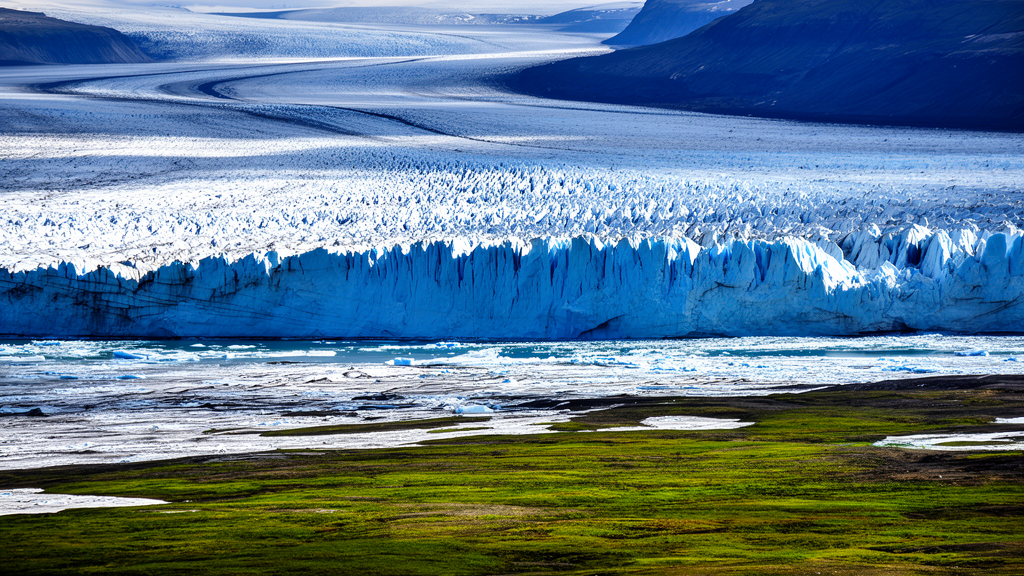
Two thousand years ago, on Baffin Island in the Canadian Arctic, the last surviving remnant of the Laurentide Ice Sheet began to grow again. That renewed expansion, geochemists now argue, marked the opening moves of Earth’s next glacial period—the kind of continental glaciation popularly known as an ice age. But the nascent ice age never got off the ground. By the 1960s, warming of the climate had raised summer temperatures enough that the ice cap was losing more mass in summer than it gained in winter, and the glaciation that had just begun quietly reversed. The finding, published in the journal Science by Nicolás Young, Joerg Schaefer of Columbia Climate School’s Lamont-Doherty Earth Observatory and their colleagues, offers a striking reframing of when ice ages begin—and a sobering example of the scale of modern climate change.
“It was just getting started, everything was normal, the next glaciation was about to happen—and yet it stopped,” says Young, a geochemist at the Lamont-Doherty Earth Observatory. “It’s a very powerful example of how we have jolted the system.” The observation is remarkable precisely because of its timing. The glacial machinery of the planet had, by the team’s evidence, already been set in motion under entirely natural conditions, with no human influence involved. What arrested it was not a natural fluctuation but the warming of the twentieth century, which arrived just as the earliest accumulation of ice was taking hold in the Arctic.
The team focused on the Laurentide Ice Sheet, the enormous ice mass that covered much of Canada and the northern United States from roughly 95,000 to 20,000 years ago. At its largest extent, it stretched from beyond the Arctic Circle down to Illinois, and in places the ice towered more than two miles thick. Continental-scale glaciation of North America began about 2.6 million years ago, and since then the Laurentide has repeatedly expanded and retreated across the continent. Today, its last vestige survives as the Barnes Ice Cap, an ice mass the size of Delaware sitting on central Baffin Island in the Canadian territory of Nunavut. “People always say that it disappeared, but that’s not true,” says Young.
Young and his colleagues wanted to answer a question that had remained stubbornly open: had the Laurentide ever shrunk even smaller than its present footprint and then regrown? Reconstructing glacial histories is difficult under any circumstances, and it becomes especially hard for the moments of maximum contraction and initial re-expansion. The origin point of a growing glacier is hard to pin down, and whatever geological clues a small glacier leaves on the landscape tend to be scoured away as the ice regrows. The cradle of the Laurentide, however, turned out to be a special case with an unusually faithful memory.
The Barnes Ice Cap is frozen directly to its underlying bedrock. Unlike most glaciers, it does not slide along its base. That seemingly technical detail is crucial: a non-sliding glacier preserves the vegetation that grew on the land during earlier times when the glacier was small, entombing plants beneath the advancing ice. As the Barnes Ice Cap has retreated since 1960, that buried vegetation has been progressively exposed, giving scientists a physical archive of the ice cap’s past advances. Researchers can date each layer by analyzing traces of carbon-14, a weakly radioactive form of atmospheric carbon that accumulates in organisms while they live and decays at predictable rates after death.
“If you do this enough times, you can actually develop a timeline of that ice margin systematically advancing over plants. You’re actually tracking the expansion of that ice margin,” says Young. By combining these analyses of plants preserved beneath the Barnes Ice Cap with material from smaller, recently melted ice caps in the same region, the researchers assembled a climate history of the Laurentide’s cradle. Each dated plant sample represents a moment when the ice margin overran living vegetation, so the sequence of dates records the ice cap’s growth step by step across the centuries.
The reconstruction showed that the Laurentide reached its minimum dimensions about 3,000 years ago. Then, roughly 2,000 years ago, the climate cooled enough for ice to accumulate, and the ice sheet began re-expanding. The researchers argue that this inflection point—the first renewed growth of an ice sheet—should be considered the beginning of Earth’s next glacial period. That interpretation challenges prevailing ideas about how glacial periods should be defined. Previous model-based studies had suggested the next glaciation would not begin for thousands or even tens of thousands of years, largely because those studies counted the start of a glacial period only once enormous continental ice sheets had assembled. Under Young and his colleagues’ criterion, the start came not in some far-future millennium but two millennia ago.
The results also supply a coda to one of the more controversial chapters in modern climate science: the 1970s claims by some scientists that a new ice age was imminent. “It actually was happening,” Young says. “They couldn’t quite prove it, but now we sort of have the evidence.” The glaciation, however, was in its very earliest stages. It would have taken thousands of years for the cooling to become noticeable at continental scales, and about 30,000 years for the Laurentide to regain its sprawling mass across Canada and the northern United States. What the new dating evidence shows is that the process had genuinely begun—not that a deep glaciation of the past was around the corner.
By the 1960s, Earth’s climate had warmed enough that the Barnes Ice Cap lost more ice each summer than it gained in winter, and the embryonic glaciation fizzled out. According to the team’s models of the glacier’s future, the ice cap will melt completely within the next few centuries. “That will be the true very last remains of the Laurentide, disappearing for good,” Young says. Its disappearance could alter the dynamics of any future glaciations, because the Laurentide long served as a glacial nucleation point: when Earth’s climate cooled, the frigid mass of the ice sheet generated self-sustaining feedbacks that encouraged still more ice to grow on top of it. The scientists note that they cannot say when a next glaciation might occur in a world with elevated greenhouse gas concentrations—but if continental ice sheets do eventually grow again, they may have to do so without the last surviving remnant of the Laurentide.
A note on terminology matters here. Technically, Earth is still living in an ice age—the Late Cenozoic Ice Age—which began about 34 million years ago. Within it, colder glacial periods alternate with warmer interglacial periods, including the one humans currently inhabit. The last glacial period ended about 11,700 years ago, and what people casually call an “ice age” usually refers to a glacial period like the one that had just begun on Baffin Island. Seen in that light, the new findings describe an observational reconstruction, based on radiocarbon dating of entombed plants, of a glacial period that started under natural conditions and was then reversed by modern warming. “What has been an extremely natural and predictable phenomenon is now gone,” says Young.
Subject of Research: Radiocarbon evidence that warming reversed the early stages of Earth's next glacial period on Baffin Island
Article Title: Climate change stopped the next ice age
Article References: Climate change stopped the next ice age. Original publication (Bibliographic details unavailable.)
Image Credits: AI Generated
DOI: Not provided
Keywords: Laurentide Ice Sheet, Barnes Ice Cap, Baffin Island, glaciation, ice age, carbon-14 dating, paleoclimatology, climate change, Arctic, Science journal, Columbia Climate School, greenhouse gases
Cite Scienmag News
Russell Cooper. (October 24, 2026). Human-Caused Warming Halted a Glacial Period That Began 2,000 Years Ago. Scienmag. https://scienmag.com/human-caused-warming-halted-a-glacial-period-that-began-2000-years-ago/
Russell Cooper. "Human-Caused Warming Halted a Glacial Period That Began 2,000 Years Ago." Scienmag, 24 October 2026, https://scienmag.com/human-caused-warming-halted-a-glacial-period-that-began-2000-years-ago/. Accessed 24 October 2026.
Russell Cooper. "Human-Caused Warming Halted a Glacial Period That Began 2,000 Years Ago." Scienmag. October 24, 2026. https://scienmag.com/human-caused-warming-halted-a-glacial-period-that-began-2000-years-ago/


