Wednesday, October 28, 2026
Science
No Result
View All Result
  • Login
  • HOME
  • SCIENCE NEWS
  • CONTACT US
  • HOME
  • SCIENCE NEWS
  • CONTACT US
No Result
View All Result
Scienmag
No Result
View All Result
Home Science News Biology

HP1α rise silences MERVL and stalls oxidatively damaged embryos

October 28, 2026
in Biology
Juliet Wilcox
By Juliet Wilcox Scienmag Editorial Profile - Human Genetics
Reading Time: 2 mins read
0
HP1α rise silences MERVL and stalls oxidatively damaged embryos

HP1α rise silences MERVL and stalls oxidatively damaged embryos

65
SHARES
587
VIEWS
Share on FacebookShare on Twitter
ADVERTISEMENT

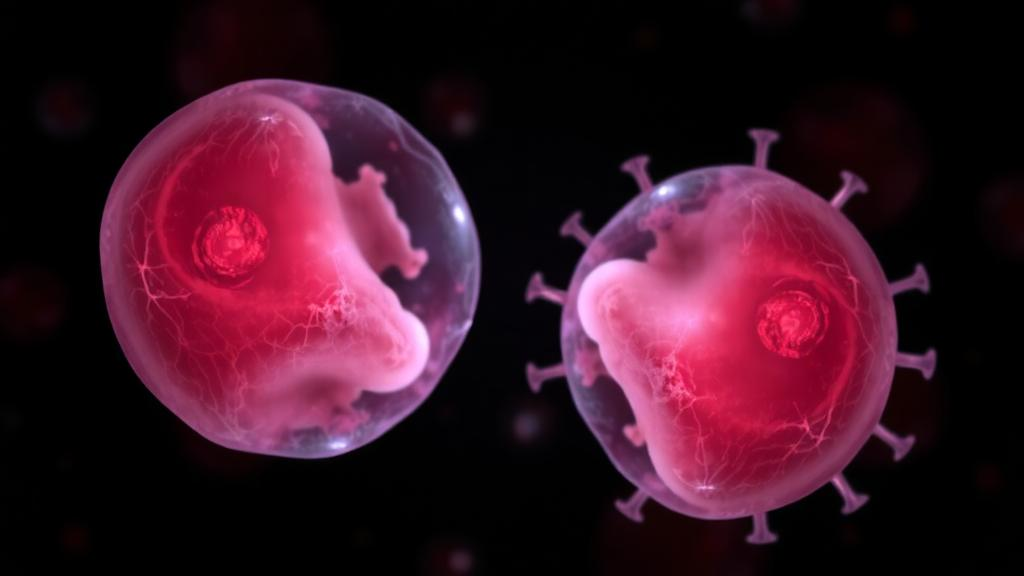
Mouse embryos exposed to oxidative damage during in vitro fertilization can stall at the two-cell stage, and a new study points to a specific epigenetic culprit: the chromatin protein HP1α. Researchers report that oxidative damage increases HP1α, which suppresses the totipotency marker MERVL and drives developmental arrest, while reducing HP1α partially rescues embryo development.

The team used an established embryonic oxidative damage model to show that oxidative damage impaired mouse embryonic totipotency and caused developmental arrest. Oxidative damage significantly altered two key epigenetic marks, H3K4me3 and H3K9me3, in mouse two-cell stage embryos, a critical period for zygotic genome activation, when the embryonic genome must be properly reprogrammed for development to proceed.

To map these changes, the researchers employed CUT&Tag technology to profile H3K4me3 after oxidative damage. They found a significant decrease in H3K4me3 distribution at promoters and transcription start sites, and the biological functions associated with the differentially marked regions were closely related to DNA damage repair, growth, and development. Differential analysis further revealed that H3K4me3 enrichment was significantly increased at the transcription start region of Cbx5, the gene encoding HP1α, after oxidative damage.

By generating HP1α overexpression and knockdown embryonic models, the authors found that HP1α overexpression enhanced H3K9me3 enrichment and suppressed MERVL expression, whereas HP1α knockdown produced the opposite effects. Moreover, knocking down HP1α in H₂O₂-treated embryos reversed the oxidative-stress-induced increase in H3K9me3, reinstated MERVL transcription, and markedly improved the blastocyst formation rate.

The study, published open access in Epigenetics & Chromatin, concludes that proper epigenetic reprogramming is essential for embryonic development and identifies HP1α as a key player in oxidative damage-induced loss of embryonic totipotency. The authors suggest HP1α may represent a novel therapeutic target for mitigating oxidative damage in embryos, though the findings so far come from mouse embryo models and interventional approaches remain at the experimental stage.

Subject of Research: Epigenetic regulation by HP1α in oxidatively damaged mouse embryos during zygotic genome activation

Article Title: Repressed MERVL expression by increased HP1α causes developmental arrest in oxidatively damaged embryos

Article References: Cao, D., Liu, L., & Li, Z. (2026). Repressed MERVL expression by increased HP1α causes developmental arrest in oxidatively damaged embryos. Epigenetics & Chromatin. https://doi.org/10.1186/s13072-026-00708-8

Image Credits: AI Generated

DOI: 10.1186/s13072-026-00708-8

Keywords: HP1α, MERVL, oxidative damage, mouse embryos, zygotic genome activation, H3K4me3, H3K9me3, CUT&Tag, totipotency, developmental arrest, IVF, Cbx5

Cite Scienmag News

Juliet Wilcox. (October 28, 2026). HP1α rise silences MERVL and stalls oxidatively damaged embryos. Scienmag. https://scienmag.com/hp1%ce%b1-rise-silences-mervl-and-stalls-oxidatively-damaged-embryos/

Juliet Wilcox. "HP1α rise silences MERVL and stalls oxidatively damaged embryos." Scienmag, 28 October 2026, https://scienmag.com/hp1%ce%b1-rise-silences-mervl-and-stalls-oxidatively-damaged-embryos/. Accessed 28 October 2026.

Juliet Wilcox. "HP1α rise silences MERVL and stalls oxidatively damaged embryos." Scienmag. October 28, 2026. https://scienmag.com/hp1%ce%b1-rise-silences-mervl-and-stalls-oxidatively-damaged-embryos/


Tags: Cbx5chromatin modifications during embryo developmentCUT&TagCUT&Tag technology in embryonic epigeneticsdevelopmental arresteffects of oxidative damage on embryo reprogrammingembryonic developmental arrest mechanismsembryonic oxidative damageepigenetic markers H3K4me3 and H3K9me3 in embryogenesisH3K4me3H3K9me3HP1αHP1α epigenetic regulationIVFMERVLMERVL gene silencing in early embryosmouse embryosoxidative damageoxidative stress impact on zygotic genome activationrole of HP1α in totipotencytotipotencyzygotic genome activation
Share26Tweet16
Previous Post

Mitochondrial transfer emerges as a potential neurotherapeutic strategy for CNS disorders

Next Post

Institutional governance shapes how green energy boosts environmental sustainability

Related Posts

Turnip-made magnesium nanoparticles dismantle drug-resistant bacterial biofilms in lab tests
Biology

Turnip-made magnesium nanoparticles dismantle drug-resistant bacterial biofilms in lab tests

October 28, 2026
Compact engineered Cas12m enables multiplexed CRISPR gene activation in mice
Biotechnology

Compact engineered Cas12m enables multiplexed CRISPR gene activation in mice

October 28, 2026
Salmonella’s SopB protein makes a key signalling lipid without host kinases
Biology

Salmonella’s SopB protein makes a key signalling lipid without host kinases

October 28, 2026
Tiny parasitoid wasps of China get their first complete identification key
Biology

Tiny parasitoid wasps of China get their first complete identification key

October 28, 2026
No single short 16S region matches full-length vaginal microbiota sequencing
Biology

No single short 16S region matches full-length vaginal microbiota sequencing

October 28, 2026
Sponge-Dwelling Fungus Yields Twelve Metabolites with Antimicrobial and Cytotoxic Activity
Chemistry

Sponge-Dwelling Fungus Yields Twelve Metabolites with Antimicrobial and Cytotoxic Activity

October 28, 2026
Next Post
Institutional governance shapes how green energy boosts environmental sustainability

Institutional governance shapes how green energy boosts environmental sustainability

  • Mothers who receive childcare support from maternal grandparents show more optimized

    Mothers who receive childcare support from maternal grandparents show more parental warmth, finds NTU Singapore study

    27656 shares
    Share 11059 Tweet 6912
  • University of Seville Breaks 120-Year-Old Mystery, Revises a Key Einstein Concept

    1061 shares
    Share 424 Tweet 265
  • Bee body mass, pathogens and local climate influence heat tolerance

    682 shares
    Share 273 Tweet 171
  • Researchers record first-ever images and data of a shark experiencing a boat strike

    546 shares
    Share 218 Tweet 137
  • Groundbreaking Clinical Trial Reveals Lubiprostone Enhances Kidney Function

    531 shares
    Share 212 Tweet 133
Science

Embark on a thrilling journey of discovery with Scienmag.com—your ultimate source for cutting-edge breakthroughs. Immerse yourself in a world where curiosity knows no limits and tomorrow’s possibilities become today’s reality!

RECENT NEWS

  • Climate change amplified Storm Boris floods far more than its rainfall
  • Dam reservoirs may emit far less carbon than previous estimates suggested
  • Gender gaps in Advanced Placement exams are narrowing, but not everywhere
  • Who actually eats traditional mountain foods? A new survey maps the gap

Categories

  • Agriculture
  • Anthropology
  • Archaeology
  • Athmospheric
  • Biology
  • Biotechnology
  • Blog
  • Bussines
  • Cancer
  • Chemistry
  • Climate
  • Earth Science
  • Editorial Policy
  • Marine
  • Mathematics
  • Medicine
  • Pediatry
  • Policy
  • Psychology & Psychiatry
  • Science Education
  • Science News
  • Social Science
  • Space
  • Technology and Engineering

Subscribe to Blog via Email

Enter your email address to subscribe to this blog and receive notifications of new posts by email.

Join 5,151 other subscribers

© 2025 Scienmag - Science Magazine

Welcome Back!

Login to your account below

Forgotten Password?

Retrieve your password

Please enter your username or email address to reset your password.

Log In
No Result
View All Result
  • HOME
  • SCIENCE NEWS
  • CONTACT US

© 2025 Scienmag - Science Magazine

Discover more from Science

Subscribe now to keep reading and get access to the full archive.

Continue reading